This course is part of the AI and Data Engineering ExpertTrack
Building Intelligent Agent Architectures
Become a GenAI production engineer—fine-tune models, deploy at scale, and maintain reliable, enterprise-ready AI systems.

Duration
2 weeksWeekly study
2 hoursIncluded in an ExpertTrack
Course 1 of 4
Building Intelligent Agent Architectures

This course has been certified by the CPD Certification Service as conforming to continuing professional development principles. Find out more.
Building Intelligent Agent Architectures
This course transforms you from an AI user into an autonomous AI architect who builds intelligent agents that think, plan, and execute complex tasks without constant human supervision. You’ll master the complete agent development lifecycle from foundational concepts to sophisticated multi-agent orchestration systems that collaborate like human teams. Through hands-on development, you’ll create specialized customer support agents, implement tool-using capabilities, and design safety frameworks that ensure reliable autonomous operation.
By the end of this course, you’ll confidently architect AI agent systems that can use tools, communicate with other agents, handle multi-step reasoning scenarios, and solve real-world business problems autonomously. You’ll have the expertise to build the next generation of AI workers that are transforming industries worldwide.
Syllabus
Week 1
Building the GenAI Foundation


Lesson 1: Course Introduction
Overview of course structure, expectations, and the advanced technical environment needed for GenAI engineering.

Lesson 2: GenAI Foundations
Learn foundational GenAI concepts, systems architecture, use cases, and real-world enterprise applications.

Lesson 3: Large Language Models
Execute fine-tuning workflows using data prep, advanced techniques like LoRA, and evaluation frameworks.

Lesson 4: GenAI Use Cases
Explore real-world GenAI use cases, design solution architectures, and measure ROI across industries from support automation to content and decision systems. Build business cases for impactful AI initiatives.
Week 2
Architecting & Deploying AI Agents

Lesson 5: Agent Fundamentals
Learn core AI agent concepts architecture, components, and decision-making to build autonomous systems that think and act independently. Gain hands-on skills to automate tasks and develop scalable, reusable agent frameworks.

Lesson 6: Agentic AI
Build advanced multi-agent systems with coordination, communication. Learn to design collaborative AI agents that share tasks and solve complex problems, enabling intelligent automation in real-world scenarios.
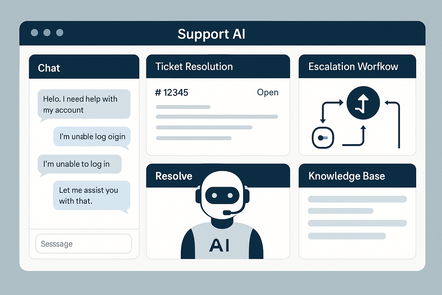
Lesson 7: Support Agent Development
Build smart customer support agents that access knowledge bases, manage escalations, and deliver human-like responses boosting satisfaction and reducing costs through scalable, automated, and brand-consistent service.

Lesson 8: Course Conclusion
Wrap up your AI agent journey by consolidating key skills, exploring deployment strategies, and discovering paths for advanced innovation in autonomous, enterprise-ready agentic AI systems.
Prove you're job ready
Highlight the new, job-relevant skills you’ve gained and supplement existing qualifications with a hard-earned, industry-specific digital certificate – plus one for every course within your ExpertTrack.
- Learn the latest in your chosen industry or subject.
- Complete each course and pass assessments.
- Receive certificates validated by the educating organisation.
- Impress employers with learning outcomes you can add to your CV.
- Make your career dreams a reality.
Download a PDF
Who is this accredited by?
The CPD Certification Service was established in 1996 and is the leading independent CPD accreditation institution operating across industry sectors to complement the CPD policies of professional and academic bodies.
Learning on this course
On every step of the course you can meet other learners, share your ideas and join in with active discussions in the comments.
What will you achieve?
By the end of the course, you‘ll be able to...
- Construct autonomous AI agents with tool integration and decision-making capabilities.
- Implement multi-agent communication protocols and coordination mechanisms.
- Develop specialized customer support agents with requirements analysis and capability planning.
- Apply advanced deployment patterns for diverse GenAI applications with scalability considerations.
Who is the course for?
This course is ideal for ML Engineers specializing in production systems, DevOps Engineers responsible for AI deployments, Platform Engineers building robust AI infrastructure, and Technical Architects designing scalable, enterprise-grade AI solutions.
Who will you learn with?
Who developed the course?

Starweaver
Starweaver is a next generation platform that engages your workforce as no other. Combining business and technical skills, Starweaver provides real-time skill building that is in line with your business objectives and strategies, and in your associates day to day tasks and jobs.

Start learning today - free 2-day trial
After your free trial you can:
- Pay $39 per month to keep learning online
- Have complete control over your subscription; you can cancel any time
- Work at your own pace and set your own deadlines at every stage
- Only pay while you’re learning; the subscription will cancel automatically when you finish
- Complete online assessments to test your knowledge and prove your skills
- Earn digital course certificates and a final award that you can share online, with potential employers, and your professional network
- Keep access to the content of courses you complete even after your subscription ends
Learning on FutureLearn
Your learning, your rules
- Courses are split into weeks, activities, and steps to help you keep track of your learning
- Learn through a mix of bite-sized videos, long- and short-form articles, audio, and practical activities
- Stay motivated by using the Progress page to keep track of your step completion and assessment scores
Join a global classroom
- Experience the power of social learning, and get inspired by an international network of learners
- Share ideas with your peers and course educators on every step of the course
- Join the conversation by reading, @ing, liking, bookmarking, and replying to comments from others
Map your progress
- As you work through the course, use notifications and the Progress page to guide your learning
- Whenever you’re ready, mark each step as complete, you’re in control
- Complete 90% of course steps and all of the assessments to earn your certificate
Want to know more about learning on FutureLearn? Using FutureLearn


