Veterinary Practitioners and the Food Supply Chain
Get postgraduate CPD training in food safety and sustainable animal production from the UK’s number one ranked veterinary school.


Duration
10 weeksCost
$1,074
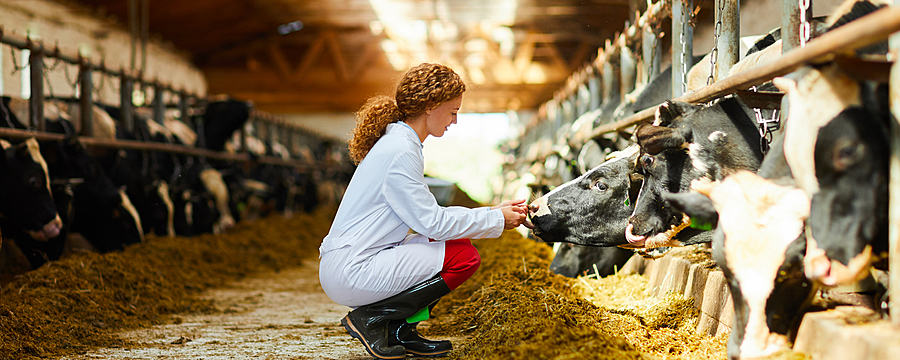
Veterinary Practitioners and the Food Supply Chain
Advance your veterinary training in protecting and securing the food chain
Veterinarians play a crucial role in the food chain, and training in ‘farm to fork’ food production is vital for national food security and public health.
This microcredential is designed for veterinarians to learn how they can work to ensure food hygiene and safety through sustainable livestock production.
Led by experienced veterinary educators in farm animal health and welfare and public health, you’ll increase your knowledge and awareness of key national and global threats to animal food production and food security.
As you explore the past, present, and future challenges to the health and welfare of livestock, you’ll consider the threats of antimicrobial resistance, epizootic diseases, emerging infectious diseases and animal welfare challenges.
You’ll appraise strategies to proactively improve food safety and to protect the food supply chain through preventive veterinary medicine.
You’ll also reflect on your professional practice and identify how to create opportunities to better serve your clients throughout the food supply chain, improving both animal and human health.
This microcredential meets the standards set by the Common Microcredential Framework.
What skills will you learn?
- Veterinary surveillance
- Diagnostics and sampling
- Preventive veterinary medicine
- Animal Welfare skills
- Food chain information
- Veterinary public health skills
What you will achieve
By the end of the microcredential, you’ll be able to...
- Reflect on the roles and responsibilities of practising veterinarians engaged in the food supply chain from farm to fork
- Evaluate past, present and future challenges to the health and welfare of livestock and their impacts on food production and public health
- Evaluate strategies to proactively improve food safety and protect the supply chain through the practise of preventive veterinary medicine
Are you eligible for this microcredential?
In order to join this microcredential, you should be a qualified veterinarian who holds an undergraduate degree in veterinary medicine.
This course is aimed at veterinary practitioners working in private farm animal and mixed practice, government veterinary service and meat hygiene.
It will be assessed through online examinations involving multiple-choice questions, extended matching questions and clinical decision-making questions.
Is this microcredential right for you?
This credential is designed for veterinary professionals who would like to upskill in farm animal health and animal welfare and its links to food production.
The credential can be used for CPD as required by the RCVS, as an insight into MSc level study in veterinary medicine, or to upskill and improve your opportunities for employment within the government veterinary sector.
The academic credits earned from this microcredential may also create interest in completing Glasgow’s MSc Food Security and MSc One Health postgraduate degree programmes.
Syllabus
What happens before, during, and after your microcredential
Before learning
You’ll be enrolled directly with The University of Glasgow, allowing you access to the University library and student services.
Course 1
From 27 Jul 2020


Welcome to Veterinary Practitioners and the Food Supply Chain
Introduction to the University of Glasgow and the key topics of this micro-credential.
1 week
10 hours per week
Course 2
From 3 Aug 2020

Improving Livestock Health and Welfare
Examine how food safety begins with feed safety. Consider endemic disease control and opportunities for better welfare outcomes.
3 weeks
10 hours per week
Course 3
From 24 Aug 2020

Diagnostics, Surveillance and Horizon Scanning
Explore how veterinary surveillance, diagnostics and horizon scanning for new disease threats protect animal health.
3 weeks
10 hours per week
Course 4
From 14 Sep 2020

From Slaughter to Consumption
Consider the importance of food chain and abattoir data, and how food hygiene and antimicrobial resistance affect public health.
3 weeks
10 hours per week
After learning
Once you have successfully completed the microcredential, you’ll receive 10 academic credits at Postgraduate level from The University of Glasgow.
What you will receive
10 UK credits at Postgraduate level from The University of Glasgow
Find out how credits work and where you can use them in our FAQs.
What is a microcredential?
Microcredentials are designed to upskill you for work in rapidly-growing industries, without the time and cost commitment of a full degree. Your microcredential can stand alone as an independent credential, and some also offer academic credit to use towards a degree.
Complete online courses led by experts over multiple weeks with a dedicated group of professionals.
Test your understanding with online tutor-marked assessments and exercises.
Finish your learning and pass your assessments to gain an accredited credential.
Use your microcredential as evidence of your specialised skills and progress further in your industry.

Career-focused learning by The University of Glasgow
Founded in 1451, the University of Glasgow is the fourth oldest university in the English-speaking world. It is a member of the prestigious Russell Group of leading UK research universities.
Established
1451Location
Glasgow, Scotland, UKWorld ranking
Top 70Source: QS World University Rankings 2020
Delivered by experts

Dr Philip Robinson is a Senior Lecturer in Veterinary Public Health at the University of Glasgow School of Veterinary Medicine and RCVS Recognised Specialist in State Veterinary Medicine.

Dr Ellie Wigham is a lecturer in Veterinary Public Health at the University of Glasgow Veterinary school and ECAWBM resident in Animal Welfare, Ethics and Law.

Veterinary consultant and European specialist in Small Ruminant Health Management

Helen Carty is Veterinary Centre Manager at the SRUC Ayr Veterinary Surveillance Hub. Her work includes farm animal pathology, disease investigation and technical cattle health scheme support.

Noelia Yusta is a Lecturer in Veterinary Public Health at the University of Glasgow School of Veterinary Medicine and RCVS specialised in Food Safety.
Dr Paul Everest is a senior lecturer in Microbiology at the University of Glasgow and an honorary Professor of Medical Microbiology at the London School of Hygiene and Tropical Medicine

Megan Fergusson is a Veterinary Investigation Officer at SRUC Ayr. Her work mainly includes farm animal pathology and disease investigations.
Learning on FutureLearn
Your learning, your rules
- Courses are split into weeks, activities, and steps to help you keep track of your learning
- Learn through a mix of bite-sized videos, long- and short-form articles, audio, and practical activities
- Stay motivated by using the Progress page to keep track of your step completion and assessment scores
Join a global classroom
- Experience the power of social learning, and get inspired by an international network of learners
- Share ideas with your peers and course educators on every step of the course
- Join the conversation by reading, @ing, liking, bookmarking, and replying to comments from others
Map your progress
- As you work through the course, use notifications and the Progress page to guide your learning
- Whenever you’re ready, mark each step as complete, you’re in control
- Complete 90% of course steps and all of the assessments to earn your certificate
Want to know more about learning on FutureLearn? Using FutureLearn
What are our learners saying?
Add a new skill or forge a new path
"I recommend Futurelearn to anyone looking to learn and upskill...If you are in the job market, you might want to add a new skill or forge a new path."
They bring the classroom right to you
"FutureLearn courses are always interesting and informative. They bring the classroom right to you and send you on a journey to explore new ideas and offer interesting topics."
When would you like to start?
Enrolment for this microcredential is closed. If this microcredential is not available on-demand, we aim to run our microcredentials every few months.
FAQ
We can accept payments made by card (Visa, Mastercard and American Express) or PayPal via our online system.
You will have 14 days from the day the course starts to apply for a refund. If this Microcredential has any non-refundable costs they will be stated in the ‘Overview’ section above. You can find more information in our cancellation and refund policy.
Microcredentials are designed to fit around your life and timezone.
There may be live events as part of your studies, but these will be recorded and can be watched afterwards if you aren’t online for the live broadcast.
No, microcredentials are designed to be taken anywhere in the world. You won’t need the right to study in the country where the university offering the microcredential is based.
Want to know more? Read the microcredential FAQs, or contact us.