This course is part of the Cybersecurity and Ethical Hacking ExpertTrack
Cyber Incident Management and Digital Forensics
Develop the incident response and digital forensics skills needed to detect, contain, and recover from cybersecurity incidents.

Duration
3 weeksWeekly study
3 hours100% online
How it worksIncluded in an ExpertTrack
Course 3 of 4
Cyber Incident Management and Digital Forensics
Learn to detect and respond to cybersecurity incidents
Cyber incidents can happen to any organisation. Knowing how to detect and respond to them quickly can help limit their impact.
On this three-week cyber course, you’ll explore the full incident lifecycle, from identifying suspicious activity to investigating, containing, and recovering from security incidents.
You’ll develop your threat detection skills by working with SIEM correlation rules, endpoint alerts, and network traffic. Using Wireshark, you’ll learn how to identify patterns associated with attacks such as DoS and DDoS in controlled scenarios.
Build practical cyber incident response skills
Effective security incident management requires a structured approach. You’ll explore how security teams classify and prioritise incidents, define roles and responsibilities, communicate during an incident, and develop response playbooks.
You’ll follow the incident response lifecycle from initial detection through to containment and recovery, building an understanding of how security operations teams coordinate their response to cyber threats.
Investigate cyber incidents with digital forensics
Develop practical knowledge of digital forensics and the techniques used to investigate security incidents. You’ll explore forensic documentation, evidence integrity, log analysis, file forensics, memory capture, and timeline reconstruction.
You’ll also examine how compromised systems can be isolated and remediated. Using Linux security tools and iptables, you’ll explore host isolation, threat eradication, system rebuild validation, and post-incident resilience measures.
By the end of the course, you’ll be able to take a structured approach to detecting, investigating, and managing cybersecurity incidents - preparing you for a range of cybersecurity roles.
Syllabus
Week 1
Security Monitoring, SIEM, and DoS Detection


Security Monitoring and SIEM Analysis
Apply SIEM concepts, log correlation, endpoint detection, and event analysis to identify security incidents. Build security visibility by investigating alerts and correlating data from multiple sources.

DoS and DDoS Detection
Examine different types of DoS and DDoS attacks and analyse network traffic to identify flooding behaviour. Use Wireshark to investigate attack patterns and evaluate mitigation strategies.
Week 2
Incident Response Foundations and Digital Forensics

Incident Response Planning and Investigation
Apply the incident response lifecycle to security events by defining roles, prioritising incidents, and investigating indicators of compromise. Build decision matrices to support consistent incident handling.

Incident Response Procedures and Readiness
Develop incident response procedures, communication plans, and response playbooks. Validate organisational readiness through testing, simulations, and coordinated response exercises.

Digital Forensics and Evidence Analysis
Perform forensic investigations by analysing digital evidence, examining encoded security data, validating image authenticity, and reconstructing events from logs, files, and memory artefacts while maintaining forensic integrity.
Week 3
Incident Containment, Eradication, and Recovery

Threat Containment and Eradication
Implement containment techniques to isolate compromised systems and prevent further attacker movement. Apply eradication methods to remove malicious artifacts and restore system integrity.

Recovery and Post-Incident Improvement
Validate system recovery through integrity checks, measure post-incident performance, and analyse lessons learned. Build resilience by evaluating recovery outcomes and strengthening future incident response capabilities.
Prove you're job ready
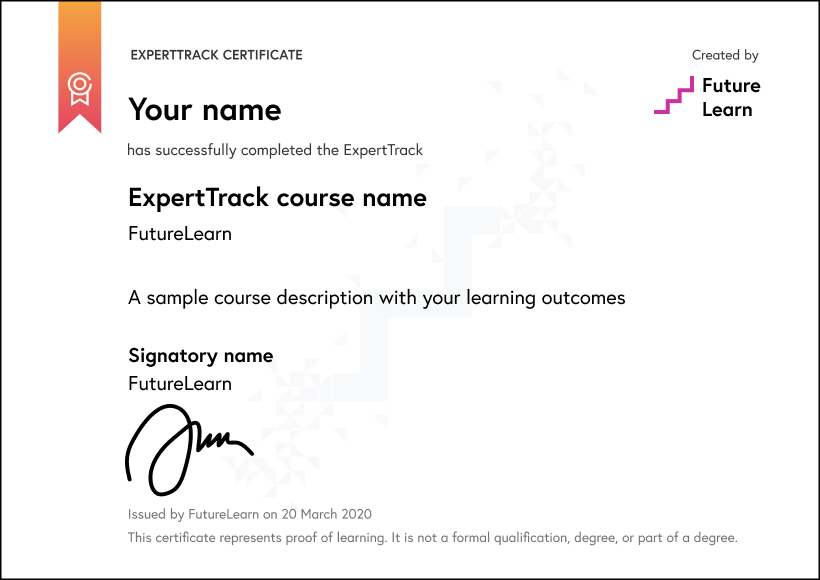
Highlight the new, job-relevant skills you’ve gained and supplement existing qualifications with a hard-earned, industry-specific digital certificate – plus one for every course within your ExpertTrack.
- Learn the latest in your chosen industry or subject.
- Complete each course and pass assessments.
- Receive certificates validated by the educating organisation.
- Impress employers with learning outcomes you can add to your CV.
- Make your career dreams a reality.
Download a PDF
Learning on this course
On every step of the course you can meet other learners, share your ideas and join in with active discussions in the comments.
What will you achieve?
By the end of the course, you‘ll be able to...
- Apply SIEM, endpoint telemetry, and network monitoring techniques to detect and investigate security incidents.
- Investigate security events, traffic patterns, endpoint alerts, and forensic evidence to determine incident scope and impact.
- Develop incident response procedures, communication plans, playbooks, and forensic documentation practices.
- Discuss containment, eradication, recovery, and return-to-service procedures during simulated security incidents.
- Evaluate incident outcomes, recovery effectiveness, response metrics, and lessons learned to strengthen organizational resilience.
Who is the course for?
This course is designed for security analysts, SOC professionals, and technically minded learners building structured capabilities in threat detection, incident investigation, and response as part of their professional development in cybersecurity.
The primary audience includes aspiring incident responders, digital forensics analysts, and security operations professionals seeking a practical, hands-on entry point into one of the most operationally critical disciplines in the industry.
It directly supports career pathways such as SOC Analyst, Incident Responder, Digital Forensics Analyst, and Threat Hunter across sectors including financial services, healthcare, government, telecommunications, and technology, where the ability to detect, contain, and recover from security incidents is a standard organisational requirement.
The course is also well suited for IT administrators, network engineers, and security generalists seeking to formalise their knowledge of detection engineering, forensic investigation, and incident lifecycle management, with prior familiarity with cybersecurity concepts, networking fundamentals, and operating system administration strongly recommended.
What software or tools do you need?
Learners should have prior knowledge of cybersecurity fundamentals, networking, Linux, and common security threats. A computer with a stable internet connection and support for virtual machines is required. SIEM, network analysis, incident response, and digital forensics tools are introduced during the course.
Who will you learn with?

Who developed the course?

Edureka
Edureka is a global online learning platform offering industry-focused training in emerging technologies such as Cloud, AI, GenAI, Data Science, DevOps, and Cybersecurity, helping professionals upskill and advance their careers.

Start learning today - free 2-day trial
After your free trial you can:
- Pay $39 per month to keep learning online
- Have complete control over your subscription; you can cancel any time
- Work at your own pace and set your own deadlines at every stage
- Only pay while you’re learning; the subscription will cancel automatically when you finish
- Complete online assessments to test your knowledge and prove your skills
- Earn digital course certificates and a final award that you can share online, with potential employers, and your professional network
- Keep access to the content of courses you complete even after your subscription ends
Learning on FutureLearn
Your learning, your rules
- Courses are split into weeks, activities, and steps to help you keep track of your learning
- Learn through a mix of bite-sized videos, long- and short-form articles, audio, and practical activities
- Stay motivated by using the Progress page to keep track of your step completion and assessment scores
Join a global classroom
- Experience the power of social learning, and get inspired by an international network of learners
- Share ideas with your peers and course educators on every step of the course
- Join the conversation by reading, @ing, liking, bookmarking, and replying to comments from others
Map your progress
- As you work through the course, use notifications and the Progress page to guide your learning
- Whenever you’re ready, mark each step as complete, you’re in control
- Complete 90% of course steps and all of the assessments to earn your certificate
Want to know more about learning on FutureLearn? Using FutureLearn


