This course is part of the Cybersecurity and Ethical Hacking ExpertTrack
Red Team Operations and Advanced Ethical Hacking
Develop in-demand ethical hacking and red team skills and learn to deliver professional penetration testing reports.

Duration
3 weeksWeekly study
3 hours100% online
How it worksIncluded in an ExpertTrack
Course 4 of 4
Red Team Operations and Advanced Ethical Hacking
Build skills for a career in offensive cybersecurity
Offensive security skills are among the most sought-after and hardest to develop in cybersecurity - often because the training stops short of the depth and hands-on practice that professional engagements actually demand.
This three-week course bridges that gap - helping you master the techniques for identifying, exploiting, and reporting security vulnerabilities across enterprise environments.
Develop advanced ethical hacking skills
Move beyond vulnerability identification and learn how vulnerabilities can be exploited as part of a structured penetration testing engagement.
You’ll explore techniques for gaining initial access and examine credential harvesting and password attack methodologies to understand how attackers can move through systems and networks.
By developing an attacker’s perspective, you’ll strengthen your ability to identify weaknesses and understand how individual vulnerabilities can contribute to a wider attack chain.
Test Active Directory and web application security
Explore two of the most important areas of modern offensive security: enterprise networks and web applications.
You’ll learn how to conduct Active Directory enumeration, examine Kerberos-based attack techniques, and understand credential-based lateral movement across simulated enterprise environments.
Throughout the course, you’ll apply ethical hacking techniques in controlled environments designed to develop practical penetration testing skills.
Learn professional red team methodologies
Discover how professional red team and penetration testing engagements are planned, executed, and communicated.
You’ll explore command-and-control concepts using Sliver C2 in controlled environments, alongside post-exploitation workflows and adversary simulation.
Syllabus
Week 1
Exploitation, Privilege Escalation, and Credential Attacks


Exploitation and Linux Privilege Escalation
Explore Metasploit exploitation and Meterpreter post-exploitation workflows, including situational awareness and Linux privilege escalation techniques.

Windows Privilege Escalation and Credential Attacks
Practice Windows privilege escalation, password hash cracking, and NTLM hash capture using WinPEAS, John the Ripper, and Responder.
Week 2
Active Directory Attacks and Advanced Web Exploitation

Active Directory Attacks and Lateral Movement
Explore Active Directory enumeration, Kerberoasting, Pass-the-Hash, lateral movement, and techniques defenders use to detect Kerberos attacks.

Advanced Web Application Exploitation
Use Burp Suite and vulnerable applications to explore SQL injection, XSS, request manipulation, SSRF, XXE, and business logic flaws.

Authentication and API Attacks
Investigate session hijacking, JWT weaknesses, API enumeration, BOLA vulnerabilities, and security risks covered by OWASP guidance.
Week 3
Red Team Methodology, C2 Operations, and Professional Reporting

Red Team Planning and C2 Operations
Explore offensive security roles, penetration testing scope, MITRE ATT&CK, and Sliver C2 for controlled post-exploitation operations.

Pentest Reporting and Career Development
Learn to plan professional penetration tests, document technical findings, communicate security risks effectively, and explore cybersecurity career pathways.
Prove you're job ready
Highlight the new, job-relevant skills you’ve gained and supplement existing qualifications with a hard-earned, industry-specific digital certificate – plus one for every course within your ExpertTrack.
- Learn the latest in your chosen industry or subject.
- Complete each course and pass assessments.
- Receive certificates validated by the educating organisation.
- Impress employers with learning outcomes you can add to your CV.
- Make your career dreams a reality.
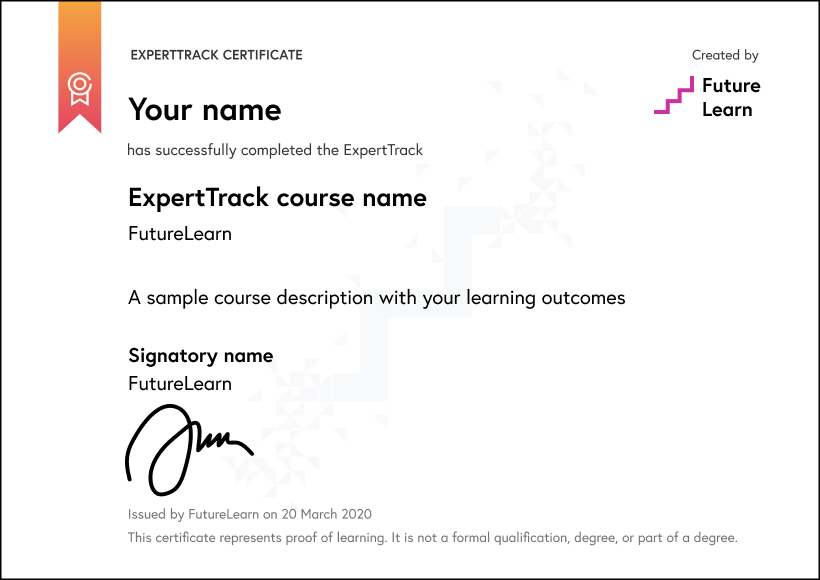
Download a PDF
Learning on this course
On every step of the course you can meet other learners, share your ideas and join in with active discussions in the comments.
What will you achieve?
By the end of the course, you‘ll be able to...
- Compare controlled exploitation, post-exploitation, privilege escalation, and credential attack techniques across Linux and Windows environments.
- Assess compromised systems, Active Directory environments, authentication mechanisms, and web applications to identify attack paths.
- Perform Kerberoasting, Pass-the-Hash, lateral movement, session attacks, and API exploitation within authorized lab environments.
- Design scoped red team and penetration testing engagements with appropriate rules of engagement and operational boundaries.
- Create professional penetration testing reports covering executive risk, technical findings, remediation priorities, and CVSS-based severity.
Who is the course for?
This course is designed for cybersecurity professionals and advanced learners ready to operate at the offensive end of the security spectrum, executing real-world exploitation techniques, attacking enterprise Active Directory environments, conducting manual web application testing, and delivering professional-grade penetration testing engagements from scoping through to reporting.
It directly supports career pathways such as Penetration Tester, Red Team Analyst, Offensive Security Engineer, Bug Bounty Hunter, and Security Consultant across sectors including financial services, healthcare, government, defence, and technology, where the ability to simulate adversary behaviour and identify exploitable weaknesses before attackers do is a high-value, in-demand capability.
The course is also well-suited for SOC analysts, incident responders, and blue team professionals who want to develop offensive fluency to sharpen their detection and response capabilities, with prior knowledge in cybersecurity fundamentals, Linux, networking, ethical hacking, and vulnerability assessment recommended.
What software or tools do you need?
Learners should have strong knowledge of cybersecurity, networking, Linux, ethical hacking, and vulnerability assessment. A computer with a stable internet connection and enough resources to run multiple virtual machines is required. Advanced exploitation, Active Directory, web security, and red team tools are introduced during the course.
Who will you learn with?

Who developed the course?

Edureka
Edureka is a global online learning platform offering industry-focused training in emerging technologies such as Cloud, AI, GenAI, Data Science, DevOps, and Cybersecurity, helping professionals upskill and advance their careers.

Start learning today - free 2-day trial
After your free trial you can:
- Pay $39 per month to keep learning online
- Have complete control over your subscription; you can cancel any time
- Work at your own pace and set your own deadlines at every stage
- Only pay while you’re learning; the subscription will cancel automatically when you finish
- Complete online assessments to test your knowledge and prove your skills
- Earn digital course certificates and a final award that you can share online, with potential employers, and your professional network
- Keep access to the content of courses you complete even after your subscription ends
Learning on FutureLearn
Your learning, your rules
- Courses are split into weeks, activities, and steps to help you keep track of your learning
- Learn through a mix of bite-sized videos, long- and short-form articles, audio, and practical activities
- Stay motivated by using the Progress page to keep track of your step completion and assessment scores
Join a global classroom
- Experience the power of social learning, and get inspired by an international network of learners
- Share ideas with your peers and course educators on every step of the course
- Join the conversation by reading, @ing, liking, bookmarking, and replying to comments from others
Map your progress
- As you work through the course, use notifications and the Progress page to guide your learning
- Whenever you’re ready, mark each step as complete, you’re in control
- Complete 90% of course steps and all of the assessments to earn your certificate
Want to know more about learning on FutureLearn? Using FutureLearn


