• Keio University logo
  • British Library
  • University of Cambridge
New

Global Codex: Hidden Stories of Books Across Cultures

Discover how the materiality and physical features of manuscripts and rare books reveal connections and contrasts across cultures

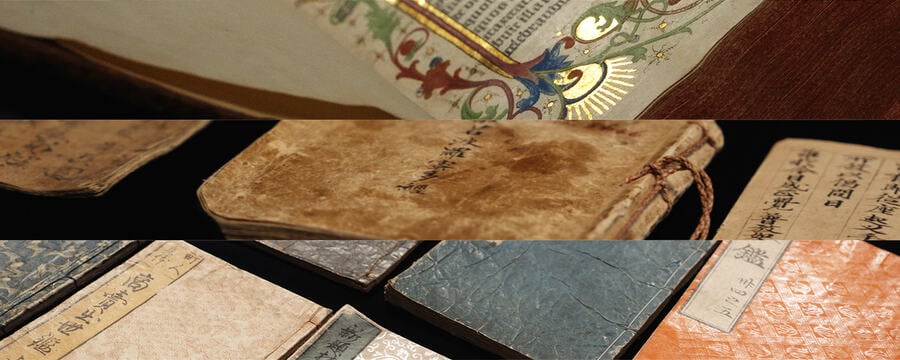
Rare and old First edition books are lined up along a bookshelf. They are leather bound and in poor condition.

Global Codex: Hidden Stories of Books Across Cultures

  • 3 weeks

  • 3 hours per week

  • Digital certificate when eligible

  • Open level

Find out more about how to join this course

  • Duration

    3 weeks
  • Weekly study

    3 hours
  • 100% online

    How it works
  • Unlimited subscription

    $244.99 for a whole yearLearn more

Every book has a story beyond its words

Books are more than containers of knowledge.

Every page, stitch, fold, illustration, and fibre preserves clues about the people who created, owned, and treasured them. Long before we read the words inside, the book itself has a story to tell.

On this course, you’ll learn to see books differently. Travelling across Japan, Dunhuang (China), Korea, Europe, the Greek and Islamicate world, and Southeast Asia, you’ll uncover the remarkable diversity of the codex and discover how manuscripts, rare books, and their physical construction reveal centuries of cultural connections and innovation.

Read the culture written into every book

Begin by exploring how the codex transformed the materiality of the book across different cultures.

You’ll compare binding traditions of historical books from Japan, Dunhuang, Europe, the Greek, and the Islamicate world dating from the eighth to the nineteenth century, discovering that the familiar book evolved in remarkably different ways depending on where and when it was created.

Learn to uncover the clues hidden in books

Next, you’ll develop the skills book historians, librarians, and conservators use to examine manuscripts and rare books.

From stitching patterns and page proportions to pigments, paper fibres, and recycled bindings, you’ll investigate how the physical features of books reveal their origins, usage, and movement across cultures.

Experience books as historical artefacts

Finally, you’ll consider how books and people’s lives shaped each other.

You’ll explore why books have always been cherished objects through ownership marks and personal annotations. Engaging books by digital technologies and the sensory experience of handling creates a deeper understanding of the past.

By the end, you’ll never look at a book in quite the same way again.

Skip to 0 minutes and 19 seconds Hi everyone, I’m Takahiro Sasaki, and I research the history of Japanese books at Keio University in Japan. I’m Satoko Tokunaga, also from Keio University, and I specialise in European book history. I’m Alessandro Bianchi from Cambridge University Libraries and Archives, and I study Japanese books in relation to the graphic arts. This course explores the history of the codex. It is a collaborative project between the British Library and Keio University with contributions from colleagues at Cambridge University.

Skip to 0 minutes and 54 seconds Moving beyond East Asia and Europe, the course offers a broader perspective on the codex across various cultures. Can you guess where we are standing now? We are here at the Mogao Caves in Dunhuang, in northwestern China. You may have heard of the “Dunhuang documents.” This is the very place where seventy thousands of written materials were discovered in 1900. In my research I have come to realize that although Japan adopted Chinese characters, the physical form, the binding methods and even the shape of the book are sometimes different. Yet among the Dunhuang documents produced more than a thousand years ago, we find examples whose structure and form closely resemble Japanese codices.

Skip to 1 minute and 53 seconds Where, then, do these books, preserved in Dunhuang like a time capsule, have their origins? Dunhuang was one of the key oasis towns on the Silk Road, which linked China to Central Asia as well as to regions of West Asia. As a trading hub, it was a vibrant and lively place where cultural exchanges flourished. The Dunhuang documents that have been passed down to the present include texts written in a range of languages and scripts. As physical objects, they display a variety of forms —not only scrolls and folded books, but also gatherings of leaves bound together. The codex has a history of more than two thousand years and continues to be an important companion to humanity.

Skip to 2 minutes and 41 seconds Yet its origins and forms remain full of mysteries. Join us, and let’s begin our journey.

Syllabus

  • Week 1

    What is a codex?

    • Starting with mysteries

      What exactly is a codex, and what is the significance of turning its pages? Explore why Japan's traditional bindings, though fragile, endured for centuries, then trace that mystery to Dunhuang, via Korea and China. Let's find out.

    • Codex bindings: Clues from Dunhuang

      This activity focuses on the Dunhuang manuscripts: their discovery, binding traditions in the British Library, comparison with Japanese codices, and how bookbinding techniques travelled between cultures.

    • Codex bindings: Around the world

      We widen our view to medieval Europe, the Greek and Islamicate world traditions, examining their codex bindings, including a medieval Bible, to see how the codex became a shared form shaped by local traditions.

    • Bringing it all together

      We close the week by sharing codices from your own collection, and recapping everything we've explored, from Japan to Dunhuang and beyond.

  • Week 2

    What do books reveal?

    • The shape of the codex

      We explore the shapes codices take, comparing aspect ratios across China, Korea, and Japan, searching for square and horizontal formats from Dunhuang to Southeast Asia, and looking at other codex forms.

    • Paper and book format

      How did paper size shape a book's format? We compare Japanese codices with European printed books and medieval manuscripts, then join two paper specialists examining Japanese books.

    • Hidden traces in books

      We look at how different cultures produced book covers, the waste paper found inside them, and the surprising, sometimes treasured discoveries covers can conceal, including fragments of the Gutenberg Bible.

    • Illustration and pigments

      We turn to colour and image, exploring Japanese illustrated books and medieval illuminated manuscripts, then examining the pigments used in Japanese books, and comparing them with those used in Europe.

    • Bringing it all together

      We close the week with a discussion reflecting on what we've explored, followed by a recap of the week's key ideas, from codex shapes to covers and pigments.

  • Week 3

    Humans and the codex

    • The joy of possessing a book

      We look at the joy of owning a book, and how readers have personalised their copies, through the example of collector Eugène Gillet before asking how you personalise yours.

    • Exploring approaches to book research

      We explore how scholars uncover a book's origin through the virtual recovery of medieval manuscript fragments, statistical codicology, and AI-driven analysis of ageing paper.

    • The sensory experience of books

      We explore the sensory side of books: the joy of turning pages, the rustle of different papers, the sound and weight of the Gutenberg Bible, and the tactile experience of bindings and interactive books.

    • Reflecting on our journey

      As the course draws to a close, we reflect on the layered history within books and the relationship between humans and the codices, before bringing our journey to an end.

When would you like to start?

Start straight away and join a global classroom of learners. If the course hasn’t started yet you’ll see the future date listed below.

  • Available now

Learning on this course

On every step of the course you can meet other learners, share your ideas and join in with active discussions in the comments.

What will you achieve?

By the end of the course, you‘ll be able to...

  • Explain the historical development and significance of the codex as a book form.
  • Identify and describe the key physical and structural features of codices from different traditions using appropriate terminology.
  • Compare codex bindings across cultures and historical periods.
  • Engage in close observation and analysis of books as historical artefacts.
  • Reflect on what books can tell us about the cultural exchanges and global connections.

Who is the course for?

This course is designed for anyone interested in the history of the book, manuscripts, rare books, and material culture. It will particularly appeal to librarians, archivists, museum professionals (such as curators, conservators, researchers), designers, students and professionals in humanities and digital humanities, collectors, publishers, and anyone curious about how books reveal the history of the societies that created them.

Acknowledgements

This course was jointly developed by Keio University, the British Library, and the University of Cambridge, in collaboration with the Dunhuang Academy.

Who will you learn with?

I’m a Professor at Keio University. My research areas include book history and medieval literature. I’m currently exploring the material and tactile dimensions of medieval manuscripts and rare books.

I am a Professor at the Institute of Oriental Classics, Keio University. I am the lead educator for "Japanese Culture Through Rare Books" and "Global Codex: Hidden Stories of Books Across Cultures".

Who developed the course?

Keio University

Keio University is Japan’s first modern institution of higher learning, and since 1858 has established itself as a leader in Japan through its continued commitment to education, research and medicine.

  • Established

    1858
  • Location

    Tokyo, Japan
  • World ranking

    Top 200Source: QS World University Rankings 2021

British Library

The British Library is the national library of the United Kingdom and one of the world’s greatest research libraries.

University of Cambridge

The University of Cambridge contributes to society through the pursuit of excellent education, learning, and research.

Best ValueBest Value - learn more, save more!

Ways to learn

Buy this course

Subscribe & save

Start learning today

Choose the best way to learn for you!

$54/one-off payment

$244.99 for a whole year

Automatically renews

Free

Fulfill your current learning needDevelop skills to further your careerTry this course - with limits
Access to this courseticktick

Limited to 3 weeks

Access to 1,000+ coursescrosstickcross
Learn at your own paceticktickcross
Discuss your learning in commentstickticktick
Certificate when you're eligiblePrinted and digitalDigital onlycross
Continue & Upgrade

Cancel for free anytime

Ways to learn

Choose the best way to learn for you!

Best Value - learn more, save more!

Subscribe & save

$244.99 for a whole year

Automatically renews

Develop skills to further your career

  • Access to this course
  • Access to 1,000+ courses
  • Learn at your own pace
  • Discuss your learning in comments
  • Digital certificate when you're eligible

Cancel for free anytime

Buy this course

$54/one-off payment

Fulfill your current learning need

  • Access to this course
  • Learn at your own pace
  • Discuss your learning in comments
  • Printed and digital certificate when you’re eligible

Start learning today

Free

Try this course - with limits

  • Limited to 3 weeks

Find out more about certificates, Unlimited or buying a course (Upgrades)

Sale price available until 2 November 2026 at 23:59 (UTC). T&Cs apply.

Find out more about certificates, Unlimited or buying a course (Upgrades)

Sale price available until 2 November 2026 at 23:59 (UTC). T&Cs apply.

Learning on FutureLearn

Your learning, your rules

  • Courses are split into weeks, activities, and steps to help you keep track of your learning
  • Learn through a mix of bite-sized videos, long- and short-form articles, audio, and practical activities
  • Stay motivated by using the Progress page to keep track of your step completion and assessment scores

Join a global classroom

  • Experience the power of social learning, and get inspired by an international network of learners
  • Share ideas with your peers and course educators on every step of the course
  • Join the conversation by reading, @ing, liking, bookmarking, and replying to comments from others

Map your progress

  • As you work through the course, use notifications and the Progress page to guide your learning
  • Whenever you’re ready, mark each step as complete, you’re in control
  • Complete 90% of course steps and all of the assessments to earn your certificate

Want to know more about learning on FutureLearn? Using FutureLearn

Do you know someone who'd love this course? Tell them about it...