This course is part of the Natural Language Processing ExpertTrack Pathway ExpertTrack
Natural Language Processing (NLP) and Text Processing Foundations
Discover how NLP transforms raw language into structured data using practical Python techniques for processing, and analysing data

Duration
3 weeksWeekly study
3 hours100% online
How it worksIncluded in an ExpertTrack
Course 1 of 3
Natural Language Processing (NLP) and Text Processing Foundations
Transform raw text into usable data with NLP
Before language models can classify, interpret, or predict from text, that text needs to be prepared properly.
On this introductory course, you’ll explore the foundations of Natural Language Processing (NLP) and learn how to turn messy, unstructured language into data that can be analysed and modelled.
Start by examining how human language is structured and why text presents unique challenges for AI.
You’ll then work through practical techniques for acquiring, cleaning, and normalising text, including encoding, case handling, noise removal, and regular expressions.
Structure language for analysis
Explore tokenisation, stemming, lemmatisation, and stop-word handling to break text into meaningful components.
You’ll also work with part-of-speech tagging, syntactic structure, and n-grams to better understand how linguistic patterns can be represented computationally.
Convert text into numerical features
Discover how techniques such as bag-of-words, count vectors, and TF-IDF transform language into numerical representations that machine learning models can use.
You’ll examine the strengths and limitations of different approaches and see how feature design influences downstream NLP tasks.
Assemble a reusable NLP pipeline
Bring your learning together by creating a reproducible text preprocessing workflow and applying it to classical NLP tasks such as keyword extraction and text matching.
By the end, you’ll be able to clean, structure, and represent text confidently, giving you the foundation needed to progress into text classification, sentiment analysis, and more advanced NLP applications.
Syllabus
Week 1
Foundations for NLP and Text Preparation


Connect Human Language to NLP
Explore how NLP processes human language through morphology, syntax, semantics and pragmatics while examining common applications and language-processing challenges.

Transform Raw Text for NLP Workflows
Follow an NLP preprocessing workflow to convert raw text into structured input using case handling, tokenisation, stop-word processing and noise removal.

Clean and Normalise Text for Reliable Processing
Apply regular expressions, punctuation handling, Unicode processing and normalisation techniques to produce consistent text for downstream NLP tasks.
Week 2
Transform Text into Features for NLP Models

Tokenise and Normalise Text for Language Processing
Process language at word, subword and character levels and apply normalisation techniques to prepare text for subsequent NLP analysis.

Reduce Word Variation with Stemming and Lemmatisation
Apply stemming and lemmatisation approaches to normalise morphological variation while examining trade-offs between rule-based reduction and meaning-preserving word forms.

Represent Text with Linguistic and Numerical Features
Transform processed language into structured features using part-of-speech information, Bag of Words, TF-IDF and word embeddings such as Word2Vec, GloVe and FastText.
Week 3
Build and Evaluate Classical NLP Solutions

Prepare Complex Text for Real-World NLP
Adapt preprocessing techniques to noisy, multilingual, code-mixed and domain-specific text to create reliable inputs for practical NLP applications.

Build and Assess Text Classification Models
Develop classical text classifiers using feature selection and machine-learning approaches such as Naïve Bayes and SVM, then assess performance using standard evaluation metrics.

Implement an End-to-End Text Classification Workflow
Integrate preprocessing, feature extraction, supervised model training, evaluation and model comparison into a complete classical NLP classification workflow.
Prove you're job ready
Highlight the new, job-relevant skills you’ve gained and supplement existing qualifications with a hard-earned, industry-specific digital certificate – plus one for every course within your ExpertTrack.
- Learn the latest in your chosen industry or subject.
- Complete each course and pass assessments.
- Receive certificates validated by the educating organisation.
- Impress employers with learning outcomes you can add to your CV.
- Make your career dreams a reality.
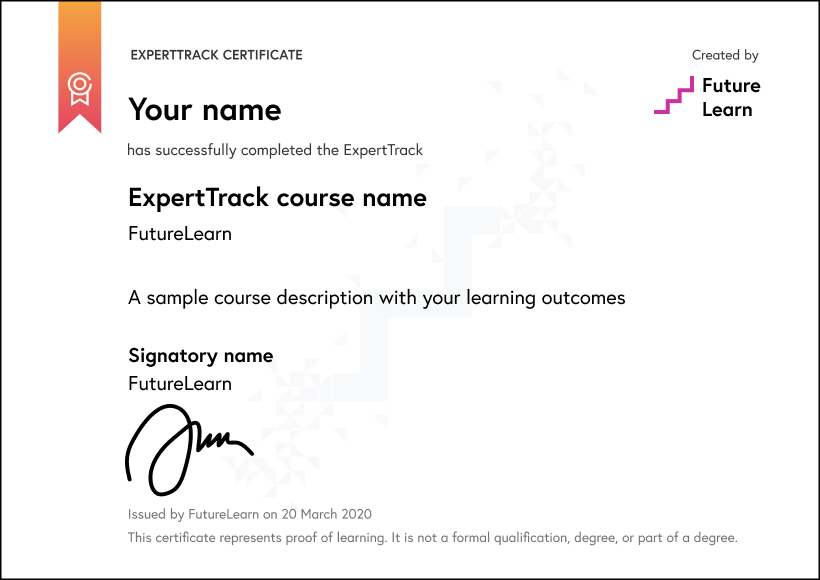
Download a PDF
Learning on this course
On every step of the course you can meet other learners, share your ideas and join in with active discussions in the comments.
What will you achieve?
By the end of the course, you‘ll be able to...
- Explain how NLP uses linguistic concepts such as morphology, syntax, semantics, and pragmatics to process human language.
- Apply text cleaning, regular expressions, and normalisation techniques to prepare raw text for NLP tasks.
- Compare tokenisation, stemming, and lemmatisation approaches for reducing variation in language data.
- Develop text representations using Bag of Words, TF-IDF, and word embeddings such as Word2Vec, GloVe, and FastText.
- Build and evaluate classical text classification models using Naïve Bayes, SVM, and standard performance metrics.
Who is the course for?
This ExpertTrack is ideal for aspiring NLP engineers, data scientists, machine learning practitioners, Python developers, and analysts who want a practical introduction to processing text data. Basic Python knowledge is recommended; no prior NLP experience is required.
What software or tools do you need?
What software or tools do you need? No prior natural language processing or text classification experience is required, although a basic familiarity with Python will help you follow the demonstrations. The course introduces the tools and setup you need from the beginning, including the Python libraries and datasets used in the practical activities. You will need access to a suitable computer, a stable internet connection and the relevant online accounts to follow the hands-on exercises.
Who will you learn with?

Who developed the course?

Edureka
Edureka is a global online learning platform offering industry-focused training in emerging technologies such as Cloud, AI, GenAI, Data Science, DevOps, and Cybersecurity, helping professionals upskill and advance their careers.

Start learning today - free 2-day trial
After your free trial you can:
- Pay $39 per month to keep learning online
- Have complete control over your subscription; you can cancel any time
- Work at your own pace and set your own deadlines at every stage
- Only pay while you’re learning; the subscription will cancel automatically when you finish
- Complete online assessments to test your knowledge and prove your skills
- Earn digital course certificates and a final award that you can share online, with potential employers, and your professional network
- Keep access to the content of courses you complete even after your subscription ends
Learning on FutureLearn
Your learning, your rules
- Courses are split into weeks, activities, and steps to help you keep track of your learning
- Learn through a mix of bite-sized videos, long- and short-form articles, audio, and practical activities
- Stay motivated by using the Progress page to keep track of your step completion and assessment scores
Join a global classroom
- Experience the power of social learning, and get inspired by an international network of learners
- Share ideas with your peers and course educators on every step of the course
- Join the conversation by reading, @ing, liking, bookmarking, and replying to comments from others
Map your progress
- As you work through the course, use notifications and the Progress page to guide your learning
- Whenever you’re ready, mark each step as complete, you’re in control
- Complete 90% of course steps and all of the assessments to earn your certificate
Want to know more about learning on FutureLearn? Using FutureLearn


