This course is part of the Natural Language Processing ExpertTrack Pathway ExpertTrack
Transformer Models and Language Understanding Systems
Advance into deep learning, attention, and transformer models to create sophisticated systems for language understanding.

Duration
3 weeksWeekly study
3 hours100% online
How it worksIncluded in an ExpertTrack
Course 3 of 3
Transformer Models and Language Understanding Systems
Unlock advanced language understanding with transformers
Modern NLP systems rely on deep learning architectures that can capture context, relationships, and meaning across complex language.
On this advanced course, you’ll move beyond classical text models and explore the technologies behind today’s language understanding systems.
Begin with sequence modelling using recurrent neural networks, LSTMs, and GRUs, examining how these approaches process text and where their limitations emerge.
You’ll then explore the attention mechanism and why it transformed the way models handle long-range dependencies in language.
Decode the transformer architecture
Explore self-attention, multi-head attention, positional encoding, and encoder-decoder structures to understand how transformer models process language at scale.
You’ll connect these concepts to the shift from recurrence towards modern transformer-based NLP.
Adapt pretrained models such as BERT
Discover how transfer learning and fine-tuning allow pretrained transformer models to tackle specialised language tasks.
You’ll work with models such as BERT and examine how existing language representations can be adapted to new datasets and use cases.
Tackle advanced language understanding tasks
Apply modern NLP techniques to named entity recognition, question answering, and text summarisation.
You’ll also consider model evaluation and responsible NLP practices when creating real-world language systems.
By the end, you’ll understand how deep learning and transformer architectures support advanced NLP applications and be equipped to create and evaluate end-to-end language understanding systems.
Syllabus
Week 1
From Neural Language Models to Transformers


Explore Neural Architectures for Language Processing
Examine how embeddings, recurrent networks, sequence-to-sequence architectures and transformers represent and process language across NLP applications.

Capture Language Context with Attention
Investigate self-attention and multi-head attention, then connect these mechanisms with transformer tokenisation and contextual language processing.

Adapt Pretrained Models for NLP Tasks
Use fine-tuning and transfer learning to adapt models such as BERT and GPT for practical language-processing applications.
Week 2
Neural and Transformer-Based Machine Translation

Navigate Machine Translation Methods and Challenges
Trace the evolution of translation approaches while examining data challenges, evaluation metrics and multilingual strategies for assessing translation systems.

Develop Neural Machine Translation Systems
Construct neural translation workflows using encoder-decoder architectures, LSTM-based sequence modelling, attention mechanisms and model training.

Enhance Translation with Transformer Models
Extend translation capabilities through transformers, zero-shot approaches and low-resource techniques while addressing errors and domain-specific requirements.
Week 3
Intelligent Language Systems for Emerging Applications

Connect Speech, Text and Visual Information
Explore speech recognition, text-to-speech and vision-language models to understand how modern NLP systems process information across multiple modalities.

Optimise NLP Systems for Efficient and Responsible Use
Improve model efficiency through compression and edge deployment while considering explainability, ethical AI and emerging directions in NLP.

Create Context-Aware Conversational Systems
Integrate intents, entities, contextual fine-tuning and multi-turn interaction to develop and evaluate practical chatbot systems.
Prove you're job ready
Highlight the new, job-relevant skills you’ve gained and supplement existing qualifications with a hard-earned, industry-specific digital certificate – plus one for every course within your ExpertTrack.
- Learn the latest in your chosen industry or subject.
- Complete each course and pass assessments.
- Receive certificates validated by the educating organisation.
- Impress employers with learning outcomes you can add to your CV.
- Make your career dreams a reality.
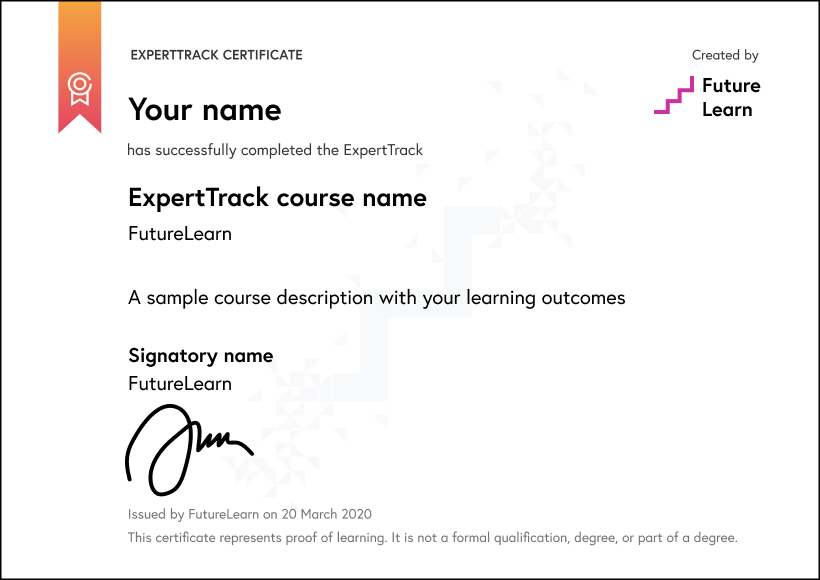
Download a PDF
Learning on this course
On every step of the course you can meet other learners, share your ideas and join in with active discussions in the comments.
What will you achieve?
By the end of the course, you‘ll be able to...
- Explain how neural architectures, attention mechanisms, and transformers represent and process language.
- Apply fine-tuning and transfer learning to adapt pretrained models such as BERT and GPT for NLP tasks.
- Develop neural and transformer-based machine translation workflows and evaluate them using standard metrics.
- Identify how speech, text-to-speech, and vision-language models extend NLP across multiple modalities.
- Design efficient, explainable, and context-aware conversational systems that support responsible NLP development.
Who is the course for?
This course is for NLP engineers, data scientists, machine learning engineers, and AI developers ready to progress into deep learning and transformer-based NLP. Experience with text preprocessing, classification, evaluation, and word embeddings is recommended.
What software or tools do you need?
No prior experience with transformer models or machine translation is required, although a basic familiarity with Python and core NLP concepts will help you follow the demonstrations. The course introduces the tools and setup you need from the beginning, including Hugging Face, the Python libraries, pretrained models and datasets used in the practical activities. You will need access to a suitable computer, a stable internet connection and the relevant online accounts to follow the hands-on exercises.
Who will you learn with?

Who developed the course?
Edureka
Edureka is a global online learning platform offering industry-focused training in emerging technologies such as Cloud, AI, GenAI, Data Science, DevOps, and Cybersecurity, helping professionals upskill and advance their careers.

Start learning today - free 2-day trial
After your free trial you can:
- Pay $39 per month to keep learning online
- Have complete control over your subscription; you can cancel any time
- Work at your own pace and set your own deadlines at every stage
- Only pay while you’re learning; the subscription will cancel automatically when you finish
- Complete online assessments to test your knowledge and prove your skills
- Earn digital course certificates and a final award that you can share online, with potential employers, and your professional network
- Keep access to the content of courses you complete even after your subscription ends
Learning on FutureLearn
Your learning, your rules
- Courses are split into weeks, activities, and steps to help you keep track of your learning
- Learn through a mix of bite-sized videos, long- and short-form articles, audio, and practical activities
- Stay motivated by using the Progress page to keep track of your step completion and assessment scores
Join a global classroom
- Experience the power of social learning, and get inspired by an international network of learners
- Share ideas with your peers and course educators on every step of the course
- Join the conversation by reading, @ing, liking, bookmarking, and replying to comments from others
Map your progress
- As you work through the course, use notifications and the Progress page to guide your learning
- Whenever you’re ready, mark each step as complete, you’re in control
- Complete 90% of course steps and all of the assessments to earn your certificate
Want to know more about learning on FutureLearn? Using FutureLearn


