This course is part of the Data Science with Python ExpertTrack
Advanced Machine Learning with Python
Take your machine learning skills into production as you gain knowledge of advanced Python techniques for real-world AI solutions.

Duration
4 weeksWeekly study
4 hours100% online
How it worksIncluded in an ExpertTrack
Course 4 of 4
Advanced Machine Learning with Python
Move from machine learning models to production solutions
Building a model is only half of data science in industry; the other half is delivering models that are fast to produce, handle real-world data patterns, and run reliably in production. On this course, you’ll learn how to take machine learning projects from development through to deployment using advanced techniques in Python and MLOps.
You’ll explore how to accelerate model development with automated machine learning and no-code platforms, while learning how to work with real-world challenges such as limited data availability, AI fairness, and changing data patterns.
By the end of the course, you’ll understand how professional data teams build, deploy, and maintain machine learning solutions.
Accelerate machine learning with AutoML and advanced modelling techniques
Discover how automated machine learning (AutoML) can help streamline the model development process.
You’ll learn how to rapidly build and compare models, generate synthetic data when real datasets are limited, and evaluate the impact of AI fairness considerations in applied machine learning scenarios.
You’ll also explore techniques to help you develop more robust predictive solutions for real-world applications.
Apply MLOps to deploy and manage machine learning models
Learn how MLOps bridges the gap between developing a machine learning model and delivering it as a reliable production service. You’ll explore CI/CD pipelines, containerisation, and service-based deployment to make models easier to manage and scale.
Through a project, you’ll apply your skills by defining a business problem, engineering features, training and tuning a model, deploying it as a service, and monitoring it in production.
By the end, you’ll be ready for machine learning engineer and applied data scientist roles.
Syllabus
Week 1
AutoML and H20 Foundations


Navigating Your AutoML And MLOps Journey
Discover why automated machine learning emerged and what it actually automates. You will compare the leading frameworks, set up H2O AutoML, and run your first automated model end to end.

Why Automated Machine Learning Emerged
Understand the pressures that produced AutoML and the manual decisions it replaces. You will walk a conventional ML workflow, see where human judgement is repeatedly spent, and judge when automation is the right answers.

Evaluate AutoML Frameworks and Set Up H2O
Survey the AutoML tooling landscape and the trade-offs that separate one framework from another.

Prepare and Validate Data for AutoML
Learn systematic approaches to assess and clean data for AutoML. You will diagnose data quality issues before they impact model performance.
Week 2
AutoML Optimisation, Evaluation, and Productionisation

Engineer Features and Prevent Data Leakage
Master feature engineering and learn to prevent data leakage, a critical mistake in ML projects. You will design feature sets that respect temporal and causal boundaries.

Configure and Control AutoML Model Search
Guide and constrain H2O AutoML model search using search constraints and ensemble strategies. You will align model selection with your project's time, compute, and business requirements.

Evaluate and Compare AutoML Model Performance
Learn when to use classification versus regression metrics and how to align metric choices with your business problem. You will discover why metric misalignment leads to production failures.

Optimise Hyperparameters and Refine AutoML Models
Systematically explore the hyperparameter space to refine AutoML models and determine when to stop tuning. You will balance optimisation effort against diminishing returns using H2O tools.

Export and Prepare AutoML Models for Deployment
Learn to export and serialise models for production deployment. You will understand deployment artefacts, versioning, and how to prepare models for real-time and batch scoring environments.
Week 3
MLOps Foundations, Versioning, and Pipelines

Track and Compare ML Experiments with MLflow
Understand MLOps, experiment tracking with MLflow, and reproducibility practices. You will set up systematic experiment management for tracking parameters, metrics, and models.

Version Data and Reproduce ML Experiments with DVC
Bring the same discipline to your data that version control brings to your code. You will use DVC to track dataset changes alongside commits, then reproduce an earlier training result exactly from its versioned inputs.

Automate ML Pipelines and Manage Model Versions
Turn a working notebook into an automated workflow. You will build and run an Airflow pipeline, trigger it through GitHub Actions, and register the resulting models with the version and stage information.
Week 4
Production MLOps, Monitoring and Model Retraining

Serve and Deploy ML Models to Production
Package a trained model as a service others can call. You will expose predictions through a FastAPI endpoint, containerise it with Docker, & deploy it to a cloud environment.

Monitor Model Performance and Automate Retraining
Detect drift, monitor performance degradation, and automate retraining triggers in production. You will learn when to automate and when human decisions are needed for model updates.
Prove you're job ready
Highlight the new, job-relevant skills you’ve gained and supplement existing qualifications with a hard-earned, industry-specific digital certificate – plus one for every course within your ExpertTrack.
- Learn the latest in your chosen industry or subject.
- Complete each course and pass assessments.
- Receive certificates validated by the educating organisation.
- Impress employers with learning outcomes you can add to your CV.
- Make your career dreams a reality.
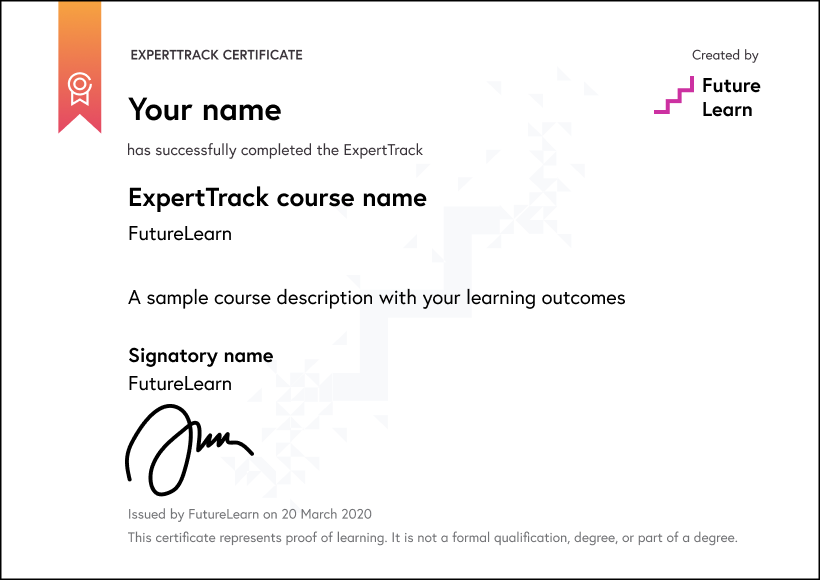
Download a PDF
Learning on this course
On every step of the course you can meet other learners, share your ideas and join in with active discussions in the comments.
What will you achieve?
By the end of the course, you‘ll be able to...
- Explain AutoML concepts, compare AutoML frameworks, and apply H2O to automate machine learning workflows.
- Apply MLflow and DVC to track experiments, version datasets, and reproduce machine learning workflows.
- Evaluate AutoML search strategies, model performance, and hyperparameter configurations to support reliable model selection.
- Demonstrate model serving and deployment workflows using FastAPI, Docker, and cloud-based approaches.
- Identify model performance changes and data drift that indicate the need for model retraining.
- Describe how monitoring, observability, and automated retraining support reliable machine learning systems in production.
Who is the course for?
This course is designed for learners who can already build and evaluate machine learning models in Python.
It is ideal for aspiring machine learning engineers, data scientists who want to operationalise their work, and developers preparing for roles where models must be deployed and maintained, not just trained.
Learners should be confident with the end-to-end modelling workflow, including feature engineering, model selection, and evaluation, before starting.
Who will you learn with?

Who developed the course?
Edureka
Edureka is a global online learning platform offering industry-focused training in emerging technologies such as Cloud, AI, GenAI, Data Science, DevOps, and Cybersecurity, helping professionals upskill and advance their careers.

Start learning today - free 2-day trial
After your free trial you can:
- Pay $39 per month to keep learning online
- Have complete control over your subscription; you can cancel any time
- Work at your own pace and set your own deadlines at every stage
- Only pay while you’re learning; the subscription will cancel automatically when you finish
- Complete online assessments to test your knowledge and prove your skills
- Earn digital course certificates and a final award that you can share online, with potential employers, and your professional network
- Keep access to the content of courses you complete even after your subscription ends
Learning on FutureLearn
Your learning, your rules
- Courses are split into weeks, activities, and steps to help you keep track of your learning
- Learn through a mix of bite-sized videos, long- and short-form articles, audio, and practical activities
- Stay motivated by using the Progress page to keep track of your step completion and assessment scores
Join a global classroom
- Experience the power of social learning, and get inspired by an international network of learners
- Share ideas with your peers and course educators on every step of the course
- Join the conversation by reading, @ing, liking, bookmarking, and replying to comments from others
Map your progress
- As you work through the course, use notifications and the Progress page to guide your learning
- Whenever you’re ready, mark each step as complete, you’re in control
- Complete 90% of course steps and all of the assessments to earn your certificate
Want to know more about learning on FutureLearn? Using FutureLearn


