Understand machine learning with Python and build predictive models to solve real-world data science problems.

Duration
3 weeksWeekly study
3 hours100% online
How it worksIncluded in an ExpertTrack
Course 3 of 4
Machine Learning with Python
Learn machine learning with Python
Machine learning powers everything from recommendation engines to fraud detection and predictive analytics. On this three-week course, you’ll learn how to build, evaluate, and improve machine learning models using Python while developing practical skills used across data science and AI.
You’ll begin by exploring the foundations of machine learning. As you progress, you’ll discover how machine learning models are developed, evaluated, and applied to solve real-world business challenges.
Build and evaluate predictive machine learning models
Learn how to create supervised machine learning models for both regression and classification problems using industry-standard techniques.
You’ll build regression models using linear, polynomial, and ridge regression before exploring classification algorithms such as logistic regression and decision trees.
Explore advanced machine learning techniques
Take your machine learning skills further by working with advanced algorithms used in professional data science projects. You’ll explore Random Forest, Support Vector Machines (SVM), and XGBoost, while learning how to improve model performance through hyperparameter tuning using grid and random search.
You’ll also discover how to interpret model predictions using SHAP values, address class imbalance with SMOTE, and build recommendation engines. Finally, you’ll explore unsupervised learning by applying K-Means, hierarchical clustering, and DBSCAN, before using Principal Component Analysis (PCA) to reduce dimensionality and uncover patterns in complex datasets.
By the end, you’ll have developed the machine learning and Python skills that are sought-after in the data science industry.
Syllabus
Week 1
Machine Learning Foundations and Regression


Step into Machine Learning with Python
Discover what machine learning is, where it creates value, and how Python supports the transition from data analysis to predictive modelling.

Machine Learning Fundamentals
Explore the machine learning lifecycle, CRISP-DM, learning categories, data preparation, train/test splitting, and baseline model development.

Build and Evaluate Regression Models
Learn to build linear and polynomial regression models and evaluate their predictive performance using appropriate error metrics.

Control Overfitting with Regularisation and Validation
Understand overfitting, bias and variance while applying Ridge regularisation and cross-validation to improve model generalisation.
Week 2
Classification, Ensemble Learning, and Model Explainability

Predict Outcomes with Classification Algorithms
Build and evaluate classification models using logistic regression and decision trees, with metrics such as precision, recall, confusion matrices, and ROC curves.

Strengthen Predictions with Ensemble Methods
Improve predictive performance using Random Forests, SVM, XGBoost, and hyperparameter optimisation techniques.

Interpretability, Imbalance, and Recommenders
Explore SHAP-based model explanations, class imbalance handling with SMOTE, and the fundamentals of recommendation engines.
Week 3
Discover Patterns with Unsupervised Learning

Segment Data with Clustering
Discover how K-Means, hierarchical clustering, and DBSCAN group similar observations and support applications such as customer segmentation.

Dimensionality Reduction
Use Principal Component Analysis (PCA) to reduce complex feature spaces while preserving important patterns and improving data visualisation.
Prove you're job ready
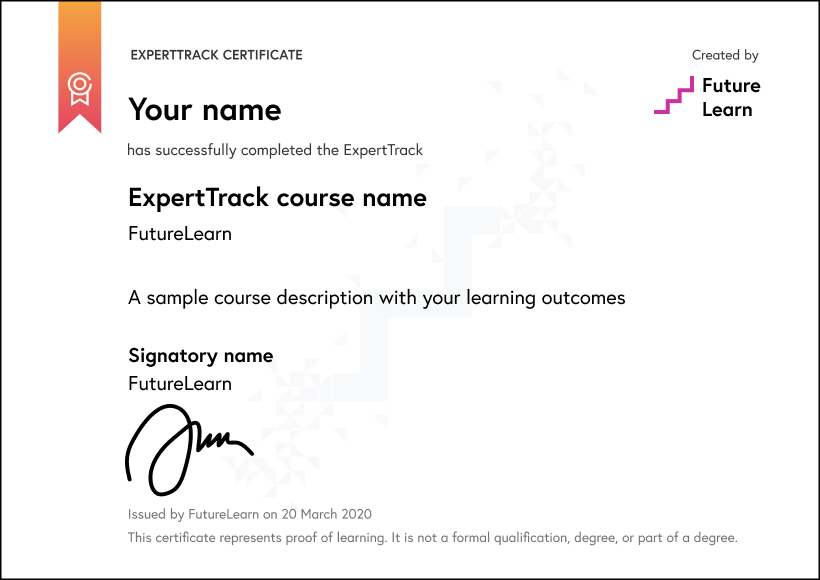
Highlight the new, job-relevant skills you’ve gained and supplement existing qualifications with a hard-earned, industry-specific digital certificate – plus one for every course within your ExpertTrack.
- Learn the latest in your chosen industry or subject.
- Complete each course and pass assessments.
- Receive certificates validated by the educating organisation.
- Impress employers with learning outcomes you can add to your CV.
- Make your career dreams a reality.
Download a PDF
Learning on this course
On every step of the course you can meet other learners, share your ideas and join in with active discussions in the comments.
What will you achieve?
By the end of the course, you‘ll be able to...
- Explain machine learning categories, the machine learning lifecycle, and how CRISP-DM structures a machine learning project.
- Apply regression and classification algorithms using Python and scikit-learn to solve predictive modelling problems.
- Interpret model performance using appropriate regression and classification metrics, cross-validation, and baseline comparisons.
- Evaluate regularisation, ensemble methods, hyperparameter configurations, class imbalance treatments, and model explanations to support reliable model selection.
- Compare K-Means, hierarchical clustering, and DBSCAN based on their approaches to identifying structure in unlabelled data.
- Demonstrate the use of PCA to reduce high-dimensional data and visualise patterns and clusters in a reduced feature space.
Who is the course for?
This course is designed for aspiring data professionals, software developers, analysts, engineers, and business professionals who want to build practical data science skills with Python. No prior data science or machine learning experience is required, though basic computer literacy and comfort with logical problem-solving will be helpful.
It is ideal for career changers moving into data roles, working professionals looking to add analytics capabilities to their current role, and graduates preparing for data analyst, data scientist, or machine learning engineer positions. It is also valuable for managers and domain experts who want to understand how data-driven decisions are made.
Who will you learn with?

Who developed the course?
Edureka
Edureka is a global online learning platform offering industry-focused training in emerging technologies such as Cloud, AI, GenAI, Data Science, DevOps, and Cybersecurity, helping professionals upskill and advance their careers.

Start learning today - free 2-day trial
After your free trial you can:
- Pay $39 per month to keep learning online
- Have complete control over your subscription; you can cancel any time
- Work at your own pace and set your own deadlines at every stage
- Only pay while you’re learning; the subscription will cancel automatically when you finish
- Complete online assessments to test your knowledge and prove your skills
- Earn digital course certificates and a final award that you can share online, with potential employers, and your professional network
- Keep access to the content of courses you complete even after your subscription ends
Learning on FutureLearn
Your learning, your rules
- Courses are split into weeks, activities, and steps to help you keep track of your learning
- Learn through a mix of bite-sized videos, long- and short-form articles, audio, and practical activities
- Stay motivated by using the Progress page to keep track of your step completion and assessment scores
Join a global classroom
- Experience the power of social learning, and get inspired by an international network of learners
- Share ideas with your peers and course educators on every step of the course
- Join the conversation by reading, @ing, liking, bookmarking, and replying to comments from others
Map your progress
- As you work through the course, use notifications and the Progress page to guide your learning
- Whenever you’re ready, mark each step as complete, you’re in control
- Complete 90% of course steps and all of the assessments to earn your certificate
Want to know more about learning on FutureLearn? Using FutureLearn


