This course is part of the Generative AI for Software Developers ExpertTrack
Building and Deploying Intelligent Features with Generative AI
Move from using AI tools to creating intelligent application features with LLMs, RAG, semantic search, and production workflows.

Duration
3 weeksWeekly study
3 hours100% online
How it worksIncluded in an ExpertTrack
Course 3 of 3
Building and Deploying Intelligent Features with Generative AI
Turn generative AI into production-ready features
Using generative AI as a developer is one thing. Integrating it into software that other people can rely on is another.
On this advanced course, you’ll explore how large language models can become part of real applications through APIs, retrieval systems, intelligent features, and production-ready engineering practices.
You’ll start by connecting LLMs to applications using APIs, SDKs, and prompt orchestration.
From there, you’ll explore how capabilities such as assistants, semantic search, summarisation, and content generation can be shaped around genuine product and user needs.
Ground AI features in your own data
Explore retrieval-augmented generation (RAG), embeddings, and vector stores to connect language models with custom information.
You’ll examine how grounding can make AI features more relevant and useful while reducing reliance on a model’s training data alone.
Judge quality beyond whether it works
Assess intelligent features across reliability, output quality, cost, and latency. You’ll examine testing and monitoring approaches that help surface weaknesses before and after deployment and support better decisions about when an AI feature is ready for real use.
Operate generative AI in production
Explore versioning, observability, iteration, and ongoing maintenance for AI-powered features. You’ll also consider privacy, security, bias, safety, and governance across the product lifecycle.
By the end, you’ll be able to take generative AI beyond development assistance and apply it to the design, integration, deployment, and maintenance of intelligent features in real software applications.
Syllabus
Week 1
Integrating LLMs and Building Intelligent Application Features


Define the Intelligent Feature You Will Build
This opening orientation activity makes Developers identify a realistic application feature, define the user task and expected output, and establish success criteria before beginning implementation part.

Connect an Application to an LLM and Invoke Tools
Developers connect application code to an LLM, configure API access, inspect request-response behavior, and expose application functions to the model so generated outputs can participate in software logic.

Build a User-Facing Intelligent Feature
Developers turn model capabilities into an application feature, working with multimodal inputs, real-time interaction, and tool-integrated workflows while keeping the feature aligned to a concrete user task
Week 2
Grounding Intelligent Features with Embeddings, Vector Stores, RAG, and Evaluation

Build a Semantic Retrieval Layer for Custom Data
Developers transform application content into embeddings, persist vectors, apply metadata-aware retrieval, and implement semantic similarity search that can support search experiences and downstream generative features.

Assemble a Grounded RAG Feature from Custom Data
Developers connect chunking, retrieval, prompt grounding, and generation into a working RAG feature that responds from retrieved evidence and handles cases where the available context does not support an answer.

Measure and Improve AI Feature Quality, Reliability, Cost, and Latency
Developers define evaluation criteria, measure output and retrieval quality, compare candidate configurations, and use results to improve feature reliability while balancing operational cost and response latency.
Week 3
Deploying and Operating Intelligent AI Features in Production

Deploy and Version an AI-Powered Feature
Developers release an AI-powered feature to a reachable environment and establish version tracking for prompts, outputs, and experiments so future changes stay reproducible.

Monitor and Govern an AI Feature in Production
Developers add observability to a deployed feature and apply the responsible AI practices needed to operate it safely, covering monitoring, safety, privacy, security, bias, and governance.
Prove you're job ready
Highlight the new, job-relevant skills you’ve gained and supplement existing qualifications with a hard-earned, industry-specific digital certificate – plus one for every course within your ExpertTrack.
- Learn the latest in your chosen industry or subject.
- Complete each course and pass assessments.
- Receive certificates validated by the educating organisation.
- Impress employers with learning outcomes you can add to your CV.
- Make your career dreams a reality.
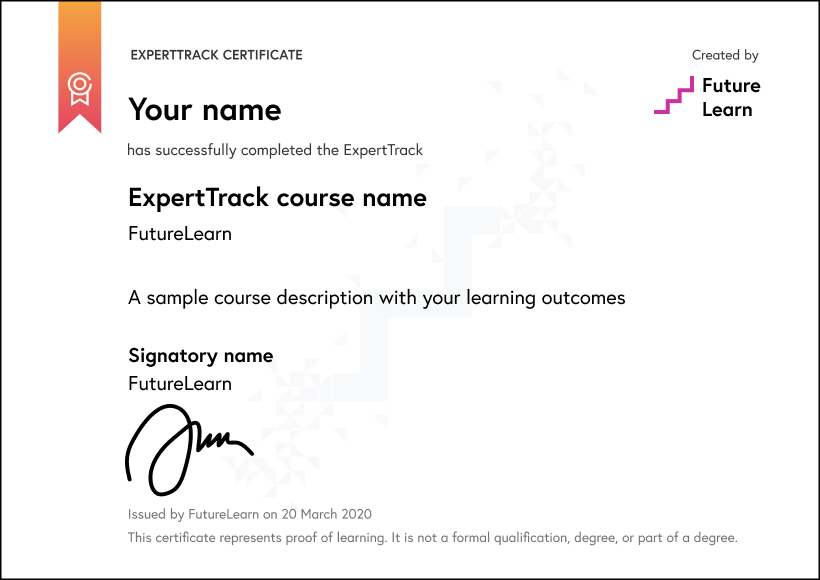
Download a PDF
Learning on this course
On every step of the course you can meet other learners, share your ideas and join in with active discussions in the comments.
What will you achieve?
By the end of the course, you‘ll be able to...
- Apply large language models in applications using APIs, SDKs, and tool-calling workflows.
- Create intelligent application features using multimodal capabilities, embeddings, vector stores, and retrieval-augmented generation.
- Evaluate intelligent features for quality, reliability, cost, and latency using appropriate evaluation methods.
- Modify AI-powered applications and their versions while maintaining reproducibility across prompts, models, outputs, and experiments.
- Improve monitoring, security, privacy, and responsible AI practices to operate intelligent features in production.
Who is the course for?
This course is for software engineers, full stack developers, application developers, and technical leads ready to integrate generative AI into real products. Programming, prompt engineering, and AI-assisted development experience are recommended.
What software or tools do you need?
Learners need a computer, a stable internet connection, and access to the relevant development environments, APIs, SDKs, and AI tools demonstrated in the course. The course covers Gemini API, Groq API SDK, ChromaDB, Vertex AI, RAGAS, and container-based deployment. Specific operating system requirements, API access requirements, account requirements, and licensing details are not fully specified in the course material and should be confirmed before finalising the setup instructions.
Who developed the course?
Edureka
Edureka is a global online learning platform offering industry-focused training in emerging technologies such as Cloud, AI, GenAI, Data Science, DevOps, and Cybersecurity, helping professionals upskill and advance their careers.

Start learning today - free 2-day trial
After your free trial you can:
- Pay $39 per month to keep learning online
- Have complete control over your subscription; you can cancel any time
- Work at your own pace and set your own deadlines at every stage
- Only pay while you’re learning; the subscription will cancel automatically when you finish
- Complete online assessments to test your knowledge and prove your skills
- Earn digital course certificates and a final award that you can share online, with potential employers, and your professional network
- Keep access to the content of courses you complete even after your subscription ends
Learning on FutureLearn
Your learning, your rules
- Courses are split into weeks, activities, and steps to help you keep track of your learning
- Learn through a mix of bite-sized videos, long- and short-form articles, audio, and practical activities
- Stay motivated by using the Progress page to keep track of your step completion and assessment scores
Join a global classroom
- Experience the power of social learning, and get inspired by an international network of learners
- Share ideas with your peers and course educators on every step of the course
- Join the conversation by reading, @ing, liking, bookmarking, and replying to comments from others
Map your progress
- As you work through the course, use notifications and the Progress page to guide your learning
- Whenever you’re ready, mark each step as complete, you’re in control
- Complete 90% of course steps and all of the assessments to earn your certificate
Want to know more about learning on FutureLearn? Using FutureLearn


