Photonic systems
In an earlier Step, we visited the laboratory of Professor Akira Furusawa at the University of Tokyo, and learned about using photons as qubits. In this video, we continue that visit and learn more about how those experiments are conducted.
To build an optical quantum computer, we must have a source of single photons, and the ability to execute some of the gates we discussed in the second week. Those gates are performed using beam splitters and devices that change the phase of a photon. To create a complete set of gates, we need a nonlinear operation and the ability to measure the photons. Professor Furusawa shows us his setup for these operations.
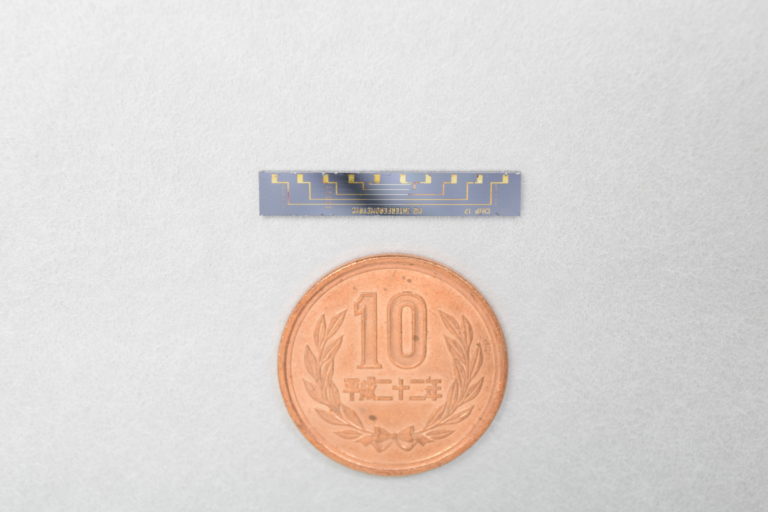
Of course, the setup on a lab bench is too big to build a large system, so Professor Furusawa also shows us a chip, made out of silicon, that performs the same functions as an entire table top full of mirrors and beamsplitters. It uses wave guides, like the optical fiber that brings the Internet to your house. Rather than having many, many chips, instead the light is recirculated back through the chip, in a loop, until the process is complete.
Professor Furusawa ends by saying that the most important challenge for building an optical quantum computer is quantum error correction. We will discuss QEC in the next Activity.
フォトニクス
これまでの講義では東京大学の古澤教授の研究室を訪れ、光子を使った量子ビットについて学びました。この動画ではさらに掘り下げ、そこで行われていた実験が実際にどのように繋がってくるかを学習します。
最適化された量子コンピュータの設計には必ず光子を利用するための光源と処理を行うためのゲートが必要であると第2週に学習しました。ゲートにはビームスプリッターと呼ばれる光束を複数に分割する装置と光子の位相を変化させる装置が使われます。そして実際にゲートを使って演算を行うには非線形媒質と光子の測定装置が必要になります。この動画では実際に古澤明教授の研究室で構築された装置について見てみます。
実際の装置はとても巨大ですが、今回は反射鏡やビームスプリッター全く同じ働きをしケイ素で作られている装置を見ます。装置にはインターネット回線として馴染みのある光ファイバーにも用いられている導波管と呼ばれる管を利用します。導波管を伝わる光子は、処理の終了と同時に再利用され循環する構造になっています。
動画の最後には、次の講義の題材でもあり最適化された量子コンピュータの設計にもっとも重要な技術でもある量子エラー訂正技術を簡単に紹介します。