
More types of rebinding
There are three other commonly used types of conversion, i.e. tetsuyōsō to scroll, fukurotoji to scroll and fukurotoji to tetsuyōsō. In this step, read about these three cases in the article below, and then watch the video to see a rather rare case of rebinding case, from tetsuyōsō to scroll.
Tetsuyōsō to scroll
Procedure: The joined sheets are carefully detached (a procedure known as aihagi), arranged horizontally in sequence, and pasted together. A roller is applied at the end and a new cover is put on.
How to tell: There are more seams between sheets/pages than in an ordinary scroll; the lines of text can be misaligned at the seams; quality of the paper and location of dirty areas.
Main advantage: Even a battered book can look spotless and unique.
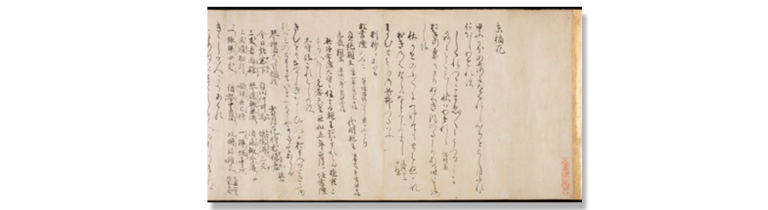 Fig.1 Example of tetsuyōsō to scroll conversion: medieval commentary of the Tale of Genji (Suetsumuhana chapter), Namboku-chō period copy, 1 scroll. Click to take a closer look
Fukurotoji to scroll
Procedure: The binding is removed and the pages are arranged in the right order. A cover and a roller are applied at the two ends.
How to tell: More seams than in an ordinary scroll; possible misalignment of the lines at the seams; check the quality of the paper and the location of dirty areas.
Main advantage: Even a battered book can look spotless and unique. (same as rebinding from Tetsuyōsō to scroll)
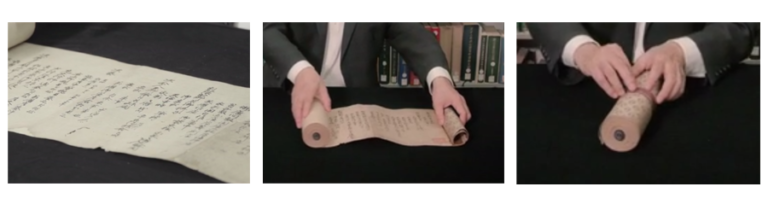 Fig.2. Example of fukurotoji to scroll conversion: Yakumo mishō [His Majesty’s Eight-Cloud Treatise].
Click to take a closer look
Fukurotoji to tetsuyōsō
Procedure: The original binding is removed, the sheets are spread out, and the pages are cut out individually. Pairs of consecutive pages are then pasted onto a new sheet of paper, two for each side. The new sheet is then folded in the middle according to the tetsuyōsō method. The entire book is then bound according to the tetsuyōsō method.
How to tell: The holes are sometimes visible on the pages; dirt in the lower center part of a two-page spread. Be careful not to confuse these marks with repairs to insect damage (nakauchi).
Main advantage: The book looks more luxurious and commanding in appearance.
 Fig.3 Example of fukurotoji to tetsuyōsō conversion: Renga sōshi
Click to take a closer look
Summary of rebinding
What immediately stands out is that most formats were converted into scrolls. It may seem odd that books with writing on both sides of the page (i.e. the detchōsō and tetsuyōsō formats) were converted into scrolls, which normally bear text only on one side. However, Japanese paper can be split into layers (a process called aihagi or aihegi), so transferring all text to one side of the sheet was technically possible (See the video for an example).
By far the most complicated conversion was from fukurotoji to tetsuyōsō binding, which required a rather laborious procedure. If one is not careful in arranging the pages in the right order, there will be gaps and discontinuities in the end text. Though rather rare, occasionally one comes across examples of such a conversion. The aim may have been financial (to increase the value of the book), but one certainly has to admire the patience and tenacity of whoever undertook such task.


