Gastric Ultrasound
In this step, Dr Kariem El-Boghdadly, Consultant Anaesthetist at Guy’s and St Thomas’ Hospital, and Honorary Senior Lecturer at King’s College London, discusses how point-of-care gastric ultrasound can help with decision making when planning an airway management strategy.
Pulmonary aspiration of gastric contents occurs in approximately 1 in 2000 to 1 in 3000 elective surgeries, and up to 1 in 900 emergency surgical procedures. It is associated with a high incidence of in-hospital mortality and accounts for half of airway-related mortality following anaesthesia. To reduce the potential risks of pulmonary aspiration in the elective setting, fasting guidelines recommend abstinence from solids for more than six hours and clear fluids for more than two hours.
There is significant inter-individual variability in the gastric emptying rate: 4.5% of patients who adhere to fasting guidelines have gastric content that would leave them at risk of pulmonary aspiration. In the emergency setting, gastric emptying is even less predictable, making clinical decision-making about airway management increasingly uncertain.
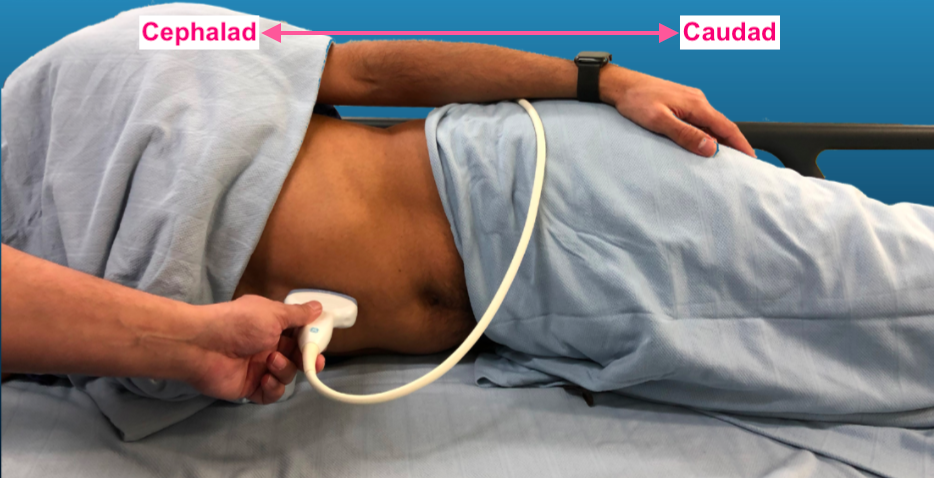
Point-of-care gastric ultrasound is an emerging diagnostic tool that may provide qualitative and quantitative information on gastric content to help guide clinical decision-making, and determine, for example, the need to perform a Rapid Sequence Induction.
- A. An empty (Grade 0) gastric antrum with a thick muscularis propriae layer and no intraluminal content. This appearance is consistent with a low risk of pulmonary aspiration.
- B. Gastric antrum containing fluid with some air bubbles.
- C. Gastric antrum after recent ingestion of solids, with a ‘frosted glass’ appearance. The anterior antral wall is visible, but there are no clear structures seen deep to the anterior antral wall.
- D. Gastric antrum containing solids, with heterogeneous echogenicity representing different consistency of solids consumed. Note the thin, hypoechoic muscularis propriae compared to figure A.
A volume of < 1.5 ml kg–1 is consistent with baseline gastric secretions (Grade 1), while a volume of > 1.5 ml kg–1 is associated with a volume that is greater than baseline secretions (Grade 2). A Grade 1 antrum is associated with a lower risk of pulmonary aspiration, while a Grade 2 antrum or any thick fluids, is associated with a higher risk of pulmonary aspiration.
 Pulmonary aspiration risk stratification with point-of-care gastric ultrasound
Point-of-care gastric ultrasound is readily learned, carries a high sensitivity and specificity, and has been shown to modify anaesthetic management. Armed with information of the true content of the gastric antrum, clinicians may make more informed decisions on the safety of anaesthetic interventions.
Recommended reading
- Gagey AC, de Queiroz Siqueira M, Monard C, et al. The effect of pre-operative gastric ultrasound examination on the choice of general anaesthetic induction technique for non-elective paediatric surgery. A prospective cohort study. Anaesthesia 2018; 73: 304–12
- Van De Putte P, Perlas A. Ultrasound assessment of gastric content and volume. Br J Anaesth 2014; 113: 12–22
- Kruisselbrink R, Gharapetian A, Chaparro LE, et al. Diagnostic Accuracy of Point-of-Care Gastric Ultrasound. Anesth Analg 2019; 128: 89–95
- Dupont G, Gavory J, Lambert P, et al. Ultrasonographic gastric volume before unplanned surgery. Anaesthesia 2017; 72: 1112–6
- Perlas A, Mitsakakis N, Liu L, et al. Validation of a mathematical model for ultrasound assessment of gastric volume by gastroscopic examination. Anesth Analg 2013; 116: 357–63
- El-Boghdadly K, Wojcikiewicz T, Perlas A. Perioperative point-of-care gastric ultrasound. BJA Educ 2019; 19(7): 219–226