
A global issue
Obesity has reached epidemic proportions globally, with at least 2.8 million people dying each year from being overweight or obese.
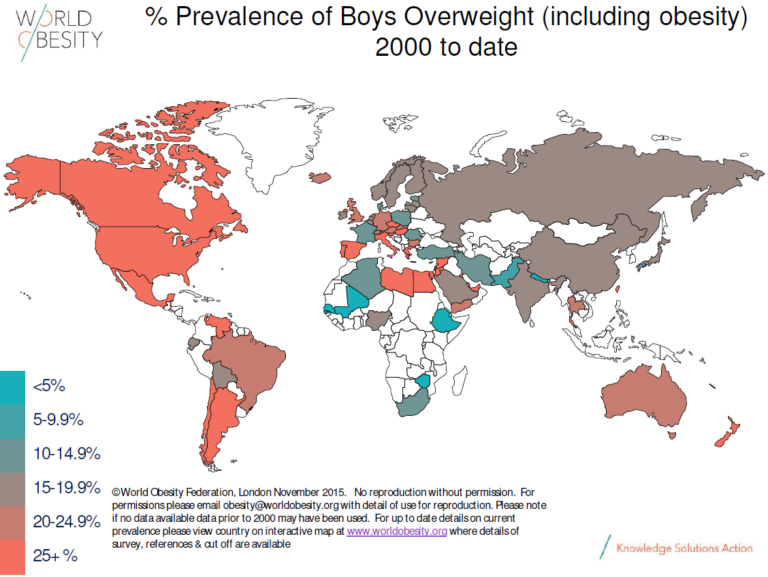
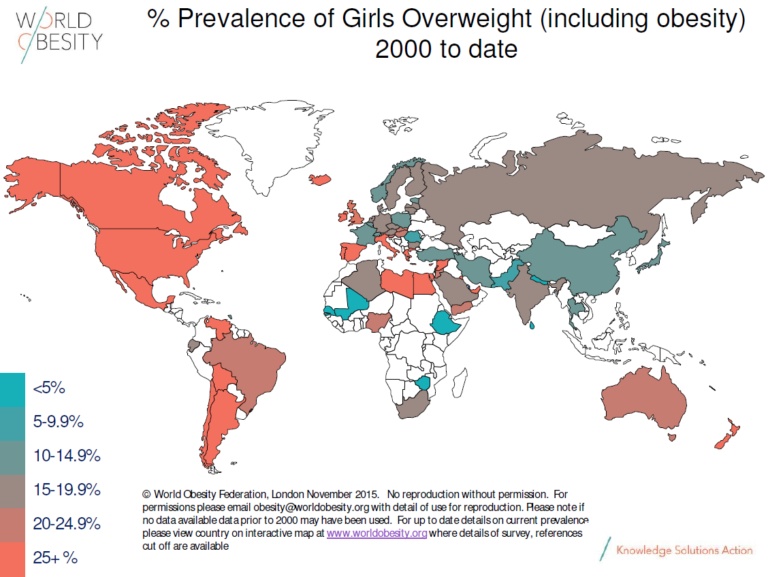
For interactive versions of these maps and other maps related to global impact of obesity visit the Obesity World Map from the World Obesity website.
The cause
The main cause of people being overweight and obese is a “caloric imbalance”—too few calories expended for the amount of calories consumed—which is affected by various genetic, behavioural, and environmental factors.
Global trends
Over the past decades, changes in lifestyles that have occurred in many countries have led to changes in dietary intake, physical activity and sleep patterns. These changes are often the result of environmental and societal changes associated with economic development and with a lack of supportive policies in sectors such as health, agriculture, transport, urban planning, environment, food processing, distribution, marketing, and education.
More information about how trends have changed over time can be found on the World Obesity website.
Increased intake of processed foods and decreased physical activity?
Globally, there has been an increased intake of energy-dense foods that are rich in sugars and fat, but low in vitamins, minerals and other healthy micronutrients. This increase has occurred alongside an increase in the accessibility and variety of ultra-processed foods and the marketing of such foods. At the same time, current global trends show a decrease in physical activity. This is likely due to the increasingly sedentary nature of many forms of work, study, leisure time activities, changing modes of transportation, and increasing urbanisation.
Sleep and screen time?
Sleep is also another element to consider in this energy balance equation, as studies show that insufficient sleep is associated with many chronic diseases, including obesity. We will be learning more about this in week 4. Likewise, children’s use of electronic media or “screen time” should also be considered because these are extremely common behaviours that can affect both sides of the energy balance equation, by reducing physical activity related energy expenditure and increasing consumption of energy dense, non-core foods (largely through exposure to advertising), and impairing healthy patterns of sleep. We will explore the impacts of screen time more in week 3.
Preventing Childhood Obesity: an Early Start to Healthy Living


Preventing Childhood Obesity: an Early Start to Healthy Living





