
When climate change meets pollution: understanding Vibrio risks
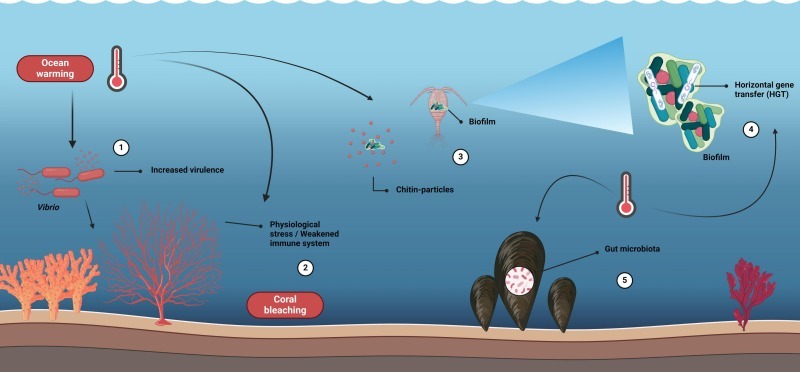
You’ve just seen how climate change can create more favourable conditions for Vibrio. But climate is only one part of a much bigger picture. Pollution, environmental change and the health of the host can interact in ways that influence how Vibrio survives, spreads and causes infection.
Coastal environments are under growing pressure from climate change and human activity. Rising temperatures, changing rainfall, sea-level rise and extreme weather can alter coastal conditions, while pollutants from sources such as wastewater, agriculture and other human activities can create additional pressures. Together, these changes can influence the behaviour and distribution of Vibrio bacteria.
So, what happens when these pressures come together?
A recent BlueAdapt review brings together evidence from around 120 peer-reviewed studies to explore how climate change and pollution interact to influence Vibrio infection dynamics. Rather than looking at the problem from just one perspective, the review brings together environmental microbiology, microbial ecology, epidemiology, infectious disease ecology, climate science and ecotoxicology.
Four ways the risks can change
The review identifies four important mechanisms through which climate change and pollution can influence Vibrio infections:
1. Vibrio can become more abundant and widespread
Changes in environmental conditions can create more favourable conditions for Vibrio growth and distribution, increasing opportunities for exposure.
2. Vibrio can become more virulent
Environmental pressures can influence characteristics linked to the ability of Vibrio to cause disease, potentially increasing the severity of infections.
3. Antimicrobial resistance can become part of the picture
Pollutants such as antibiotics can enter coastal waters and create conditions that favour the development and spread of antimicrobial resistance. The review also highlights the role of horizontal gene transfer in the movement of resistance and virulence genes.
4. The health of the host matters too
Exposure to Vibrio does not automatically lead to the same outcome for everyone. The review highlights how environmental pressures can affect the immune system and gut microbiome of hosts, potentially changing their susceptibility to infection.
Seeing the bigger picture
One of the most interesting aspects of the review is the way these connections are brought together using the DPSEEA framework: Driving Force, Pressure, State, Exposure, Effect and Action.
The framework helps show how climate change and pollution can drive changes in the coastal environment, alter the state of Vibrio and its hosts, influence exposure, and ultimately affect health outcomes. The authors also add “host health status” to the traditional framework, recognising that susceptibility is an important part of infectious disease dynamics.
This way of looking at the problem also helps identify where action can make a difference. The review highlights measures ranging from climate change mitigation and pollution prevention to improved wastewater treatment, antimicrobial stewardship, environmental monitoring and early-warning systems.
Why is this useful?
The key message is that Vibrio risk cannot be understood by looking at climate, pollution, pathogens or people in isolation.
The different pieces are connected. Understanding these connections can help researchers, public health professionals, environmental managers and policymakers identify opportunities to reduce risks before they become outbreaks.
Want to go further?
Read the full publication: A review on the effects of climate change and pollution on Vibrio infection dynamics
Explore more BlueAdapt publications to discover the research underpinning the project.
Climate Change, Coastal Waters and Health: Risks and Solutions

Climate Change, Coastal Waters and Health: Risks and Solutions





