
Introduction to depressions
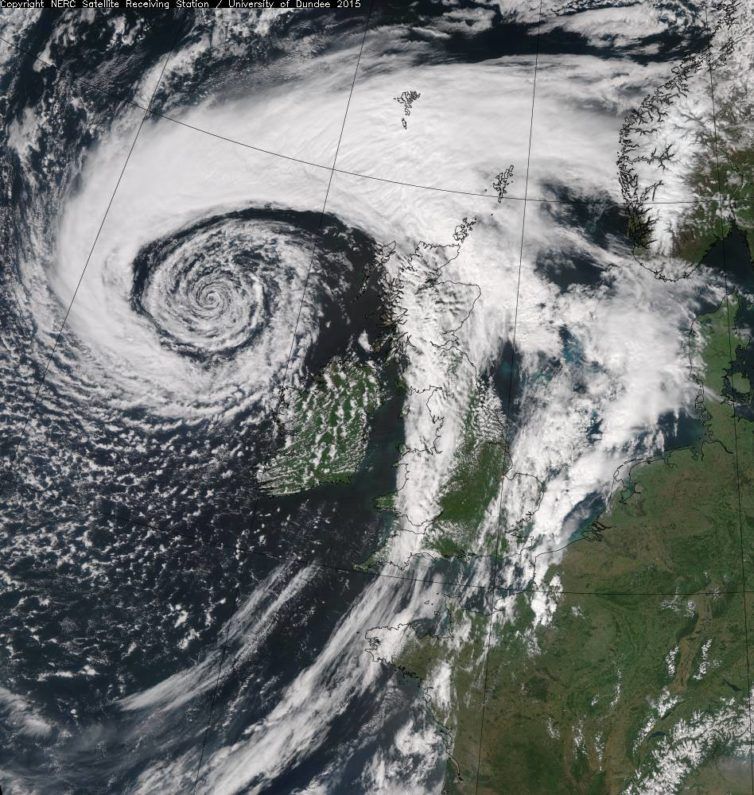
Mid-latitude depressions, extra-tropical storms, cyclones (at mid-latitudes) or low pressure systems are all different names for the same thing. They all refer to the storms which bring the UK most of its weather, particularly in the autumn and winter. But what are they, how do they form in mid-latitudes, and why do they cause weather?
These storms typically last several days, are a few hundred kilometres in size and travel approximately eastwards across the North Atlantic. They are characterised by a swathe of cloud the same scale as the UK, and when shown on a weather map (also known as a synoptic chart), are distinguished by low pressure in the middle and distinctive fronts. They bring us both our ‘normal’ and our ‘extreme’ weather.
Figure 1: A weather map or synoptic chart showing a typical mid-latitude depression approaching the UK. © Crown Copyright, Met Office
The pole-to-equator temperature gradient
Figure 2: The pole-to-equator temperature gradient © Crown Copyright, Met Office
Figure 3: A graph showing how the amount of energy the Earth receives from the Sun (blue line) and the amount of energy the Earth loses to space (red line) varies with latitude. If the blue line is above the red line, the Earth is getting more energy than it is losing at that latitude. If the red line is higher, the Earth is losing more energy than it is getting.
Figure 4: A map of average December temperature of the atmosphere about 1.5km above the ground. © NOAA-ESRL Physical Sciences Division, Boulder Colorado. Data source NCEP/NCAR Reanalysis 1: Summary
The Bergen meteorologists realised this temperature gradient was a key part of the formation of weather systems. They saw the mid-latitudes as being where the warm, tropical air met and ‘fought’ the cold, Polar air. They were working at a time when fronts were very much part of people’s vocabulary, they referred to the temperature gradient as ‘the Polar front’; a boundary separating competing warm tropical air from colder air near the pole.
We’ll discover in the next article why depressions form on this polar front.
Come Rain or Shine: Understanding the Weather

Come Rain or Shine: Understanding the Weather





