
Words that minimise harm

The previous step highlighted a different side to language use around pregnancy loss; specifically, the question of how language is used in mass communication. In this context, the strategies discussed in the previous section of the course are unlikely to be applicable, since the audience for these documents is vast and will possess a range of experiences, preferences and potential triggers.
This step sets out a separate set of recommendations for words and phrases which limit the potential negative impact that language can have in this context. These recommendations are based on the empirical evidence gathered through analysis of the SuPPL “acceptability” survey responses discussed in Week 1.
Words to avoid, with clear alternatives
As we saw in step 1.10, some words and phrases that participants were asked to rate in the survey were rated “unacceptable” by a clear majority, while others were rated “acceptable” by a clear majority. For some terms, the consensus was less clear. Even in these cases, it is often possible to identify an existing alternative term which was felt to be acceptable by a higher majority of respondents (for example, as was the case for baby over fetus). We can therefore say that the following words and phrases are best avoided wherever possible in mass communication contexts, and can recommend evidence-based alternatives. While these alternatives will affect those who have experienced pregnancy loss differently, by aiming to reduce this impact they might be considered “safer” choices.
Words lacking a clear alternative
Unfortunately, for some terms, including some rated “unacceptable” by a very high consensus in our data, there is not yet an obvious alternative or equivalent term in use. Avoiding these phrases is therefore more difficult. In these cases, while an evidence-based alternative is not available, we can nonetheless suggest alternatives extrapolated from discussions with lived experience participants and healthcare professionals.
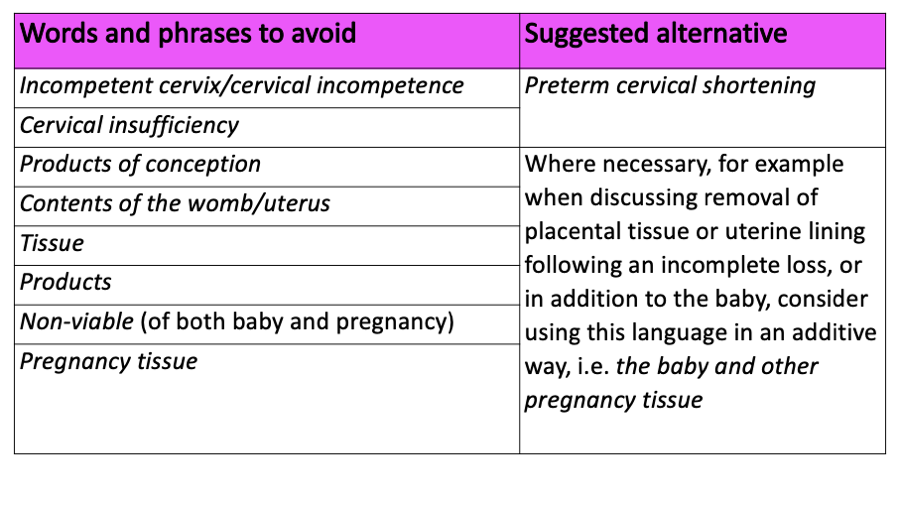
Though made with mass communication contexts in mind, these recommendations and suggestions offer a starting point for optimising language in any context where pregnancy loss language cannot be individualised. Working with people with lived experience of pregnancy loss to develop and check any materials offers another way of minimising harm in such contexts. And, of course, it is still important to remember that these recommendations do not resolve the issues we have seen throughout this course. The need for awareness of individual language needs in the context of care remains as strong as ever.
Share your thoughts
In the comments below, share your thoughts on what you have read:
1. How useful do you find these recommended and suggested alternatives?
2. Can you see any issues with these substitutions?
Effective Communication for Pregnancy Loss Care


Effective Communication for Pregnancy Loss Care





