
Achieving Business Impact with Data
For Chief Data Officers to achieve business impact, they need to use the insights value chain, which has the two key components.
- Technical value—eg data, analytics (algorithms and technical talent), and IT.
- Business value—eg people (non-technical) and processes.
(Remember: Value is possible only when we use smart algorithms to extract high-quality, meaningful data.)
The list below further breaks down the key components listed above into seven key considerations:
- Data
The process of collecting, linking, and enriching internal information, as well as security and privacy.
- Analytics
Analytics here includes (1) a set of digital methodologies (e.g. software and systems that are deployed to extract insights from data), and (2) talent such as data scientists and data engineers who have the knowledge and capability to apply these methods.
- Information Technology (IT)
IT includes technical capabilities that enable the storing and processing of data such as data lakes.
- People
This includes the people needed to run analytics operations that turn data into insights and successfully implementing those insights across the business. The critical success factor here is the ability to translate analytics and data-driven insights into business implications and actions.
- Processes
Processes should deliver results that scale. Old processes might need to be re-designed, while others need to become more ‘agile’.
- Strategy and Vision
Data analytics should be carried out in fulfillment of the organisation’s vision and in support of the overall business strategy.
- Operating Model
Operating models refer to core business matters that need to be addressed. This includes where data analysts would sit within the organisation, and how the model will function and interact within the business (be it centralised, decentralised or hybrid).
The Insights Value Chain
Now that you understand the key components of the insights value chain, consider the following visualisation of the entire domain:
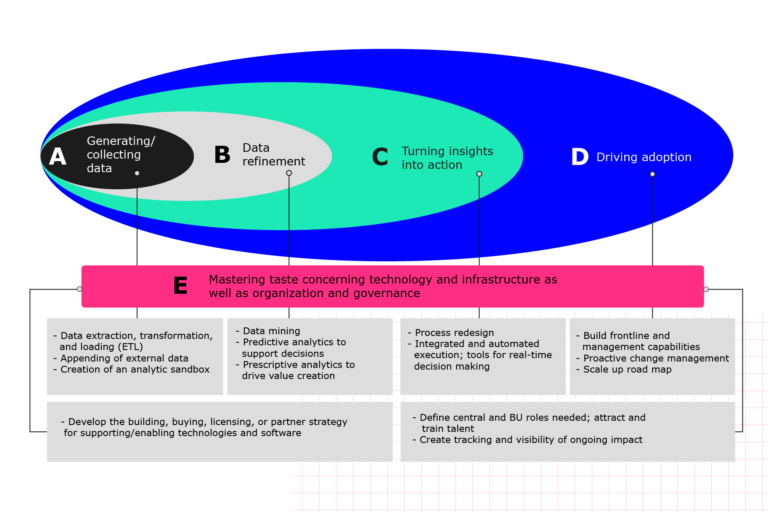
Source: McKinsey [1]
Notice that there are upstream processes, namely generating/collecting data and data refinement, downstream activities (eg driving adoption), as well as measuring tasks concerning technology and infrastructure as well as organisation and governance.
Capturing value from data requires operational excellence in all components of the insights value chain. Why? Because the chain is only as good as its weakest component (i.e. the insights value chain is multiplicative); the integrity of the chain matters.
It’s important not to lose sight of the fact that the insights value chain is about achieving insight to fit the purposes of the business, which occurs when an initiative creates an output that is:
- fit-for-the-business
- fit-for-purpose
- can be measured in commercial terms
- deployed, integrated and used
- creates commercial value.
Those are the desired outputs, but what should be the focus? Three categories stand out:
- Top-line use cases: Helps companies improve customer-facing activities. These use cases can improve activities in the areas of pricing, churn prevention, cross- and upselling, and promotion and optimisation to drive growth.
- Bottom-line use cases: Employs data-driven insights to optimise internal processes. Supply chain optimisation and fraud prevention are some of the processes that can be improved with the use of data analytics.
- New business models: Focuses on expanding a company’s portfolio of offerings. This can include straightforward selling of data, selling insights generated from data, offering new products, or providing analytics as a service.
It’s important not to lose sight of the fact that the insights value chain is about achieving insight to fit the purposes of the business, which occurs when an initiative creates an output that is:
Challenges and Looking Ahead
Perhaps you have already been imagining all the challenges that can emerge as businesses and change agents work towards delivering actionable value. From ensuring data quality up to creating a collaborative, data-driven organisation, there will be significant challenges that, to the best of your ability, will need to be mapped in advance and navigated (this is another place with decision trees can be incredibly useful).
In terms of the challenges around capturing value in data insights, there is always the risk of separating the data and the business; a risk, in other words, that there will be a gap between what is possible from a data science capability versus the development of solutions that fit the business needs. The transition from insight into insight-based value creation is also at risk of not being fully and properly considered. Perhaps the most critical challenge is the lack of proper anchoring of data analytics competence at a senior leadership level. There’s no way around it: commitment leadership and direction are required to drive insights-oriented transformations.
To conclude, and with the expectation that formidable challenges will emerge as we aim to deliverable actionable value, let’s note some of ways medium to long term strategic actions can help translate insights into action:
- Data forward-thinking: First identify the business problems you believe in and then determine the models and data you require to operationalise them.
- Prioritise the three top use cases: Focus on the ones that generate the most business impact.
- Build basic IT in an agile way.
- Hire the correct talent, which should include those with data analytic capabilities (i.e. data scientists).
- Set yourself up for scale to build a central analytics team and provide up to date training to build capabilities.
Now reflect on your own experiences around data and organisational culture. What were some of the challenges you witnessed as a business tried to make the shift to an analytics culture?
Share your thoughts in the comments.
References
- Achieving business impact with data. [Internet]. McKinsey, 2018. Available from: https://www.mckinsey.com/business-functions/mckinsey-analytics/our-insights/achieving-business-impact-with-data
Financial Analysis for Business Performance: Data-Driven Decision Making


Financial Analysis for Business Performance: Data-Driven Decision Making





