Ethics of Human Skeletal Analysis
Ethical Considerations
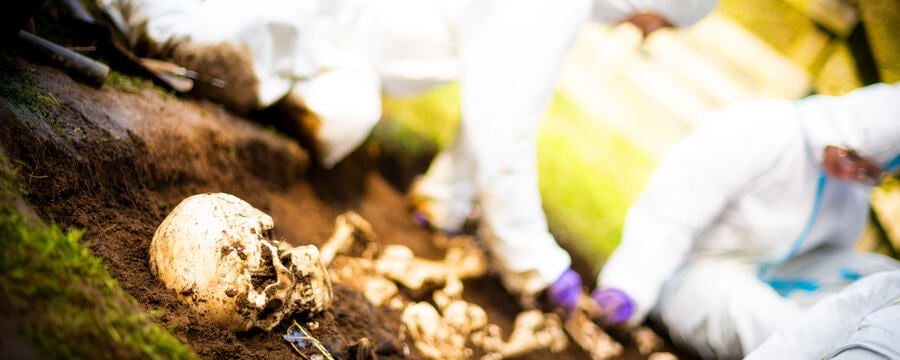
Human bones are the remains of once-living people and they require ethical and legal consideration above and beyond other forms of archaeological and forensic evidence. Human remains should always be treated with care and respect. The analysis of real human bones is essential to teaching because humans express skeletal traits in a variety of subtly different ways.
Many of our methods and techniques rely on a good understanding of human skeletal development and variation. In order to learn human osteology effectively, we believe that it is essential that students are exposed to large numbers of skeletons, ideally from a range of different contexts and different degrees of preservation. This is why we have included real bones in the images, models and videos in this course.
Different countries have different laws concerning the storage and handling of human remains. In the UK, we have the Human Tissue Act which determines how we can use human remains in our studies. Human skeletons over 100 years old are not included in this Act, which is why many forensic students learn using archaeological skeletons. In the US, the Native American Graves Protection and Repatriation Act is significant because the collection and storage of the skeletal remains of indigenous peoples is regarded as a form of structural violence against a marginalised group. Legal and ethical considerations regarding the curation and analysis of human skeletal remains vary by country and are grounded in specific historical and political contexts.
It is important when analysing skeletons in practice to adhere to professional codes of ethics and standards. In the UK, bioarchaeologists follow the Code of Ethics and Code of Practice outlined by the British Association for Biological Anthropology and Osteoarchaeology. The American Academy of Forensic Sciences and the American Association of Physical Anthropologists also have guidance and recommendations regarding ethical practice. This is particularly important when undertaking destructive analysis, such as biomolecular studies (see Week 5). Ethical guidelines for destructive analysis are available.
This course contains many images, videos and interactive 3D models of human bones to help your learning. The vast majority of the bones included here are from archaeological contexts in the UK. Those with the copyright ICRC derive from forensic contexts from a variety of countries.
Recently there has been a lot of discussion about the ethics surrounding the use of photographs and 3D models of human skeletal remains. Much of the concern focuses on issues of consent and ‘ownership’. Do the images and 3D models have the same rights as the actual remains?
This course does not include any images of fleshed or decomposing bodies. However, the external links that we have included in this course may do. We cannot guarantee that external sites will not show fleshed or decomposing bodies and we take no responsibility for the content of those websites.
If students find images of human remains offensive or triggering then please be careful when accessing external materials as they could contain images that some may find distressing.
Recommended Further Reading
(NB these are not essential for this course, but if you’re a student wishing to learn more then see if your library has them)
Passalacqua, N.V. and Pilloud, M. A. 2018. Ethics and Professionalism in Forensic Anthropology. Academic Press.
Squires, K., Errickson, D., Márquez-Grant, N. 2019. Ethical Approaches to Human Remains. A Global Challenge in Bioarchaeology and Forensic Anthropology. Springer.