
Mainstreaming awareness

Celebrities, philanthropists, corporations and governments all seem to be placing a high priority on gender issues.
We have seen wars fought in the name of women’s rights, campaigns against governments that ban homosexuality, and celebrities travelling across the world to speak up in favour of women’s rights.
But is this a step forward for the field of gender and development? Has it been a success? Is it a good thing that gender and development issues have gone mainstream?
This UN Office of the Special Adviser on Gender Issues report presents mainstreaming as a major and positive strategy to achieve gender equity, but does it effect meaningful change?
Clickbait: where’s the harm?
Celebrities have been crucial to giving gender issues a higher profile, because gender and development is not often an issue that makes the front pages of newspapers, nor is it an issue that goes viral on social media, without celebrity clickbait value.
However, some activists and academics argue that celebrity activists are not adding any value and may actually do more harm than good (Brean 2013; Easterly 2010; Easterly 2011).
At the heart of these objections is the claim that celebrities present themselves as development experts suggesting short term rather than strategic solutions to development problems.
An even sterner claim is that the celebrity publicity creates a sense that something is being “done” and this absolves citizens of their responsibilities to critically consider their role in global inequalities.
Your task
Watch some of these videos in this YouTube playlist and reflect on how you feel about celebrities speaking up about gender and development issues.
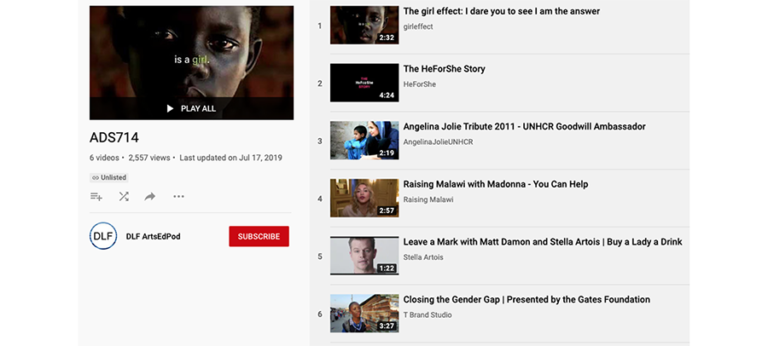
Select the image and open the YouTube playlist
What do you make of the current spate of celebrities promoting gender equity in mainstream media? What are the benefits and what are the risks?
Discuss your ideas (curiously, constructively and compassionately) with other learners in the comments.
References
Office of the Special Adviser on Gender Issues Department of Economic and Social Affairs United Nations 2002, Gender Mainstreaming An Overview, United Nations, retrieved 11 June 2019.
Brean, J. 2013, The spectacle of charity: A York professor’s new book accuses stars of ‘humanitainment, National Post, Canada, Jan 17, accessed 11 June 2019.
Easterly, W. 2010, John Lennon vs. Bono: The death of the celebrity activist, washingtonpost.com, Dec 10, accessed 11 June 2019. .
Easterly, W. 2011, Who is the Target Audience for Celebrity Aid Campaigns?, HuffPost, 25 May, accessed 11 June 2019.





