
Making your research inclusive – disabilities and impairments
In this video, user researchers discuss the importance of inclusive research.
Why is inclusive research important?
Making a service inclusive and accessible to everyone must start with inclusive research. You need to learn about all users.
Users come from all sorts of demographics and people have different needs and requirements that must be met. When building digital services, it is important that you include disabled users and those who need support to use your service.
Under the Equality Act 2010, there is a legal requirement to make services accessible and there not discriminate against anyone for any reason, but there is also a moral requirement – including people is simply the right thing to do.
Making your research sessions inclusive will help you to:
- understand how people with different needs or abilities might use your service, as well as the barriers they face
- refine your design, functionality and content based on how different kinds of users experience them
- meet government accessibility requirements
And you must actively include people in your research who:
- have a disability and/or access need
- need support to use your service, including those who do not use your digital service and need a non-digital alternative
Everyone needs to use government services – it is vital for user researchers to know about different types of disability, impairments, access needs and barriers so that we can design services that are accessible to everyone.
Disabilities and impairments
Disabilities or impairments can affect sight; hearing; touch or mobility; and voice or understanding. For some people, these are permanent, but people can also have impairments that are temporary or situational.
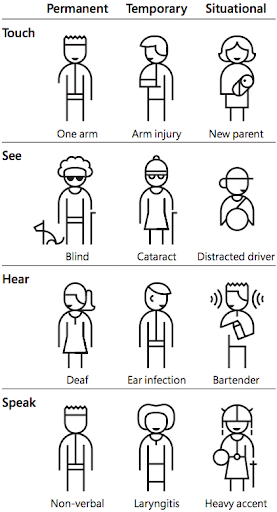
A permanent disability or impairment is something that cannot be changed, either due to someone being born with it or sustaining an injury or chronic illness that has caused it.
A temporary disability or impairment is something perhaps caused by an injury or illness that is not permanent, as the person will only be affected during the time it takes them to recover.
A situational impairment occurs when the environment makes it difficult to see, hear or communicate in some way.
Let’s explore some examples.
Touch and mobility
A permanent impairment of touch or mobility would be someone with only one arm or leg. A temporary impairment would be an injury that requires someone to have their arm in a plaster cast and a sling, while a situational impairment could be a new parent holding their child in their arms, which would make it difficult to perform other manual tasks.
Sight
Some people are permanently blind or have very limited vision, while some people could have an infection or a condition such as cataracts that can be resolved with time or medical intervention. A situational impairment to sight would be a distracted driver taking their eyes off the road in front of them.
Hearing
Some people are permanently deaf or have a permanent condition such as tinnitus or hearing loss, while others can have temporary conditions that would affect their hearing, such as an infection or a build-up of earwax. A situational impairment to hearing could occur in a very noisy bar or restaurant, where it is simply too loud to hear someone speak.
Speech and communication
Some people are permanently non-verbal, while others may suffer from temporary conditions or infections that affect their ability to speak, such as a transient ischaemic attack (TIA). A situational impairment relating to speech and communication could be someone talking in a heavy accent – this is not a real barrier to communicating, but may require more effort than in a usual interaction to understand what the person is saying.
It is vital that user research takes all of these possibilities into account so that there are no barriers to people accessing government services.
In the next step, we will learn more about inclusive research and access needs.
Task
Take a moment to reflect on your current or previous roles. If you have worked with someone with a disability or impairment, or if you yourself have one, what accessibility measures were in place – or should have been in place? Would this have made the situation different?
Reminder: as this is a potentially sensitive topic, please only engage in the conversation if you feel comfortable, and remain respectful to your fellow learners sharing their experiences.
User Research in Government: Getting Started


User Research in Government: Getting Started


