
Simple prompts to surface skills
Reflection is most effective when it moves beyond describing what happened and starts exploring decisions, actions, and evidence of capability.
The following prompts are designed for common higher education learning experiences, including work-integrated learning (WIL), capstone projects, group work, and reflective portfolios.
Each includes a simple scaffold to help learners get started and can be adapted to suit your discipline or context.
There is a downloadable version at the end of this article.
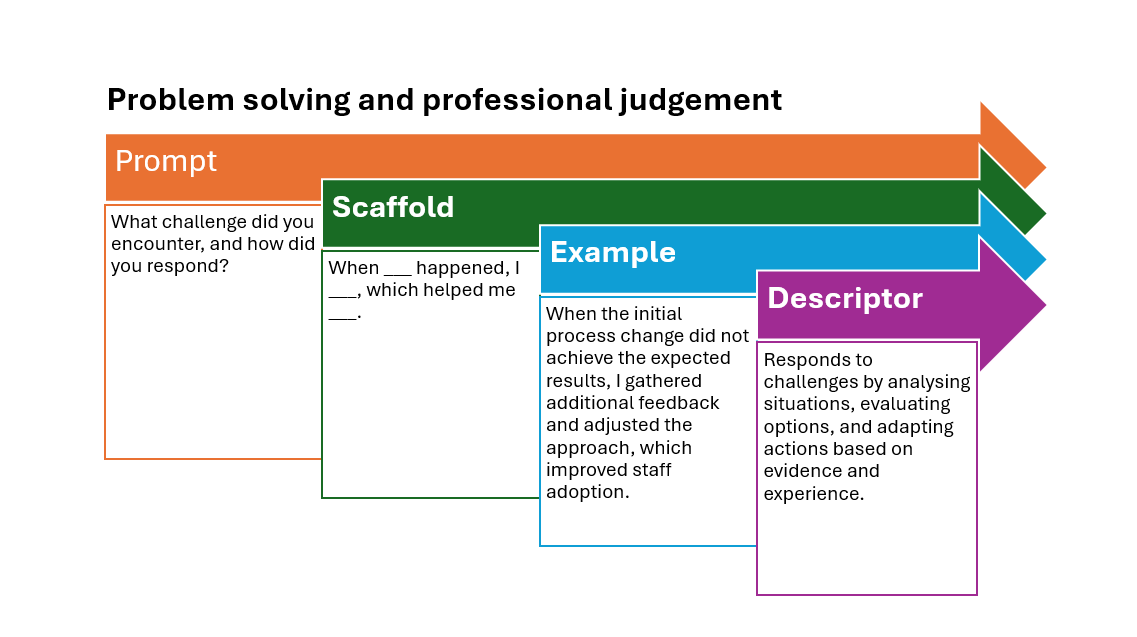
Skills: Problem solving and professional judgement
Prompt: What challenge did you encounter, and how did you respond?
This prompt helps learners focus on:
- identifying a challenge or obstacle
- explaining the decisions they made
- describing how they adjusted their approach
Scaffold: When __ happened, I __, which helped me ___.
Example: When the initial process change did not achieve the expected results, I gathered additional feedback and adjusted the approach, which improved staff adoption.
Descriptor: Responds to challenges by analysing situations, evaluating options, and adapting actions based on evidence and experience.
Skills: Critical thinking and decision making
Prompt: What options did you consider, and why did you choose one approach over another?
This prompt helps learners focus on:
- evaluating alternatives
- using evidence to support decisions
- explaining their reasoning
Scaffold: I chose to __ because __, which resulted in ___.
Example: I chose to prioritise patient education strategies because the evidence suggested they would have the greatest impact on long-term outcomes.
Descriptor: Evaluates evidence, weighs alternatives, and makes informed decisions.
Skills: Applying learning in practice (WIL and placements)
Prompt: How did you apply your learning in a real-world situation?
This prompt helps learners focus on:
- connecting theory and practice
- applying knowledge in authentic contexts
- recognising capability in action
Scaffold: I applied __ when __, which enabled me to ___.
Example: I applied communication techniques from the course when working with clients, which helped me adapt information to their needs.
Descriptor: Applies knowledge and skills effectively in professional and workplace contexts.
Skills: Collaboration and teamwork
Prompt: How did you contribute to the success of the group?
This prompt helps learners focus on:
- their role within the team
- responding to others’ ideas and feedback
- contributing to shared outcomes
Scaffold: I contributed by __, which helped the team __.
Example: I coordinated stakeholder feedback and helped the group prioritise actions, which improved the quality of our final recommendations.
Descriptor: Works effectively with others to achieve shared goals and outcomes.
Skills: Integrative learning (Capstone projects)
Prompt: How did you bring together knowledge, skills, or experiences from different areas?
This prompt helps learners focus on:
- making connections across subjects
- combining different types of knowledge
- applying learning in complex situations
Scaffold: I drew on __ and __ to ___.
Example: I drew on research skills from earlier subjects and workplace experience to develop practical recommendations for the project.
Descriptor: Integrates knowledge, skills, and experiences to address complex challenges.
Skills: Reflection and professional growth
Prompt: What have you learned about yourself as a learner or professional?
This prompt helps learners focus on:
- recognising growth
- identifying strengths and areas for development
- building professional identity
Scaffold: I realised that __, and I would like to continue developing __.
Example: I realised that I am confident analysing information but need more experience presenting recommendations to senior stakeholders.
Descriptor: Reflects on experiences to support ongoing learning and professional development.
Using these in practice
You do not need to introduce every prompt at once.
Many educators begin with a single reflection question linked to an assessment, placement activity, capstone project, or portfolio task. The scaffold can be used initially as a sentence starter and gradually removed as learners become more confident reflecting on their capability.
Over time, learners begin to move beyond describing what they completed and start recognising what they can do, how they developed it, and where they might apply it in future study, work, and professional contexts.
Lifelong Learning: Developing Transferable Skills in Higher Education


Lifelong Learning: Developing Transferable Skills in Higher Education





