
Making evidence useful
Making learning visible is important. But for it to be useful, it needs to do more than describe a learning activity or assessment. It needs to help someone else understand what a learner can do and how that capability might transfer into another context.
Useful evidence is not just helpful for reflection. It is what allows capability to be recognised and understood by others.
In higher education, this becomes increasingly important as learners move between subjects, placements, projects, portfolios, professional accreditation processes, and employment opportunities.
A lecturer, placement supervisor, career advisor, employer, or professional body may all need to interpret evidence of what a learner can actually do.
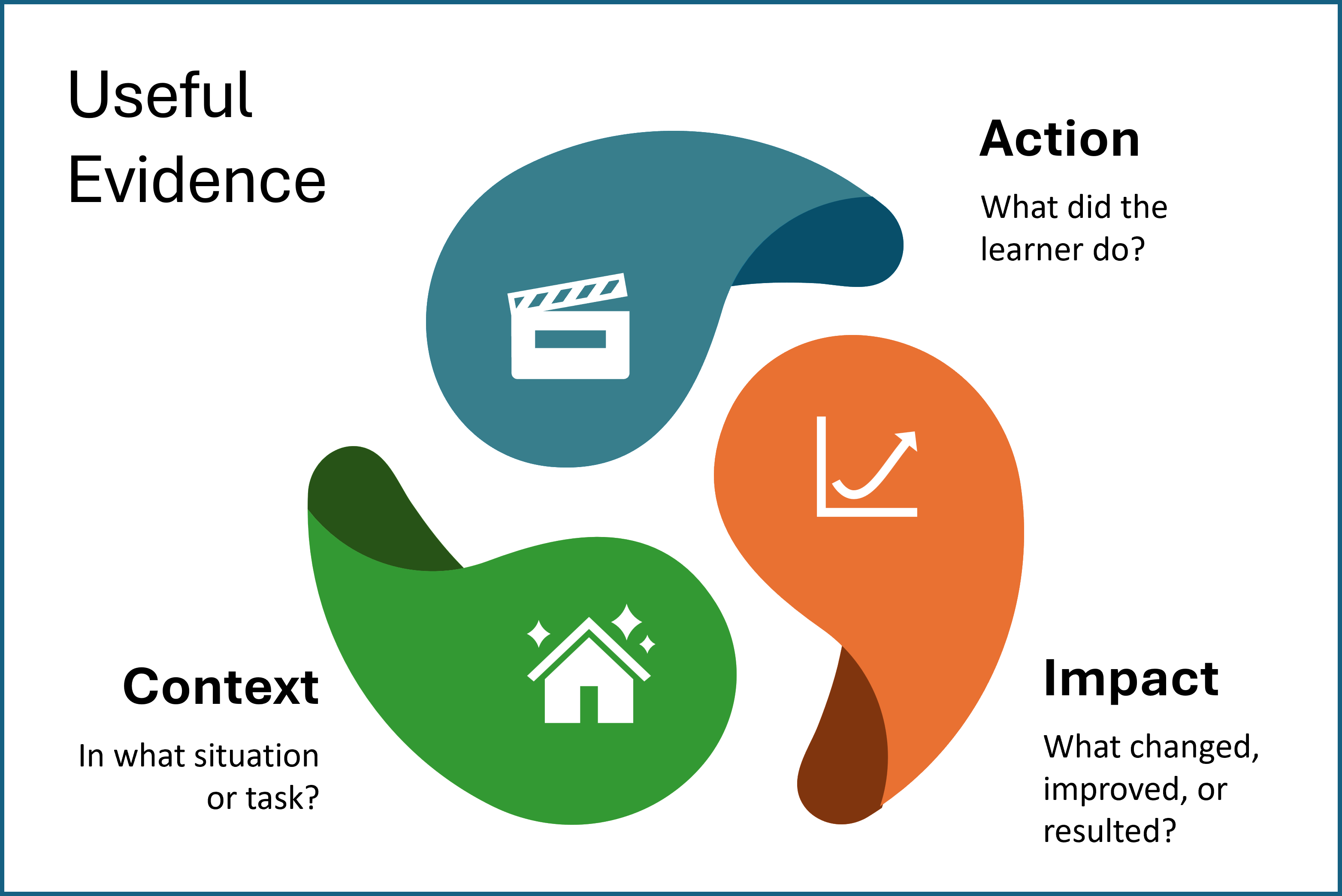
Useful evidence should at least, have these three elements:
- Action: What did the learner do?
- Context: In what situation, project, assessment, or workplace setting?
- Impact: What changed, improved, or resulted?
Hannah’s Note from Practice
When we built the digital credential for Innovation and Organisational Change, we made a deliberate choice not to rely on rich, descriptive skills statements. Instead, we leveraged the platform’s existing skills taxonomy, the standard tags and metadata it already supported. It seemed like a small decision at the time, but it taught us something important: technology can get in the way of good intentions.
A platform’s skills framework might not match the nuance of what you’re actually trying to credential, and if you’re not paying attention, the tool ends up shaping the message rather than the other way around. This is part of why skills literacy needs to be a practice at every level of Higher Education, not just in course design, but in how we evaluate and choose the platforms and systems we credential through. The infrastructure decisions you make early on quietly determine how well skills get represented later.
You can see this for yourself in the credential summary, the language doesn’t fully match the skills tags behind it, and that disconnect is worth acknowledging. Even so, it still prompts learners to stop and think about their skills, which matters more than getting the taxonomy perfect.
An Example from Daniel
I completed a workplace improvement project as part of my microcredential.
As part of a workplace improvement project, I analysed operational data and gathered feedback from staff to identify the causes of delays in stock movement. I tested alternative approaches and adjusted the process based on the evidence collected. The revised process reduced bottlenecks during peak periods and improved the consistency of stock movement across the warehouse.
More useful. This example provides enough detail for someone else to understand what Daniel did and what capability he demonstrated.
Which Is More Useful?
Marcus is reviewing examples from learners’ portfolios and reflections.
Rather than deciding whether they are “weak” or “strong”, consider:
- Which statements would be most useful to someone outside the course?
- Which ones provide clear evidence of what the learner can actually do?
- Which include detail, but still do not make capability visible? Why?
A. Maya participated in a group health promotion project, attended meetings regularly, and completed all of the tasks allocated to her by the team.
B. Maya worked with her team to develop a health promotion campaign, coordinated feedback from group members, and helped refine the final recommendations based on stakeholder input.
C. Maya kept detailed notes throughout the project, documented team discussions, and recorded the decisions made during each meeting.
D. Maya facilitated discussions when different viewpoints emerged, helped the team reach agreement on key recommendations, and contributed to the development of a final campaign proposal.
Which statements are most useful, and what makes them more useful?
Rewrite for Usefulness
Choose one of the less useful statements and rewrite it so that:
- it shows what the learner did and can do
- it includes some context
- it gives a sense of impact or change
Share Your Thoughts
Share your rewritten statement in the comments and explain why the original statement was less useful.
As you read other responses, consider:
- What evidence makes capability easier to recognise?
- What details help another person understand what the learner can do?
- How might this evidence be used in a portfolio, placement application, or employment context?
Lifelong Learning: Developing Transferable Skills in Higher Education


Lifelong Learning: Developing Transferable Skills in Higher Education





