Personal Protective Equipment for Healthcare Workers

Personal Protective Equipment (PPE) helps to protect staff from contracting the virus and therefore is central to both the wellbeing of staff and limiting the onward transmission of the virus to both other patients and colleagues.
The evidence for PPE is briefly considered on the Centre for Evidence-Based Medicine’s website.
The appropriate form of PPE varies depending upon the healthcare setting (as shown in this table on Public Health England website). The correct type of PPE must be used by the healthcare staff in specified settings and must be put on correctly (donning) and taken off (doffing) appropriately to minimise the risk of onward transmission.
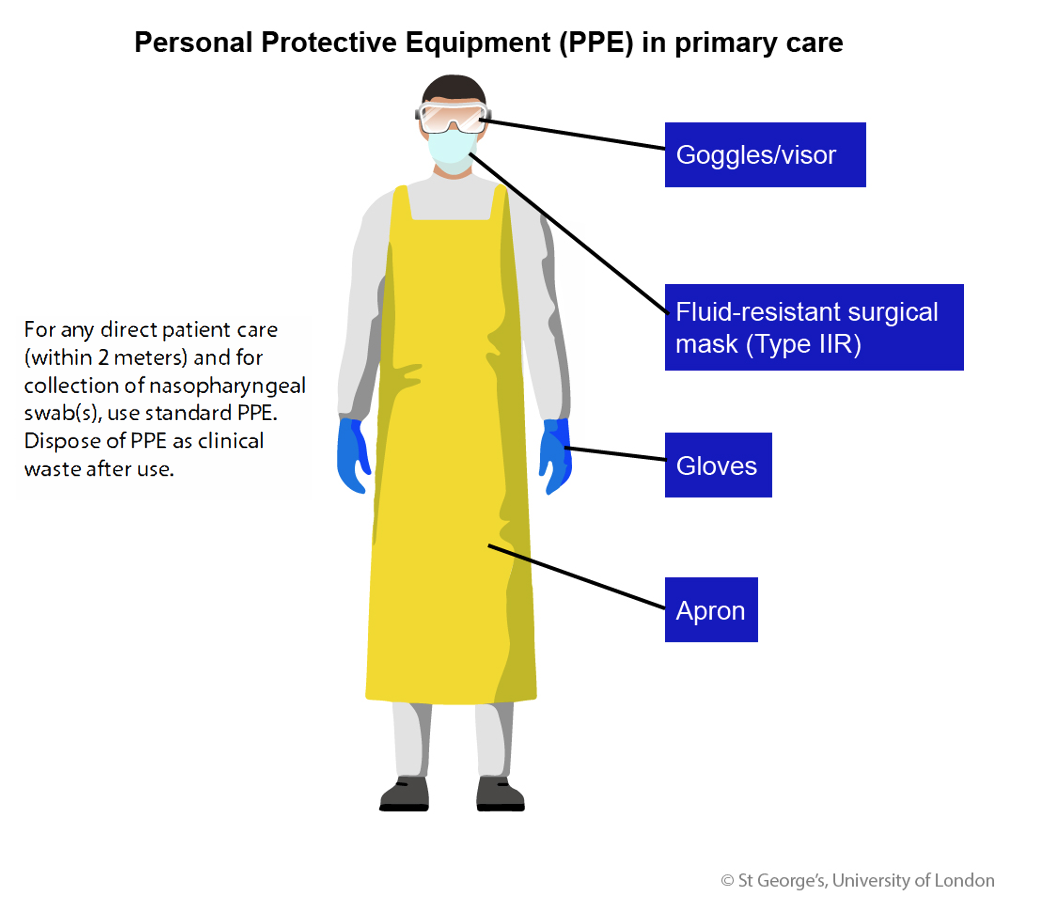
• For any direct care (within 2 meters) of possible or confirmed cases or for collection of the nasopharyngeal swab(s), wear protective clothing in line with the standard infection control precautions, such as gloves, apron, a fluid-resistant surgical mask (Type IIR) and goggles or visor, and keep exposure to a minimum.
• Subject to local risk assessment, PPE may also be indicated for work in settings where there is sustained transmission of covid-19.
• Aprons and gloves are for single use only. A fluid-resistant surgical mask (FRSM) and eye protection can be for single use or used for a full session. A session ends when the healthcare worker leaves the clinical care setting. A mask should be changed if it is moistened, damaged, or soiled. It should be noted that masks become less effective when moistened.
Below is an illustration of the standard PPE which should be worn by primary care staff for face-to-face contact (within 2 meters) with the patient.

Personal Protective Equipment (PPE) in primary care
Click to expand
© St George’s, University of London
Wearing PPE
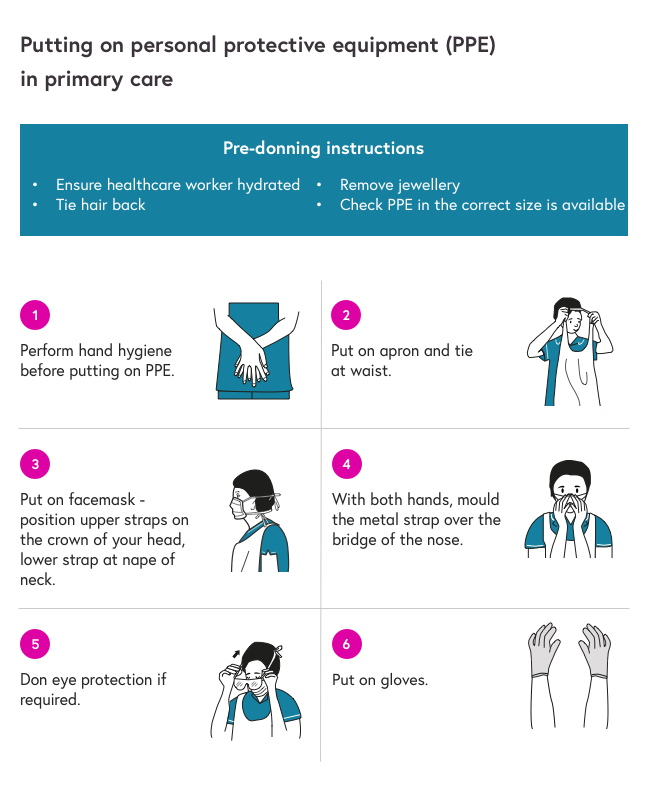
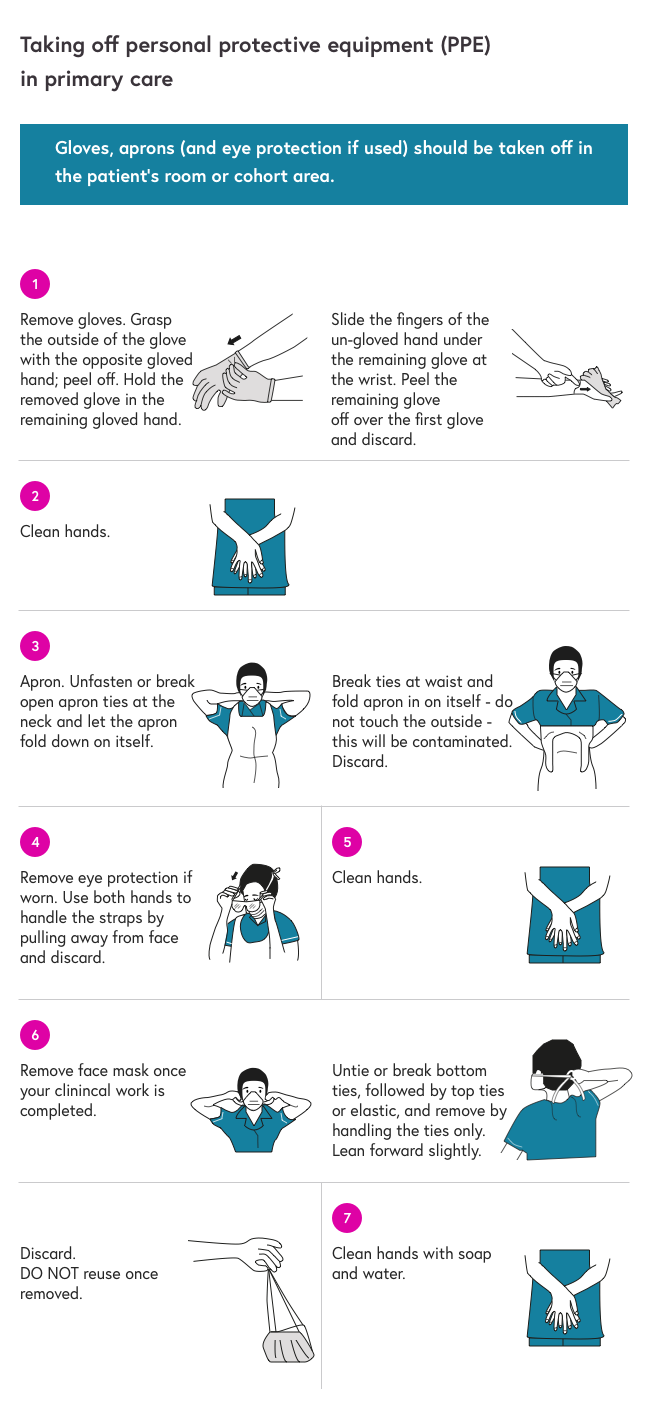
Healthcare staff should follow instructions to put the PPE on (donning) correctly and to remove (doffing) it appropriately. These instructions are based on the guidance from Public Health England.
The diagrams below show this correct procedure.
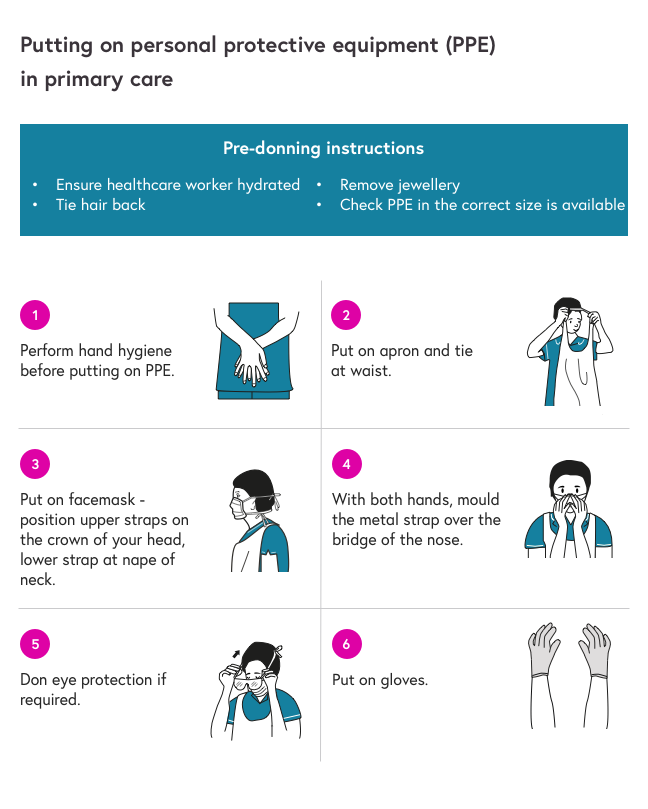
Putting on personal protective equipment (PPE) in primary care
Click to expand
© St George’s, University of London
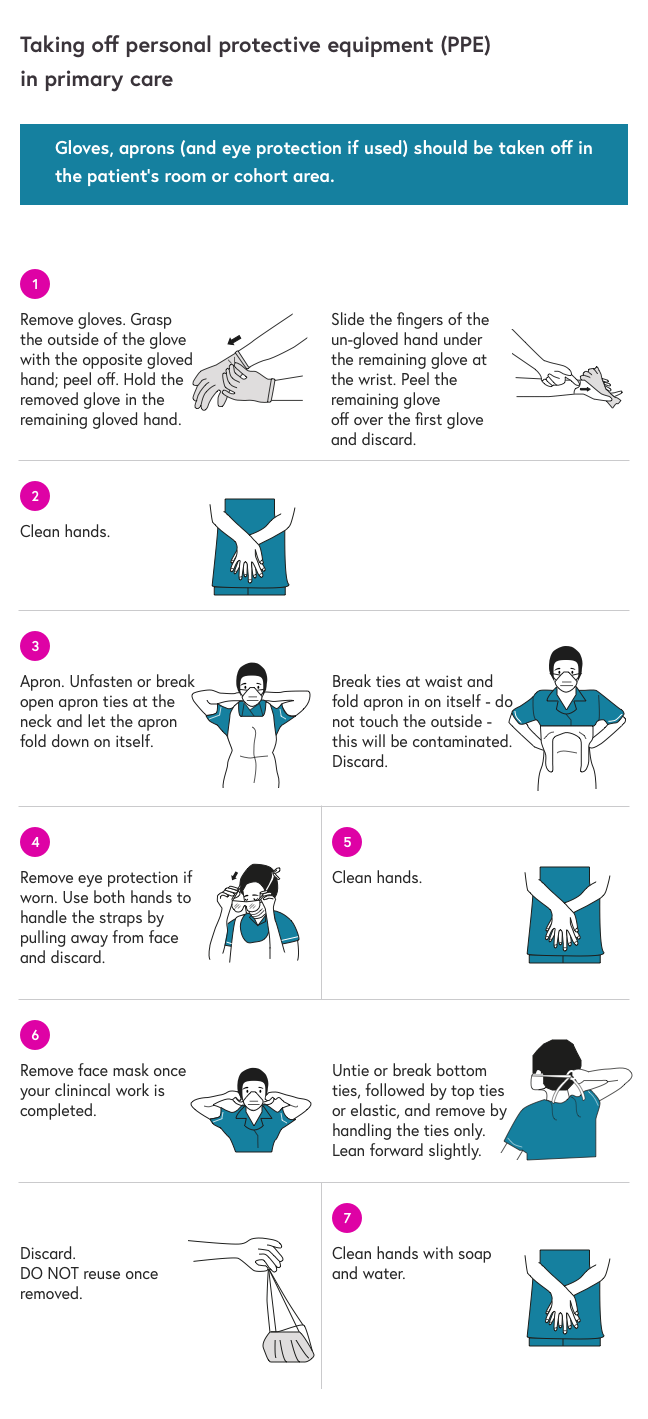
Taking off personal protective equipment (PPE) in primary care
Click to expand
© St George’s, University of London
Want to know more?
This short video from the Cambridge University Hospitals NHS Foundation Trust shows the procedures that should be used when wearing and removing PPE.
This is an additional video, hosted on YouTube.