
The lifecycle of process innovation
Innovation affects processes as well. Let’s explore this in more detail. We’ll start by focusing on the stages of the lifecycle of process innovation and then explore the emphasis that is placed on each of them.
The four stages of engaging with open process innovation
Ideation
The first stage, usually triggered when some performance gaps are identified, eg a process not being as efficient as it could be
Adoption
The second stage, which includes the activities related to facilitating and making investment decisions
Preparation
The third stage consists of those activities which help develop the technology and also activities that plan for the associated organisational change
Installation
The final stage – which includes activities involved in the implementation of the technology and the associated change
A key element in this lifecycle of implementation is that it combines both the implementation of technology and the associated organisational change. For instance, when an organisation is implementing a new invoicing system, it will not only need to change the technology, but also the procedures that employees are following to issue any invoices.
The lifecycle is ‘asymmetric’, which means that efforts to change are not uniformly spread across it. Early on there is an increased emphasis on the implementation of the new technology, for example, the new invoicing system.
This is then followed by the organisational and potentially cultural changes that are needed to make the new process work, for example changing the procedures to integrate the new invoicing system with the existing processes.
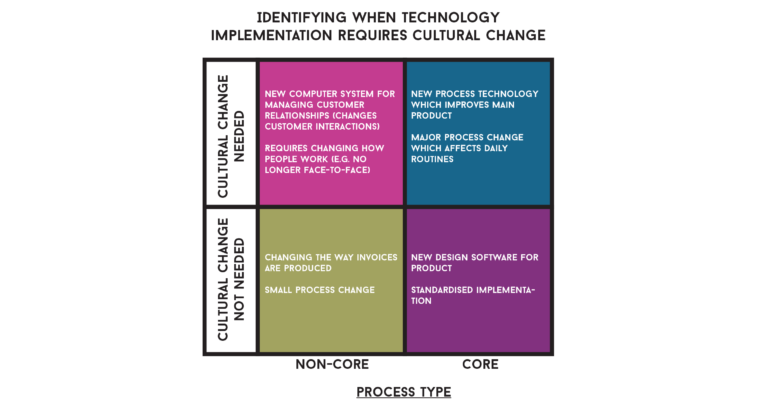 Diagram 1 (Click to expand)
Open innovation and lifecycle
In addition, there are some asymmetries in how organisations engage with open innovation across the lifecycle. This is likely to be different depending on whether the relevant process change is on a core part of the business or not. More specifically, when change is sought for non-essential parts of the business, acquisition and integration is seen more positively.
As a result, such parts of the business are more likely to benefit from ways of making processes more consistent, ie standardised. Conversely, the resistance to change as a consequence of ideas that result from engaging with open innovation is likely to be higher when the focus is on changing something that the business sees as important and close to its competitive advantage.
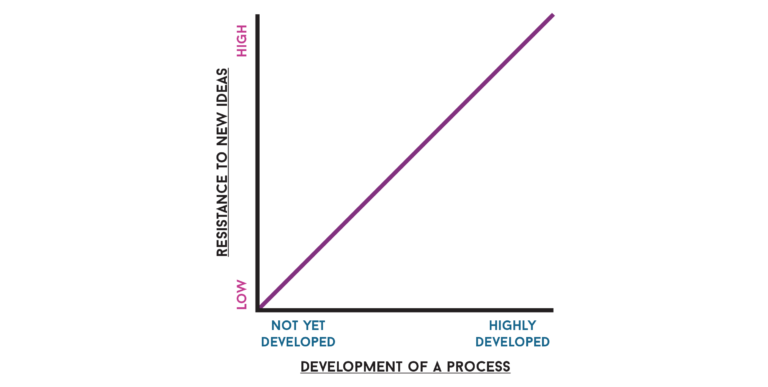 Diagram 2 (Click to expand)
In summary, their research (Milewski et al., 2015) suggests that early implementation of new technology is relatively easy, but that it becomes effective only when the more difficult organisational change is complete.
Similarly, externally acquired technology is more likely to be accepted and integrated when it is seen as non-essential to the core business. Therefore, continuing from the other research presented in this course, engaging with open innovation is likely to differ from one organisation to another while it is also likely to require a significant amount of time to develop.
Engaging with open innovation is a difficult process that requires time and an understanding of an organisation’s own processes.
Reference
Milewski, S., Fernandes, K.J. and Mount, M.P. (2015) ‘Exploring technological process innovation from a lifecycle perspective’, International Journal of Operations and Production Management, vol.35(9), pp.1312-1331. (http://www.emeraldinsight.com/doi/full/10.1108/IJOPM-02-2015-0105).
If you’d like to learn more about harnessing open innovation in business, check out the full online course from Durham University, below.





