Following a recognised approach
Over time, the approaches and the techniques used for successful and effective project management have become formalised. By the mid-20th century, project managers began the work of seeking recognition for project management as a profession. One aspect of this work involved obtaining agreement on the content of the Body of Knowledge (BOK) called project management. This BOK became known as the Project Management Body of Knowledge (PMBOK).
The Project Management Institute (PMI) produced a baseline of charts and glossaries for the PMBOK. Project managers soon realised that no single book could contain the entire PMBOK. Therefore, the PMI developed and published A Guide to the Project Management Body of Knowledge (PMI 2017).
The PMBOK and other approaches (for example, Prince2) are designed to ensure clarity, and a systematic, well-defined approach to managing projects – to avoid ambiguity. But why is ambiguity something to be avoided?
Your task
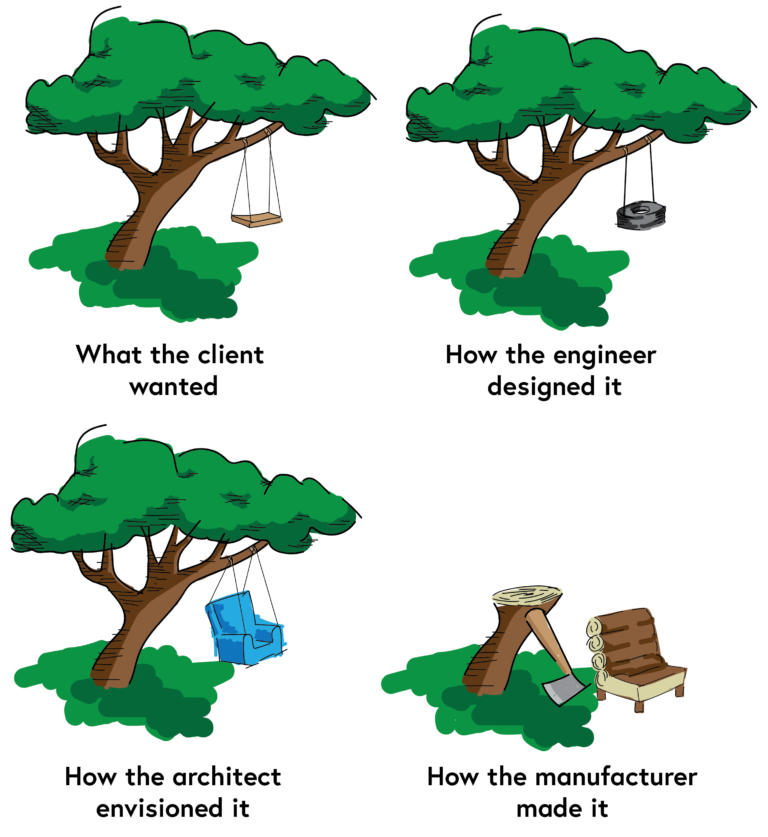
Within most companies, there are staff with different roles, ideas and expectations. Imagine you ask everyone in your company to design a swing. How different might their ideas be? The image below demonstrates this:Consider the picture above. Why do you think ambiguity is a problem in project management?Post your answer in the comments below.
References
Project Management Institute (2017) A Guide to the Project Management Body of Knowledge: PMBOK Guide. 6th edn. Newtown Square, Pennsylvania: Project Management Institute