This course is part of the Modern Full Stack Web Development with AI ExpertTrack
AI-Powered Backend Development with Node.js, Express, and MongoDB
Develop secure RESTful APIs, manage MongoDB databases, and implement authentication by using Claude Code for backend development.

Duration
3 weeksWeekly study
3 hours100% online
How it worksIncluded in an ExpertTrack
Course 3 of 4
AI-Powered Backend Development with Node.js, Express, and MongoDB
Power full stack applications with Node.js and MongoDB
A polished front end is only one half of a complete web application. On this course, you’ll move behind the interface and explore the server-side technologies responsible for handling requests, storing data, securing access, and connecting applications together.
Start with Node.js and learn how JavaScript runs on the server through modules, npm, and its event-driven model. You’ll then use Express to create web servers, organise routes and middleware, and handle incoming requests.
Create REST APIs with Node.js and Express
Explore the principles behind RESTful API design and create endpoints that exchange structured JSON data. You’ll practise handling requests and responses while organising server-side logic into a maintainable application structure.
Store and manage application data with MongoDB
Use MongoDB and Mongoose to model document-based data, define schemas, and carry out create, read, update, and delete (CRUD) operations. You’ll connect your database to API endpoints so applications can persist and retrieve real information.
Secure and connect your full stack application
Add authentication and authorisation using sessions, tokens, password hashing, and protected API routes. You’ll then connect a React front end to your Express and MongoDB back end to bring both sides of the application together.
By the end, you’ll be able to create secure REST APIs, manage application data, and connect front-end interfaces to the server-side services that power complete full stack applications.
Syllabus
Week 1
Build and Structure a Server-Side Application with Node.js and Express


Map the Back-End Development Journey
This lightweight opening activity introduces the course journey, prepares the development environment and starter project, and encourages developers to reflect on the server-side capabilities they want to build.

Build the Node.js Foundation and Structure the Project
Developers explore Node.js, modules, npm, and asynchronous execution before creating a back-end project, running an HTTP server, and planning the application's layered structure and configuration.

Build and Control Request Handling with Express
Developers extend the Node.js project into a structured Express application. They configure the environment, organise routes and controllers, add middleware and centralised error handling, then test and debug request processing.
Week 2
Model Data and Build REST APIs with MongoDB and Mongoose

Model and Connect Application Data with MongoDB
Developers examine document-oriented data and translate application requirements into MongoDB structures. They connect the Express application to MongoDB Atlas, then create validated Mongoose schemas and models.

Build RESTful CRUD Endpoints and Related Data
Developers expose each database operation directly as a RESTful endpoint, so CRUD and REST are learned together rather than twice. They apply HTTP methods and status codes, then connect related data across models.

Refine, Validate, and Test the REST API
Developers prepare APIs for production with filtering, sorting, pagination, input validation, consistent error handling, automated Jest and Supertest testing, and structured debugging.
Week 3
Secure and Integrate the Full-Stack Application

Build a Secure User Authentication Flow
Developers establish how authentication works before implementing it. They create the user model, registration with password hashing, and login with JWT issuance.

Protect, Harden, and Validate API Access
Developers extend authentication into access control. They protect endpoints, enforce role and ownership rules, harden the API, and verify successful and failed access scenarios with automated tests.

Connect, Validate, and Prepare the Full-Stack MERN Application
Developers integrate Express and MongoDB with React, configure CORS and authentication, test end-to-end workflows, and prepare the application for deployment.
Prove you're job ready
Highlight the new, job-relevant skills you’ve gained and supplement existing qualifications with a hard-earned, industry-specific digital certificate – plus one for every course within your ExpertTrack.
- Learn the latest in your chosen industry or subject.
- Complete each course and pass assessments.
- Receive certificates validated by the educating organisation.
- Impress employers with learning outcomes you can add to your CV.
- Make your career dreams a reality.
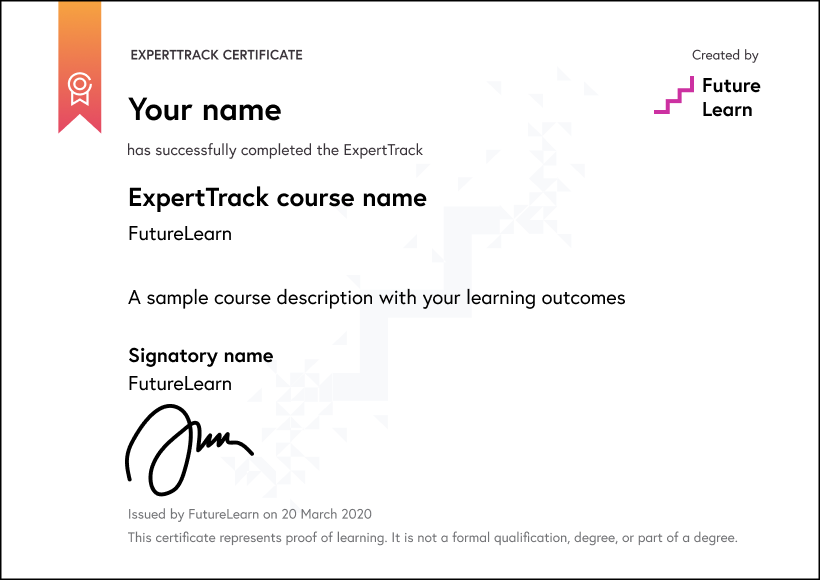
Download a PDF
Learning on this course
On every step of the course you can meet other learners, share your ideas and join in with active discussions in the comments.
What will you achieve?
By the end of the course, you‘ll be able to...
- Explain Node.js architecture, asynchronous JavaScript, and Express.js for building structured back-end applications.
- Develop RESTful APIs using Express, MongoDB, and Mongoose, including CRUD operations, data modelling, and validation.
- Apply AI-assisted development workflows to generate, review, test, and debug back-end application code.
- Demonstrate secure authentication, authorisation, and API protection using JWTs, password hashing, and access controls.
- Evaluate full-stack application functionality through React integration, automated testing, end-to-end validation, and deployment preparation.
Who is the course for?
This course is for front-end developers moving into full stack development, aspiring back-end developers, and software engineers who want to work with Node.js, Express, MongoDB, and REST APIs. JavaScript knowledge is required; React familiarity is helpful.
What software or tools do you need?
A computer, a stable internet connection, Node.js, npm, VS Code, Git, Express.js, MongoDB Atlas, Mongoose, and Claude Code are required. Thunder Client or Postman is used for API testing, while Jest and Supertest support automated testing. A React starter application is provided. MongoDB Atlas and Claude Code accounts may be required. Software versions, system requirements, and licensing should be confirmed prior to setup.
Who will you learn with?

Who developed the course?

Edureka
Edureka is a global online learning platform offering industry-focused training in emerging technologies such as Cloud, AI, GenAI, Data Science, DevOps, and Cybersecurity, helping professionals upskill and advance their careers.

Start learning today - free 2-day trial
After your free trial you can:
- Pay $39 per month to keep learning online
- Have complete control over your subscription; you can cancel any time
- Work at your own pace and set your own deadlines at every stage
- Only pay while you’re learning; the subscription will cancel automatically when you finish
- Complete online assessments to test your knowledge and prove your skills
- Earn digital course certificates and a final award that you can share online, with potential employers, and your professional network
- Keep access to the content of courses you complete even after your subscription ends
Learning on FutureLearn
Your learning, your rules
- Courses are split into weeks, activities, and steps to help you keep track of your learning
- Learn through a mix of bite-sized videos, long- and short-form articles, audio, and practical activities
- Stay motivated by using the Progress page to keep track of your step completion and assessment scores
Join a global classroom
- Experience the power of social learning, and get inspired by an international network of learners
- Share ideas with your peers and course educators on every step of the course
- Join the conversation by reading, @ing, liking, bookmarking, and replying to comments from others
Map your progress
- As you work through the course, use notifications and the Progress page to guide your learning
- Whenever you’re ready, mark each step as complete, you’re in control
- Complete 90% of course steps and all of the assessments to earn your certificate
Want to know more about learning on FutureLearn? Using FutureLearn


