
What is an antibiogram?

The microbiology lab plays an important role in optimising management of a patient with an infection or suspected infection. In addition to contributing to the management of individual patients, the microbiology lab plays a part in the surveillance of the epidemiology and occurrence of resistance within an institution.
Antibiograms
One way to observe the susceptibility rates and monitor resistance trends within an institution is to use an antibiogram.
An antibiogram is a cumulative summary of in vitro antimicrobial susceptibility test results obtained with bacteria and/or fungi recovered from patients with infection over a defined period of time in a given healthcare setting.
Made correctly, the information contained in cumulative antibiograms can serve as a valuable tool for optimising antimicrobial therapy in patients with infection and an extremely useful information resource for active antimicrobial stewardship programmes.
Antibiograms are often used by clinicians to assess local susceptibility rates, as an aid in selecting empiric antibiotic therapy, and in monitoring resistance trends over time within an institution.
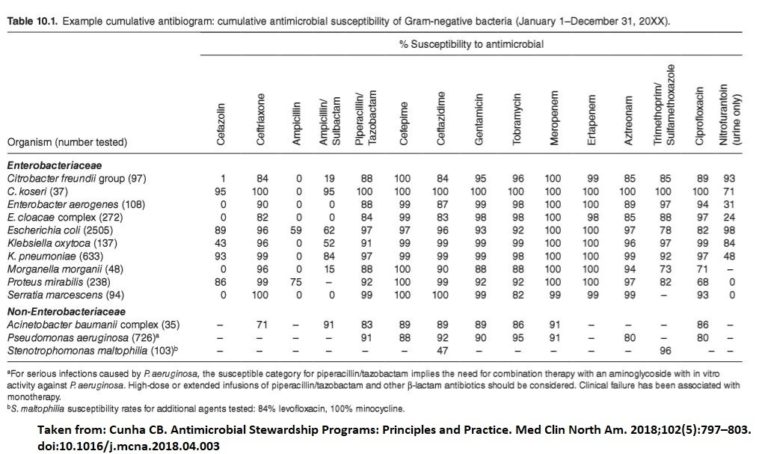
How to create an antibiogram
There are several key things to remember:
- Restrict to isolates that are clinically significant
The antimicrobial susceptibility information included should be restricted to organisms of known (or at least highly suspected) clinical significance. The inclusion of results obtained with nonclinically significant isolates can lead to erroneous and potentially clinically misleading information, and should be avoided. - Eliminate duplicate isolates
It is also very important to avoid the inclusion of susceptibility test results that have been obtained from what are essentially multiple isolates of the same organism from the same patient. A simple way to achieve this is to only include the first isolate of a given organism from an individual patient. - What to measure?
For a cumulative antibiogram, the percentage of isolates determined to be susceptible should be tallied. - How many isolates?
At least 30 unique patient isolates of a particular organism tested against a given antimicrobial agent within no more than a one-year period are required before that drug–bug combination can reliably be reported on a cumulative antibiogram. - Which antimicrobial agents should be included?
Only agents that can reliably be tested in the laboratory against specific organisms are candidates for inclusion.
Care area-specific antibiograms
Cumulative antibiograms should be compiled at least once annually. The concept of developing antibiograms for specific care areas is highly desirable, but only if sufficient numbers of unique patient isolates can be tested.
One important consideration in crafting care area-specific antibiograms is to ensure that the organisms that are included actually originated in, and are representative of, that care area.
Antimicrobial Stewardship for the Gulf, Middle East and North Africa


Antimicrobial Stewardship for the Gulf, Middle East and North Africa





