
Get to know the team
This course was created by experts from universities, research institutions, and ocean science organisations across Africa, Europe, and North America, as part of the OPERA Capacity Development Activities — led by the Gulf of Guinea Ocean Sciences Summer School (GGOSSS) and the ICMPA-UNESCO Chair at the University of Abomey-Calavi, Benin.
We came together to build a learning experience that equips you to understand and use ocean forecasting in your own professional or academic context. Your educators will join the discussions throughout the course and do their best to respond to your questions. This course is also built around a strong learning community, so we encourage you to engage with one another — ask questions, share experiences, and explore new perspectives together.
Your educators
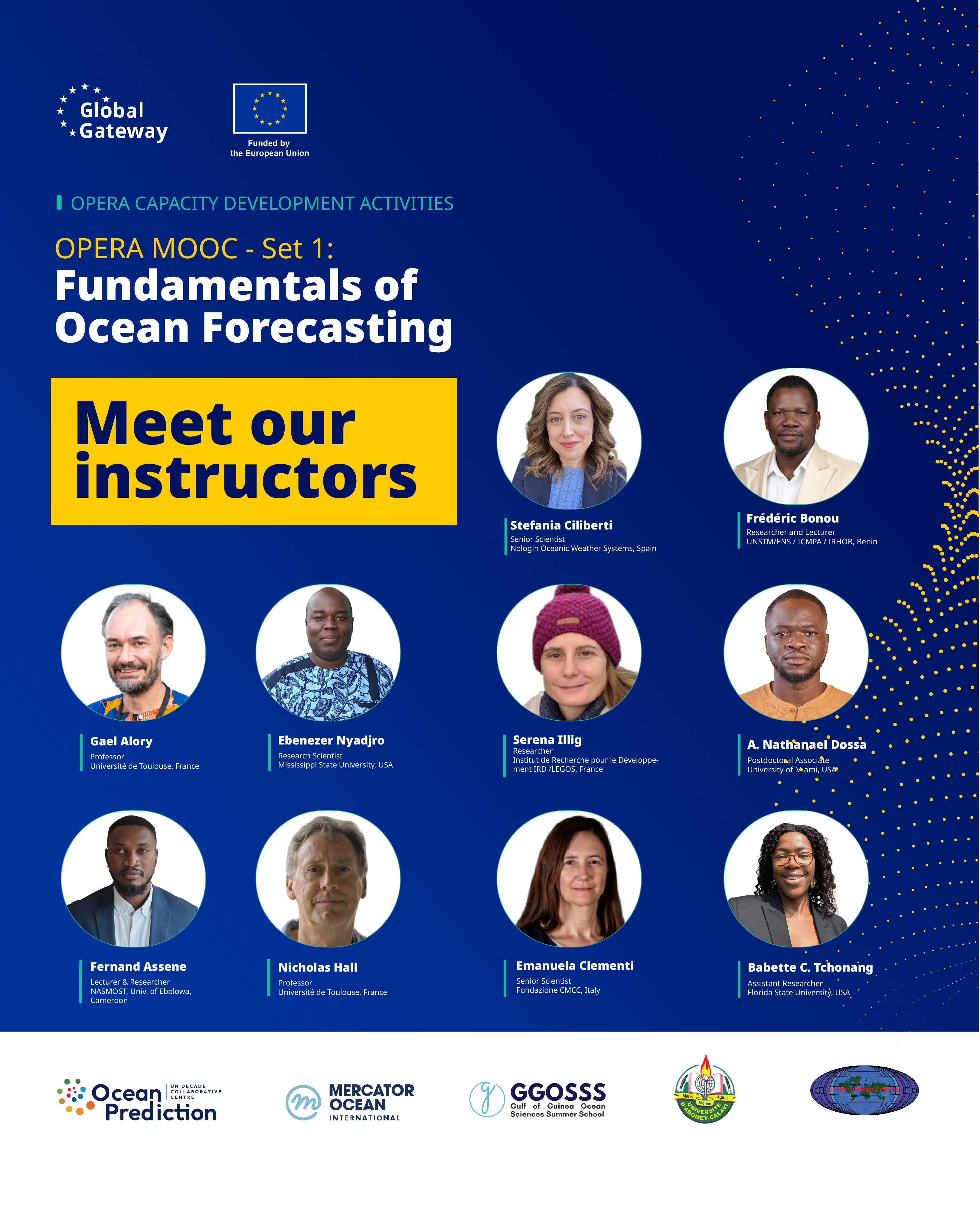
This course is taught by 10 educators, with each week led by a different expert or team of experts. Here is who you’ll be learning from over the next seven weeks.
Week 1 — Overview of the End-to-End Ocean Forecasting System Stefania Ciliberti — Ocean modelling scientist at Nologin Oceanic Weather Systems, specialising in operational forecasting systems for the Mediterranean and global ocean.
Week 2 — Fundamentals of Ocean Dynamics Gael Alory — Physical oceanographer at the Université de Toulouse, researching tropical ocean dynamics and climate variability across the Atlantic and Indian Oceans. Serena Illig — Ocean scientist at IRD, specialising in tropical Atlantic and Indian Ocean variability and its impacts on African coastal regions. Nicholas Hall — Atmospheric and ocean scientist at the Université de Toulouse, with expertise in tropical dynamics and ocean–atmosphere interactions.
Week 3 — Introduction to Numerical Ocean Models Emanuela Clementi — Senior ocean modelling researcher at Fondazione CMCC, specialising in Mediterranean and global ocean forecast systems and data assimilation. Fernand Assene — Ocean scientist at the National Advanced School of Maritime and Ocean Science and Technology, University of Ebolowa, Cameroon.
Week 4 — Ocean Observations and Data Assimilation Frédéric Bonou — Physical oceanographer at the National University of Sciences, Technology, Engineering and Mathematics (NUSTM), Benin, specialising in Gulf of Guinea ocean dynamics. Babette C. Tchonang — Technical and scientific lead of the OPERA Capacity Development Activities; Assistant Researcher at Florida State University and the Naval Research Laboratory, specialising in ocean observations and operational oceanography.
Week 5 — Upstream Data Sources for Ocean Forecasting Ebenezer Nyadjro — Ocean scientist at the Northern Gulf Institute, Mississippi State University, specialising in African ocean observations and data analysis. A. Nathanael Dossa — Physical oceanographer at the University of Miami, researching ocean dynamics and variability in the tropical Atlantic and African coastal ocean.
Week 6 — Interpretation of Ocean Forecast Outputs Ebenezer Nyadjro (see Week 5)
Week 7 — Introduction to Downstream Applications of Ocean Forecasts Ebenezer Nyadjro (see Week 5)
Our partners
This course was made possible through the work of the following partner organisations:
- Gulf of Guinea Ocean Sciences Summer School (GGOSSS) — regional capacity development initiative and technical lead of the OPERA Capacity Development Activities
- ICMPA-UNESCO Chair, University of Abomey-Calavi (UAC) — leading centre for advanced research and postgraduate education in West Africa
- Mercator Ocean International — one of the world’s leading ocean prediction centres, entrusted entity for the Copernicus Marine Service, and implementing organisation of OPERA
- OceanPrediction Decade Collaborative Centre (DCC) — global structure promoting collaboration across the UN Decade of Ocean Science for Sustainable Development
The OPERA project
OPERA — Ocean Prediction Enhancement in the Regions of Africa — is a five-year project implemented by Mercator Ocean International, with funding from the European Union under the Arc X / Global Gateway programme. It aims to strengthen ocean forecasting capacity across Africa by building the skills of African scientists and practitioners, improving access to observations, models, and forecast products, connecting African institutions with the global forecasting community, and supporting the use of forecasts in real-world decisions — from fisheries to disaster risk reduction.
Learn more about the project: Ocean Prediction Enhancement in the Regions of Africa (OPERA).
By taking this course, you’re not just gaining knowledge — you’re joining a growing community working to bring ocean forecasting capacity to the regions that need it most.
Part of a larger learning journey
This course — MOOC Set 1: Fundamentals of Ocean Forecasting — is the first in a series of four MOOCs being developed under the OPERA Capacity Development Activities over the next three years:
- MOOC Set 1 — Fundamentals of Ocean Forecasting (this course)
- MOOC Set 2 — Building an Ocean Forecasting System
- MOOC Set 3 — Operational Forecasting & Service Management
- MOOC Set 4 — Ocean Forecasting Applications & Data Interoperability
MOOC Set 2 is planned for next year and will guide you through the practical steps of building an ocean forecasting system, building directly on the foundations you establish here. Together, these four courses form a complete training pathway for the ocean science community in Africa and beyond.
Join us in shaping the future of ocean forecasting in Africa!







