
Why the ocean moves
The ocean is one of two thin envelopes of fluid that wrap around our planet – the other being the atmosphere. Neither is very deep compared with the size of the Earth, yet together their motion regulates the whole climate, moving heat from the warm equator toward the cold poles. This reading gathers the foundations from the lecture: what the ocean is, why it moves, and the vast range of scales on which it moves.
Two fluids, alike and different
The ocean and the atmosphere behave in surprisingly similar ways – both are fluids on a spinning planet, both form swirling currents and eddies, both carry heat polewards. But the differences matter just as much:
| Property | Ocean | Atmosphere |
|---|---|---|
| Density | ~1025 kg/m³ | ~1 kg/m³ |
| Vertical structure | Free surface | Density decreases with height |
| Circulation | Constrained by continents | Free to circulate |
| Composition | Salt | Water vapour |
| Main driver | Mechanically driven (wind) | Thermally driven (heating) |
| Typical eddy size | ~10 to 100 km | ~1000 km |
Keeping these similarities and differences in mind helps you reason about the ocean by analogy with the weather, while remembering where the analogy breaks down.
Energy: the engine of motion
Why does any of this move at all? The ultimate cause is an imbalance in energy. More sunlight arrives at the equator than escapes back to space, while the poles lose more than they receive. The result is net heating at the equator and net cooling at the poles.
Nature does not tolerate that imbalance quietly. To keep the planet in a steady state, heat must be carried from where there is a surplus to where there is a deficit – and the ocean and atmosphere are the two great conveyors that do it. At the sea surface, heat passes between the two fluids: in the tropics the atmosphere warms the ocean, while in the extra-tropics the ocean gives its heat back to the atmosphere. This constant poleward export of heat is the engine behind much of the motion you will study this week.
What sets the ocean moving
The lecture identified four ultimate causes of ocean motion:
- The wind – the main driving force. As air blows across the sea, it drags the water along, driving everything from shallow surface currents to basin-wide gyres.
- The Sun – drives the system by heating it unevenly, and by shaping the ocean’s temperature and salinity, and therefore its density.
- The Moon – its gravitational pull across the Earth raises the tides (the Sun contributes too, to a lesser degree).
- The Earth itself – exchanges of momentum between the solid Earth and the ocean, and events such as earthquakes, which can trigger tsunamis.
Wind and Sun drive the everyday circulation; the Moon drives the tides; the Earth adds the rarer, dramatic events.
A huge range of scales
One of the hardest things to grasp about the ocean is just how many scales it moves on – at once. Turbulent mixing happens over centimetres and seconds. Surface waves span metres. Coastal upwelling, fronts, and eddies play out over tens to hundreds of kilometres. Basin-scale gyres and slow planetary waves stretch across whole oceans and take months or years.
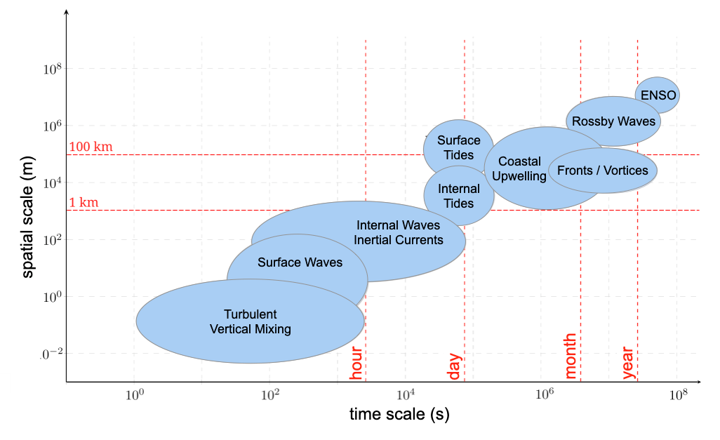 Figure 1: Ocean processes span an enormous range of scales, from turbulent mixing (seconds, centimetres) to ENSO (years, ocean-basin size). Recognising where a process sits helps you understand it and choose the right tools to represent it
A modern high-resolution simulation of the Atlantic captures this beautifully: in a single image you can see tides, the large gyre circulation, the Gulf Stream, and a froth of turbulent eddies – all coexisting.
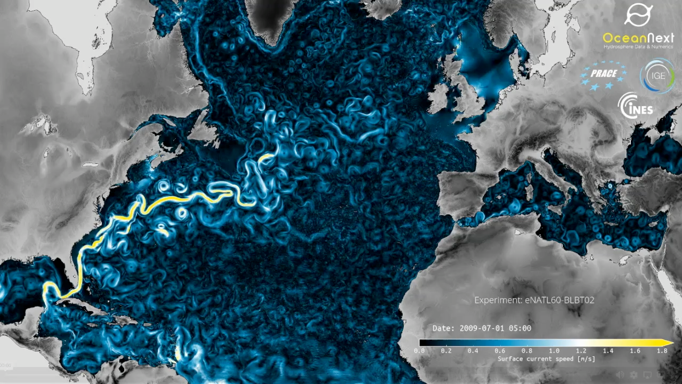 Figure 2: A state-of-the-art high-resolution simulation of the Atlantic reveals multiple spatial and temporal scales at once – tides, gyre circulation, the Gulf Stream, and turbulent eddies. Source: Laurent Brodeau, MEOM/OceanNext, Grenoble (experiment eNATL60).
Recognising which scale a process belongs to is the first step in understanding it, and in knowing which forecasting tools can represent it.
Following the flow
To describe how the ocean changes, it helps to think not about a fixed point in space, but about a parcel of water moving with the flow. The temperature at a fixed spot can change in two ways: the water there can be heated directly, or a current can carry warmer or cooler water past that point. This second effect – advection – is why understanding motion is essential to understanding change. It is a theme that runs through all of ocean physics: to describe how things evolve, we follow the moving fluid.
Pressure and depth
Finally, the lecture introduced pressure – the force pressing on every parcel of water from all directions. Beneath the surface, the pressure on a parcel is simply the weight of all the water above it, so pressure rises steadily as you go deeper. Because water is so dense, it rises fast: descending just 10 metres in the ocean adds roughly one atmosphere of pressure – the same increase you’d get from the entire height of the atmosphere above your head.
 Figure 3: The pressure on a parcel of water is the weight of all the water above it, so it rises steadily with depth. Because water is dense, descending just 10 m adds about one atmosphere.
This downward increase of pressure, balanced against gravity, is what holds the ocean up – the buoyancy force that keeps a parcel of water in place. Differences in pressure from place to place, as you’ll see next, are what set the water in motion.
Key takeaways
- The ocean and atmosphere are two thin fluids whose motion moves heat from the equator to the poles, keeping the climate in balance
- The climate system is driven by differential heating – a surplus of energy at the equator, a deficit at the poles
- Ocean currents are driven mainly by the wind, with the Sun, Moon, and Earth playing their own roles
- The ocean moves on an enormous range of scales, from turbulent mixing to basin-wide gyres, often all at once
- To describe change we follow the moving fluid, and the forces that drive motion come from differences in pressure, whose vertical increase balances gravity







