
The forces that move the ocean
In the first lecture we asked why the ocean moves. Now we ask how. Like any object, a parcel of seawater obeys Newton’s laws: it keeps doing what it is doing unless a force acts on it, and when a force does act, the parcel accelerates in the direction of that force. So to understand ocean motion, we need to know the forces at play. There are only a handful, and this reading takes them one at a time.
Gravity
The most familiar force is gravity, pulling every parcel of water downward. On its own, gravity would simply pile all the water at the bottom. What stops that is pressure – and the balance between the two, as we saw last time, is what holds the ocean up. Gravity’s main role in ocean dynamics is vertical; the interesting horizontal motion comes from the other forces.
The pressure gradient force
Pressure pushes on a parcel of water from every direction at once. If the pressure were the same everywhere, all those pushes would cancel and nothing would move. But when pressure is higher in one place than another, the pushes no longer balance, and there is a net force directed from high pressure toward low pressure.
This is the pressure gradient force, and it is one of the great movers of the ocean. Wherever the sea surface is slightly higher in one place than another, or wherever denser water sits beside lighter water, pressure differences appear – and water is pushed from high to low. Much of the circulation you will study this week begins here.
Friction: shear stress
Now imagine two layers of water sliding past each other at different speeds. The faster layer drags the slower one along, and the slower one holds the faster one back. This internal friction is called shear stress – a force per unit area, like pressure, but acting along a surface rather than pushing on it.
Shear stress matters enormously for the ocean, because it is the route by which the wind’s pull enters the water. The wind grips the sea surface through friction and drags it along; that momentum is then passed downward, layer by layer, into the ocean below. Where the flow changes speed sharply – near the surface, the coast, or the sea floor – shear stress is strongest. In the calm interior of the ocean, it is negligible.
Conservation of mass
Before we reach the most subtle force, one principle ties everything together: water is not created or destroyed. If more water flows into a region than out of it, something must give – the water piles up, or the surface rises. This is conservation of mass, and in fluid dynamics it appears as the continuity equation. In plain terms: wherever flows converge, water must go somewhere – downward, upward, or into a rising sea surface. This simple bookkeeping turns out to be essential for understanding upwelling and much else later in the week.
The force of a spinning planet
Here is where the ocean does something that feels strange at first. The Earth is rotating, and we, along with the ocean, are rotating with it. From our spinning point of view, moving objects seem to be pushed sideways by a force that an outside observer would not see at all.
You have felt something like this on a fairground ride: as the platform spins, you feel flung against the wall, as if a force were pushing you outward. That is the centrifugal force. It is not a “real” force – it appears only because you are in a rotating frame – which is why physicists call it a fictitious force. For the ocean, it turns out the centrifugal force can be quietly folded into gravity and set aside.
But rotation has a second, more important consequence.
The Coriolis force
When a parcel of water moves across the rotating Earth, it appears – from our rotating viewpoint – to be deflected sideways. This apparent deflection is the Coriolis force, and it is central to almost everything in ocean dynamics.
A few key facts give you all the intuition you need:
- It acts only on moving water – a parcel at rest feels no Coriolis force
- In the northern hemisphere it always deflects motion to the right of the flow; in the southern hemisphere, to the left
- It is strongest at the poles and vanishes at the equator, where it acts vertically rather than sideways and is neglected
- For a given speed, it is a real organiser of large-scale flow, even though it does no work
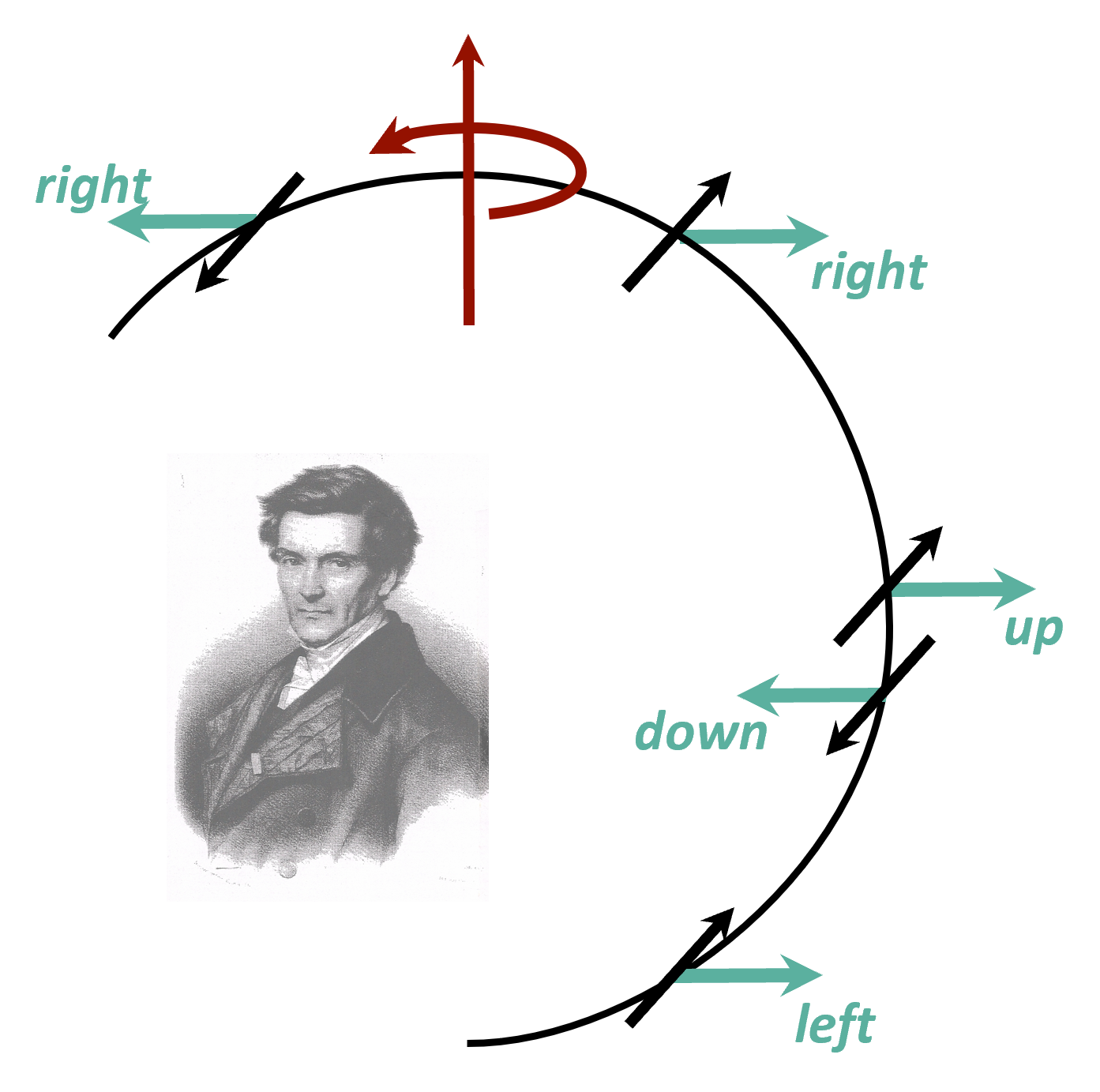 Figure 1: The Coriolis force deflects moving water to the right in the northern hemisphere and to the left in the southern hemisphere, with the deflection vanishing at the equator.
Because it turns moving water sideways, the Coriolis force is what allows the great balanced flows of the ocean – the geostrophic and Ekman balances you will meet in the next two lectures – to exist at all.
Gathering the forces: the primitive equations
Once we know the forces – gravity, the pressure gradient, friction, and Coriolis – we can gather them into a single set of relations that describe how a parcel of water accelerates. These are the primitive equations, the physical heart of every ocean model. You do not need the mathematics; what matters is the idea: the primitive equations are simply Newton’s second law, written for a fluid on a rotating planet, with all the forces accounted for and mass conserved.
A useful simplification: the shallow-water equations
The full equations are rich but complex. A powerful simplification imagines the ocean as a single layer of uniform density with a free surface. In this picture, the slope of the surface sets the horizontal pressure force, and the flow is the same all the way down through the layer. The result – the shallow-water equations – is simpler, yet captures a remarkable amount of real ocean behaviour. Vertical structure can be added back by stacking layers of different density. You will meet these equations again when we study waves and tides, where they come into their own.
Key takeaways
- Ocean motion follows Newton’s laws: forces cause parcels of water to accelerate
- The main forces are gravity (vertical), the pressure gradient force (high to low pressure), shear stress (friction, and the way wind’s pull enters the ocean), and the Coriolis force
- Conservation of mass means converging flows must go somewhere – a key to understanding upwelling
- The Coriolis force acts only on moving water, deflecting it right in the north and left in the south, vanishing at the equator – and it makes the ocean’s great balanced flows possible
- The primitive equations gather these forces into the physical basis of ocean models; the shallow-water equations are a powerful simplification you’ll use for waves and tides







