
Ocean waves: from surf to wave physics
Stand at the shore and waves seem endless – arriving one after another, breaking on the beach, sometimes gently, sometimes with real force. That simple sight raises a surprisingly deep question: what is actually travelling across the ocean? It looks like the water is moving forward. It isn’t. A wave mainly transports energy, while the water itself moves back and forth, more or less in place. This reading builds from that idea up to the physics of how waves travel, grow, and break.
What a wave is
A wave is an oscillation around an equilibrium state. Disturb the ocean surface and restoring forces try to bring it back: gravity pulls raised water down, and pressure pushes depressed water up. But water has inertia, so it overshoots – and the result is an oscillation that travels across the surface.
Because gravity is the main restoring force, ocean surface waves are gravity waves. Unlike a wave on a string, they combine both vertical and horizontal motion, as we’ll see.
Describing a wave
To work with waves we need a simple description.
Take a snapshot of the sea surface, and a wave has an amplitude (its maximum displacement from the calm level) and a wavelength (the distance between two successive crests). Watch instead from a fixed point – a tide gauge, say – and the surface rises and falls with a period: the time between two crests passing.
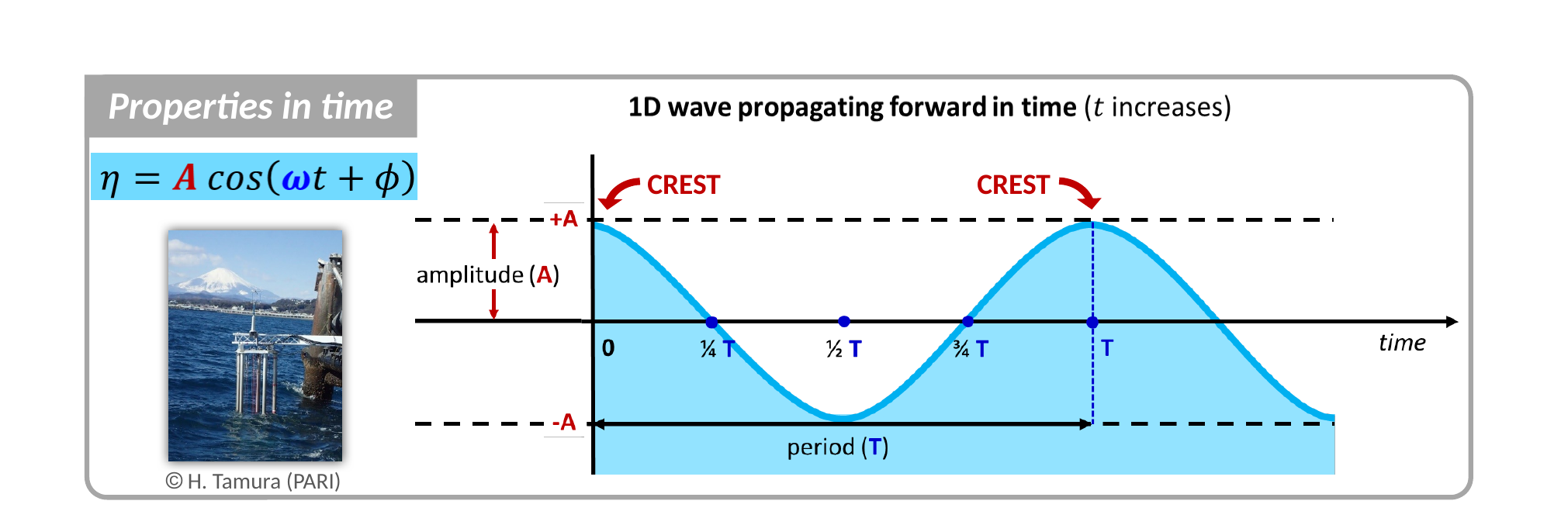 Figure 1: A wave described in space (amplitude, wavelength) and in time (period).
From these come the speed at which a crest travels – the phase speed, simply wavelength divided by period.
Wave groups and dispersion
Real seas are never made of a single, pure wave. The surface is a mixture of many waves of different lengths, and when they overlap they interfere – adding up where they’re in step, cancelling where they’re not.
The result is that waves travel in groups: packets of larger waves separated by calmer stretches. Here’s the subtlety. Within a group, the individual crests move at the phase speed – but the group itself, the envelope carrying most of the energy, travels at a different speed, the group speed. Since energy is what matters, the group speed is often the more important of the two.
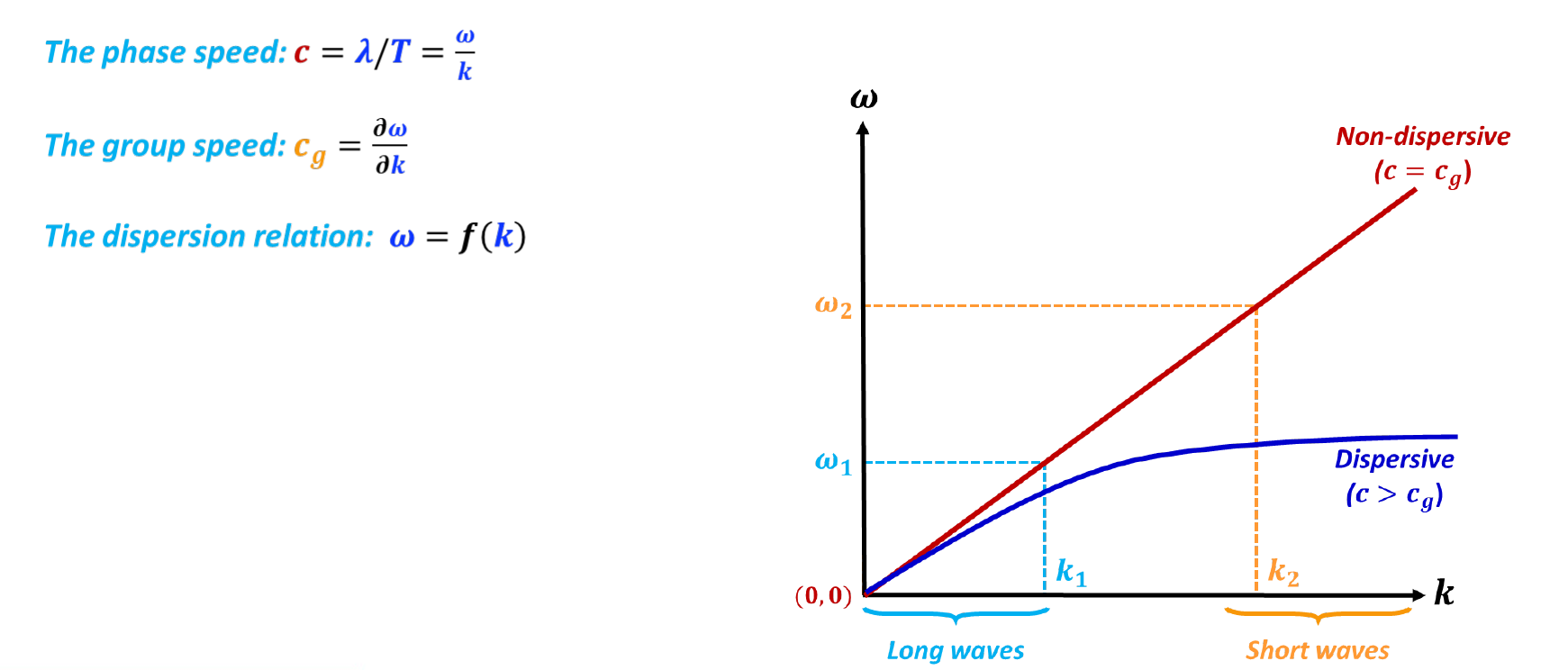 Figure 2: The relationship between frequency and wavelength – the dispersion relation. Long waves travel faster than short ones, so a mixed wave field spreads out as it propagates.
The relationship between a wave’s frequency and its wavelength is called the dispersion relation, and for deep-water waves it says something you can observe for yourself: long waves travel faster than short ones.
Imagine a distant storm churning up a mixture of wavelengths. As they cross the ocean, the long waves pull ahead and arrive first; the shorter ones straggle in behind. The wave field spreads out and sorts itself by wavelength. This is dispersion, and it’s why the long, clean swell from a far-off storm reaches a coast days before the choppier seas. When all wavelengths travel at the same speed instead, the field holds together and the waves are non-dispersive – a case we’ll meet again shortly.
How the wind makes waves
Where does the energy come from? Overwhelmingly from the wind – between 70 and 90% of the energy in surface waves.
The mechanism is elegant. Wind blowing over a slightly rippled surface has a little more room above the troughs, so the airflow there slows down and the pressure changes. Those pressure differences push and pull in just the right places to amplify the existing ripples. Once started, waves keep growing through this air-sea interaction – and stronger winds, blowing for longer, over larger areas, build bigger waves. Once made, they can travel far from where they were born.
Motion beneath a wave
Now to the counterintuitive part. Beneath a passing wave, water particles don’t travel with it – they trace circular orbits, coming back nearly to where they began. The wave form moves on; the water stays roughly put.
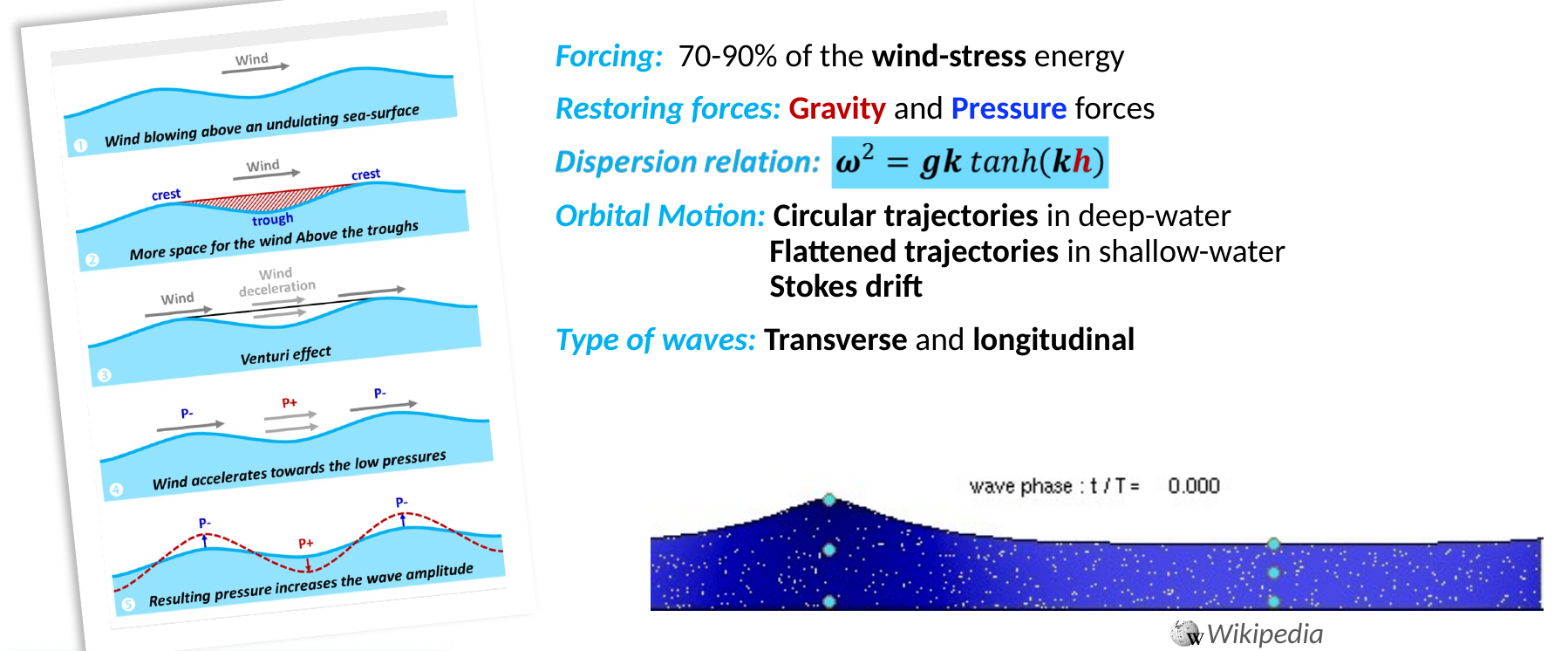 Figure 3: Water particles follow circular orbits beneath a wave. The orbits shrink with depth, so deep water barely feels a surface wave passing.
Those orbits are widest at the surface and shrink rapidly with depth, so a wave’s influence fades as you go down. (There is a small net movement – the Stokes drift – but it’s a slow trickle compared with the wave’s own speed.) And as the water gets shallower, the wave starts to feel the seabed: the orbits are squashed from circles into flattened ellipses.
Deep water and shallow water
This raises a question with a trap in it: what counts as “deep” water?
The answer is not simply how deep the ocean is. It depends on how the depth compares with the wavelength. A short wave in modest water can behave as a deep-water wave, because its orbits die away long before they reach the bottom. A very long wave over much deeper water can behave as a shallow-water wave, because its orbits still reach the seabed.
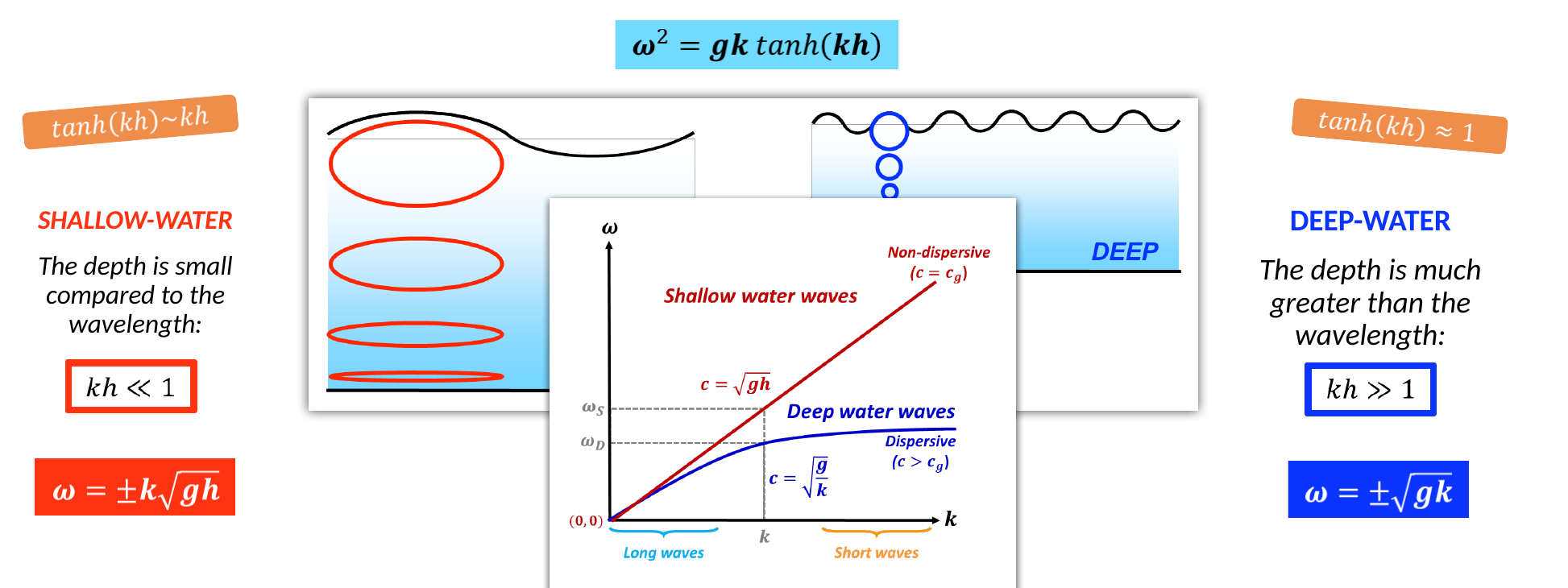 Figure 4: Whether a wave behaves as deep- or shallow-water depends not just on the depth, but on the depth compared with the wavelength
The distinction matters because the two behave differently. Deep-water waves are dispersive – long ones outrun short ones, as we saw. Shallow-water waves are non-dispersive – all wavelengths travel at the same speed, set only by the depth. That single fact explains what happens next.
At the coast: shoaling, breaking, and refraction
Follow a wave into shallowing water. Its speed depends on depth alone, so as the water shallows, the wave slows down.
But the wave’s frequency doesn’t change – crests don’t simply vanish. So as the wave slows, its wavelength shortens, and the same energy is squeezed into a shorter wave. The result: the wave grows taller and steeper. Eventually it becomes unstable and topples over – and that’s the surf zone.
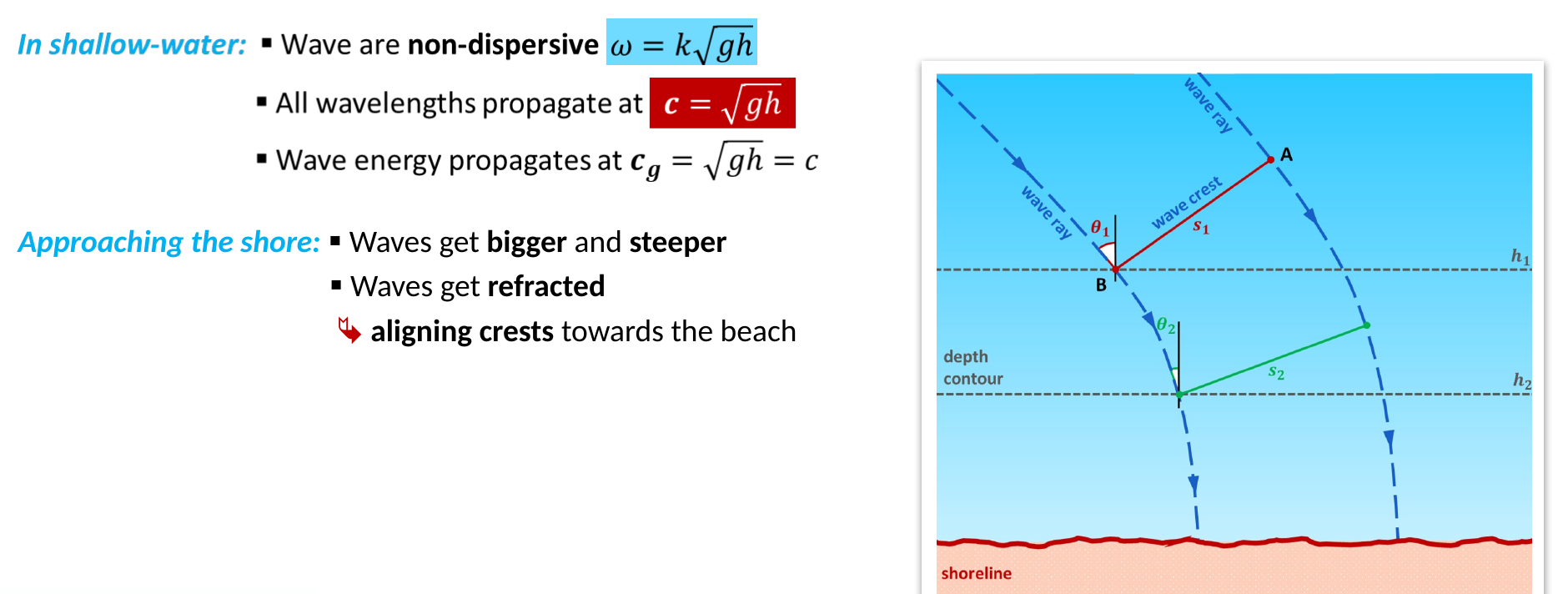 Figure 5: As waves approach the shore they slow, shorten, steepen, and break. Waves arriving at an angle bend (refract) until their crests align with the shoreline.
One more coastal effect. When waves approach the shore at an angle, the end of each crest in shallower water slows first, while the end in deeper water races ahead. The crest pivots. Just as light bends entering glass, waves refract – progressively turning until they arrive nearly parallel to the beach. It’s why surf so often rolls in straight at the shore, whatever direction the swell came from.
Waves in forecasting
Operational wave models don’t track individual waves – there are far too many. Instead they describe the sea state statistically, as a wave spectrum: how much energy sits at each frequency and travelling in each direction. The model then evolves that spectrum, accounting for wave generation by wind, propagation, interactions between waves, refraction, and the loss of energy when waves break.
Ocean circulation models, meanwhile, usually don’t represent surface waves at all. When the two are coupled, waves feed back on the circulation – stirring the surface, transferring momentum, driving surface drift, and generating currents along the coast.
Key takeaways
- A wave carries energy, not water: beneath it, water traces circular orbits and returns near where it started, with orbits shrinking with depth
- Waves travel in groups, and the energy moves at the group speed, not the phase speed of individual crests
- Deep-water waves are dispersive – long waves outrun short ones, sorting a storm’s swell as it crosses the ocean; shallow-water waves are non-dispersive
- Whether a wave is “deep” or “shallow” depends on depth compared with wavelength, not depth alone
- Approaching the shore, waves slow, shorten, steepen, and break in the surf zone, and refract until they align with the coast
- Operational models represent waves as a statistical spectrum of energy, and coupling them to circulation models captures how waves stir and push the ocean







