
Parameterization: representing what a model can’t see
In the video, Emanuela Clementi explained that no model can resolve everything – and that what it can’t resolve, it must represent instead. This reading looks closer at how that’s done, why the choices involved matter so much, and where the limits of any model lie. The honest message running through it: parameterizations are not exact physics, but informed approximations – and they shape every forecast.
Why parameterization is needed
The ocean is governed by continuous physical laws – the conservation of mass, momentum, and heat. But a numerical model solves those laws on a finite grid. That creates a hard boundary: only processes larger than a grid cell can be represented explicitly. Everything smaller – the sub-grid processes – falls through the gaps.
And there is always something smaller. Even the highest-resolution models cannot resolve turbulent motions, sub-mesoscale eddies, vertical mixing, or fine bathymetric features. No matter how fine the grid, a scale below it remains – and crucially, these unresolved processes are not just noise. They exert a first-order control on the large-scale flow the model can see. They cannot simply be ignored.
What parameterization is
Parameterization is how models handle this. Instead of resolving a small-scale process directly, the model represents its average effect on the resolved scales, using a simplified mathematical relationship based on theory, observations, or empirical formulas.
A helpful way to think of it: the model doesn’t simulate each turbulent eddy stirring the water, but it does estimate how much those eddies, collectively, mix heat and salt – and applies that effect to the resolved flow. The small scales are represented by their consequences, not their details.
The key parameterizations
Ocean forecasting models rely on several families of parameterization:
- Vertical turbulence and mixing – schemes (with names like K-profile, or KPP, and k-ε) that control how heat, salt, and momentum mix through the water column. These set the stratification, the mixed-layer depth, and the exchange of heat with the atmosphere
- Horizontal eddy mixing and diffusion – representing how unresolved eddies transport heat, salt, and momentum sideways
- Wave-current interactions – especially important in coastal work: Stokes drift, wave-induced mixing, and radiation stress, which strongly influence surface currents and drift prediction
- Sub-grid bathymetry – representing unresolved channels and small topographic features that shape coastal circulation
Why the choice matters: two examples
Parameterization isn’t a minor numerical detail – the scheme a modeller chooses measurably changes the ocean the model produces. Two examples make this vivid.
Vertical mixing of tracers. The turbulent eddies that mix heat and salt vertically operate at scales of 1 to 100 metres – far below any model grid – so their effect must come from a turbulence closure scheme. Comparing three such schemes for the same tropical turbulence shows they produce measurably different vertical heat fluxes, and therefore different thermocline depths and sea surface temperatures.
 Figure 1: Vertical temperature flux in tropical turbulence from three approaches to microscale mixing (scales of 1-100 m): (a) LES, a high-fidelity reference too expensive for operational use; (b) CATKE, a turbulent-kinetic-energy scheme; and (c) k-ε. The choice of scheme changes the simulated heat flux – and so the thermocline and SST. Image source: Wagner et al., 2025.
Momentum advection. Even a purely numerical choice – how the equations are discretized – can behave like a parameterization. In the Agulhas Current retroflection south of Africa, a standard energy-conserving scheme (ENS) makes the current break into a train of unrealistic eddies, while an energy-enstrophy-conserving scheme (EEN) keeps it as a coherent, realistic current.
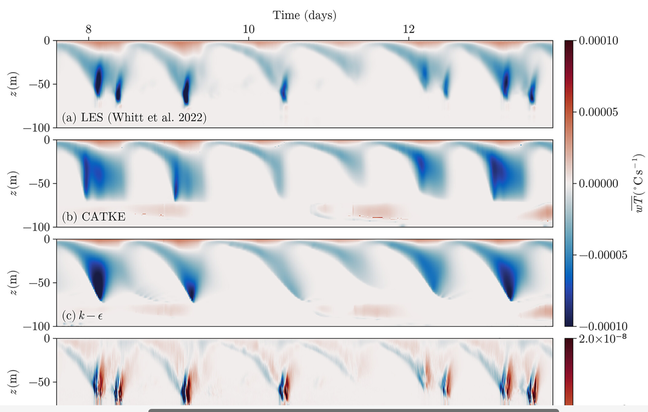 Figure 2: Current speed at 25 m depth in the Agulhas Current retroflection with (A) the energy-enstrophy conserving scheme (EEN) and (B) the standard scheme (ENS). Under ENS (B) the current disintegrates into large, unrealistic eddies; under EEN (A) it is a continuous, realistic stream. Image source: Bernard et al., 2006.
These two examples show that parameterization choices act on both the physical side (how tracers mix) and the numerical side (how momentum is advected) of a model – and that either can determine whether a major current system is represented realistically.
Why it’s especially critical in forecasting
Parameterization matters even more for operational forecasting than for research, because forecasts must run quickly and reliably. High resolution everywhere simply isn’t feasible on an operational schedule, so many processes stay unresolved – and forecast skill depends strongly on the parameterization choices made to represent them.
Strengths and weaknesses
Parameterizations are a genuine trade-off:
- Strengths – they make it possible to model complex systems at all, they cut computational cost dramatically, and they are what makes operational forecasting feasible
- Weaknesses – they rest on empirical assumptions, they need tuning and calibration, and a scheme that works well in one region or condition may not carry over to another
This is the honest heart of the matter: parameterizations are not “exact physics” but informed approximations. They are a genuine source of uncertainty in ocean forecasts – and this is precisely why developing and testing better schemes is an active area of ocean-model research.
Key takeaways
- Models solve continuous physics on a finite grid, so sub-grid processes always exist – and they exert a first-order control on the resolved flow
- Parameterization represents the average effect of those unresolved processes, rather than simulating them directly
- Key schemes cover vertical mixing, horizontal diffusion, wave-current interactions, and sub-grid bathymetry
- The choice of scheme measurably changes the result – from thermocline depth to whether the Agulhas Current is realistic – on both the physical and numerical sides of a model
- Parameterizations are informed approximations, not exact physics – a real source of forecast uncertainty, and improving them matters as much as increasing resolution







