
Data assimilation: keeping the model close to the real ocean
In the video, Babette Tchonang introduced data assimilation – the process that combines observations with a numerical model to produce the best possible estimate of the ocean. This reading gathers the idea in one place, so you can see clearly why assimilation is needed, how its cycle works, and why it sits at the heart of every operational forecast. The mathematics stays out; the aim is the concept.
Why assimilation is needed
Two sources of information describe the ocean, and each has a matching strength and weakness.
Observations are accurate – they measure the real sea – but they sample only part of it, scattered in space and time. Numerical models are the opposite: they give continuous coverage everywhere, at every moment, but they are not perfect. Because of small uncertainties in the model physics, in the atmospheric forcing, and in the starting conditions, a model left to run on its own gradually drifts away from reality.
The figure below shows this clearly. Left alone, the model (blue) wanders away from the true ocean measured by the observations (the circles). But when observations are regularly fed in, the model (green) stays close to reality.
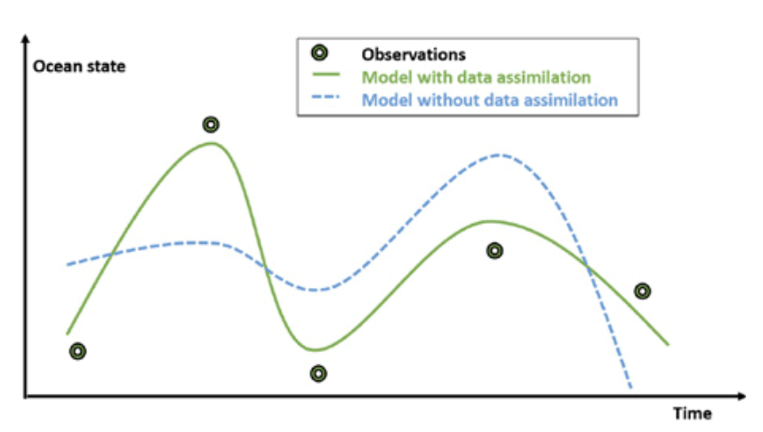 Figure 1: Without data assimilation, a model’s estimate of the ocean state (blue) drifts away from the observations over time. Regularly incorporating observations (green) keeps the estimate close to the real ocean. Source: MEDCLIC project, SOCIB-La Caixa Foundation.
Data assimilation is what produces that green curve. By regularly pulling the model back toward the observations, it creates the best available estimate of the ocean – and that estimate has a name: the analysis.
How the cycle works: four key terms
At its core, assimilation is an elegant loop, and four terms describe it. Meet them once and the whole process falls into place.
- The first guess (also called the background) is the model’s estimate of the ocean before any new observations are added – its best prediction of what the sea looks like right now.
- The innovations are the differences between the incoming observations and that first guess. They are the crucial signal: they show where, and by how much, the model disagrees with the real ocean.
- The increments are the corrections the assimilation system computes from those innovations, and applies to the model – adjusting its temperature, salinity, sea level, and currents to bring them into line with what was observed.
- The analysis is the result: the improved estimate of the ocean after the corrections are applied. It combines the accuracy of the observations with the complete coverage of the model.
Before any of this happens, incoming observations pass through automatic quality control, which screens out suspicious or erroneous measurements so that only reliable data are used. Good assimilation depends on good data going in.
The sequence, then, is: start from the first guess, compare it with observations to get innovations, compute increments, and apply them to produce the analysis. Observe, compare, correct – and the ocean estimate is renewed.
Where assimilation fits in the forecasting cycle
That analysis is not the end of the story – it is the starting point of the next forecast. Operational systems run a continuous three-step cycle:
- Step 1 – Analysis. New observations are combined with the model through assimilation to produce the analysis, while the atmospheric forcing (winds, heat fluxes, precipitation) is prepared. The analysis becomes the initial condition for the forecast.
- Step 2 – Forecast. The model starts from the analysis and runs forward in time, driven by the forcing, predicting how temperature, salinity, currents, and sea level will evolve over the coming hours or days.
- Step 3 – Products. The forecast is checked and turned into the products delivered to users.
Then the cycle repeats: the next batch of observations arrives, a new analysis is made, a new forecast runs. This is why assimilation matters so much – because every forecast begins from the analysis, the quality of the assimilation directly shapes the quality of the forecast.
What gets assimilated
Operational systems assimilate a wide mix of observations – the very platforms you met earlier in the week. From satellites: sea surface height from altimetry, sea surface temperature, and more. From in-situ platforms: temperature and salinity profiles from Argo floats, moorings, drifting buoys, and research vessels. The two families come together here, each contributing what the other cannot.
Benefits, challenges, and limits
Data assimilation is powerful, but it is not magic. Its benefits are clear: it produces a far more accurate and complete picture of the ocean than either observations or models alone, and it gives every forecast the best possible starting point.
Its challenges are just as real. Assimilation depends on having enough good observations – so in data-sparse regions, such as much of the African coastline and the deep ocean, its corrections are weaker simply because there is less to work with. It requires careful estimates of how much to trust the observations versus the model. And it cannot fix everything: it improves the estimate of the ocean state, but it does not remove the underlying uncertainties in the model itself.
Key takeaways
- Observations are accurate but sparse; models are complete but drift. Data assimilation combines them to keep the estimate close to the real ocean
- Four terms describe the cycle: the first guess (model before), the innovations (observation minus first guess), the increments (the corrections), and the analysis (the improved estimate after)
- Observations are quality-controlled before assimilation, so only reliable data are used
- The analysis becomes the initial condition for the next forecast, so assimilation quality directly drives forecast quality
- Assimilation depends on good observations – it is weaker where data are sparse, and it improves the ocean state without removing all model uncertainty







