
From production to interpretation
Operational ocean forecasting systems generate large amounts of information, but forecasts become useful only when users can correctly interpret and communicate them.
This week introduces three major categories of forecast visualization products:
- Maps
- Time series
- Vertical profiles
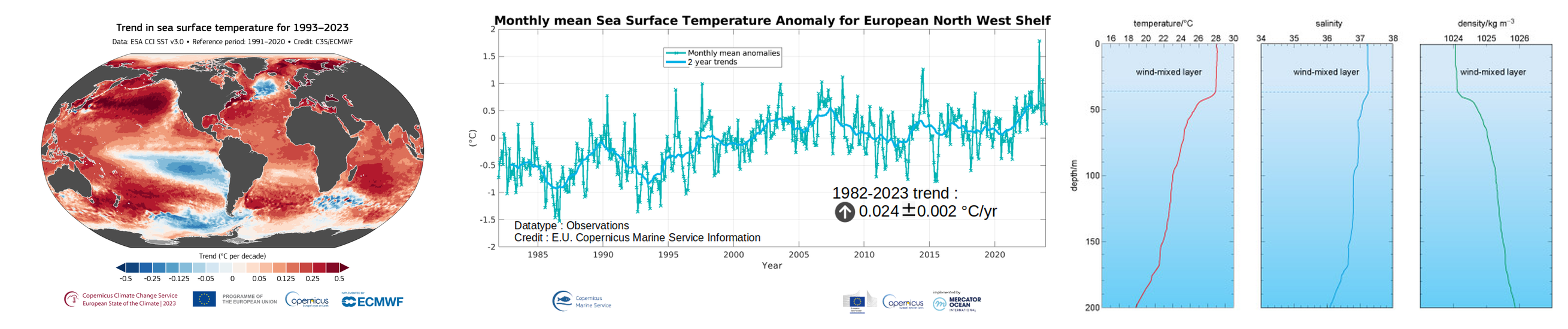 Figure 1: Three families of forecast product — a map, a time series, and a vertical profile. Sources: Copernicus Climate Change Service (C3S)/ECMWF; E.U. Copernicus Marine Service; The Open University.
- Map: “Where is it happening?”
- Time Series: “When is it changing?”
- Profile: “What is happening with depth?”
Responsible interpretation checklist
- Check the variable
- Check the units
- Read the colour bar
- Understand the scale
- Consider uncertainty
Why visual interpretation matters
Ocean forecasting systems produce information that supports fisheries, coastal management, shipping, marine safety, environmental monitoring, offshore operations, and climate services. Forecast products often appear highly technical, but their interpretation follows a set of logical principles.
Users must understand:
- what variable is being displayed,
- the units used,
- the spatial and temporal scales involved,
- and the uncertainty associated with the forecast.
Incorrect interpretation can lead to poor decisions, confusion, or overconfidence. For this reason, operational forecast literacy is an essential skill for ocean practitioners and downstream users.







