
The road to Dunhuang: The Korean Peninsula
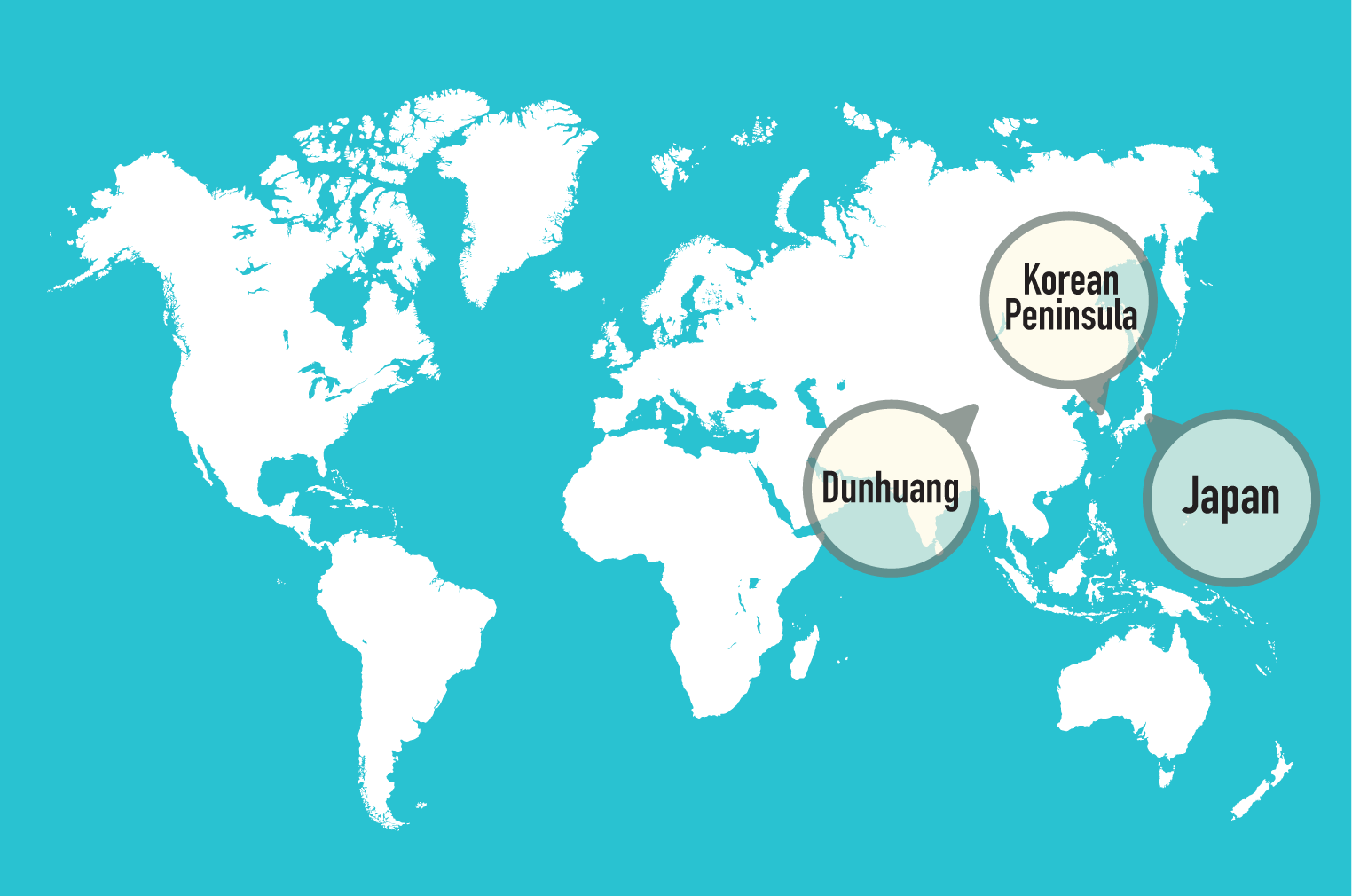
| Let’s begin our exploration by looking at the Korean Peninsula |  |
Japanese book culture was strongly influenced by both China and the countries of the Korean Peninsula, which is connected to China by land.
We have already seen that detchōsō (butterfly binding) and tetsuyōsō (thread binding) both had serious weaknesses. So, let’s see whether these same binding styles were also used in these neighbouring regions.
We’ll begin with the Korean Peninsula. It played an important role in the history of Japanese books: papermaking reached Japan through the peninsula in the seventh century, followed many centuries later by movable-type printing in the late 16th century.
Movable-type printing was widely used on the Korean Peninsula. Most of the printed books I had come across were fukurotoji (pouch-bound), in Japanese terminology — a binding particularly suited to producing books in large numbers. For a long time, I knew very little about the use of other binding styles there.
Then I heard that some printed books in detchōsō (butterfly binding) had been found inside Buddhist statues relatively recently. The statues had acted almost like time capsules, preserving old books inside them. Finding books and other materials inside Buddhist statues is not unusual in Japan either.
Curious to learn more, I asked a Korean colleague who specialises in bibliography (*Note). I learned that three examples of detchōsō, dating from around the end of the 14th century, have been identified.
Here they are:
- The Śūraṅgama Sūtra: The Great Buddha’s Crown, the Tathāgata’s Secret Cause, the Complete and Final Teaching on the Cultivation and Verification of the Bodhisattva’s Myriad Practices 大佛頂如來密因修證了義諸菩薩萬行首楞嚴經. Girimsa Temple, South Korea
- The Concise Commentary and Notes on the Mahāvaipulya Sūtra of Complete Enlightenment 大方廣圓覺略疏注經. Horim Museum, South Korea
- The Sūtra of Forty‑Two Chapters Spoken by the Buddha 佛說四十二章經. Borimsa Temple, South Korea
All three were made in the same way. Each sheet was folded vertically in half, with the printed side facing inwards. Paste was applied near the fold, and the folded sheets were then stacked in the same direction to form a codex.
In structure, this is the same as detchōsō found in early Japanese manuscripts. But there is an interesting difference: in these Korean examples, only one side of each sheet was printed. Among the manuscripts Kūkai brought back from China, thin sheets were written on only one side, while thicker sheets were written on both sides. In later Japanese detchōsō manuscripts, however, both sides of the paper were normally used for writing.
So, while the basic structure is familiar from Japanese detchōsō, these three examples seem to show a strong influence from Chinese printed books.
What, then, about tetsuyōsō (thread binding)? As far as I know, no examples have been identified on the Korean Peninsula.
This leaves me with a puzzling question: why did a binding style that does not seem to have been used on the Korean Peninsula become so widely used in Japan?
Note: We are grateful to Eury Lee (李裕利), a curator at the National Museum of Korean Literature, for kindly sharing her expertise on these examples.
Global Codex: Hidden Stories of Books Across Cultures

Global Codex: Hidden Stories of Books Across Cultures





