
The Bible: Is it a codex or a scroll?
| To close this activity, Mayumi Ikeda explores the changing physical form of one of the most influential books in Europe: the Bible. |  |
| In discussing the codex in medieval Europe, it is apt to look first at the most essential book of the period, the Bible. |  |
The term Bible itself derives from the Greek word biblion, meaning a ‘book’. Biblion could either designate a codex or a scroll, but have you ever thought about which format the Bible took on from the ancient to the medieval period?
To answer this question, let us first start with clues found in the Bible itself. In the Gospel of Luke 4:16-20, Christ reads out a passage from the Book of Isaiah in the synagogue; this book was likely to have been a scroll, as hinted by the word ‘revolvit’ (perfect tense of ‘revolvo’, to roll back) used in the Latin version of the Bible (The New Vulgate Version). Flipping forward to the end of the New Testament, in Chapter 5 of the Book of Revelation, we read about opening and reading a book in the scroll format: St. John the Evangelist witnesses One seated on the throne holding ‘a scroll written inside and on the back, sealed with seven seals.’ John weeps, ‘because no one was found worthy to open and read the scroll…’ (New King James Version).
Archaeological evidence also points to the scroll as the most common book format used in the ancient period leading up to the time of Christ: the famous Dead Sea Scrolls, dating from between the third century B.C.E. and the first century C.E., do not include a single codex. The Scrolls comprise all books from the Hebrew Bible–what would later be called the Old Testament by Christians–except for the Books of Esther and Nehemia. The Book of Isaiah, the text which Christ read aloud in the synagogue, is also included.
The Bible manuscripts compiled in the Christian context, however, were swiftly replaced by the codex form. This may in part reflect the general trend of the book form of the period, but research suggests that Biblical texts for Christians were much more likely to have been in the codex than other types of text. Why was the Bible more likely to take on the codex form? One reason may be due to its portability. Owing to the fact that both sides of a page can be utilized, the same amount of text can be carried in a much more compact form in a codex than in a scroll. Another suggestion is that some of the earliest recordings of Christ’s words were made on papyrus tablets, a sort of notebook used for children’s learning and daily records.
Whatever the initial reason(s) for adopting the codex form in Christianity, this new book form quickly assumed a spiritual significance for Christians and their new faith. The sacred text of Judaism was represented by the scroll, that is, the ancient and authoritative form of a book. In contrast, the newly introduced codex form was associated with Christianity, symbolizing the good news (‘gospel’) brought about by Christ. For the Christians of the period, the codex must have embodied the message of hope and salvation.
The association of the codex with Christianity (or the New Testament) and the scroll with Judaism (or the Old Testament) persisted well into the Middle Ages. In so many images from this period, the book held by Christ and the Evangelists is in the codex form, whereas the Old Testament prophets typically carry scrolls. Occasionally we see evidence that the choice was intentional.
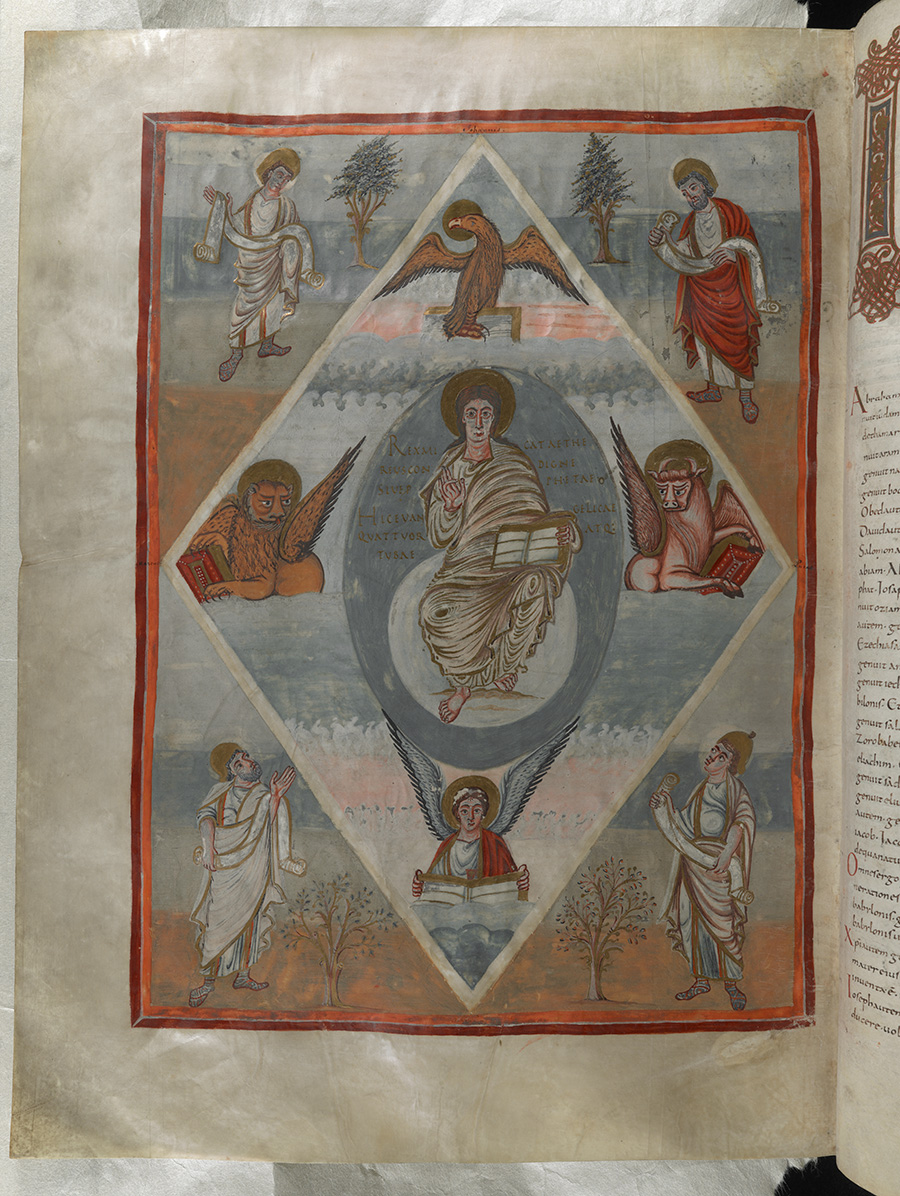
The miniature of Christ in Majesty in the magnificent Moutier-Grandval Bible is a case in point: Christ, in the centre, surrounded by the symbols of the Four Evangelists, holds an open codex (Fig. 1).
 ©British Library Board |
Fig. 1. Christ in Majesty, Moutier-Grandval Bible. France, Tours, c. 830-c. 840, British Library, Add. MS 10546, fol. 352v [1] Click here to take a closer look |
Mark the Eagle at the top and Matthew the Angel at the bottom both display open codices, while John the Lion and Luke the Ox to the left and right carry closed codices with handsome red bindings. In contrast, the Four Major Prophets from the Old Testament, occupying the four corners of the miniature, invariably hold unrolled scrolls in their hands.
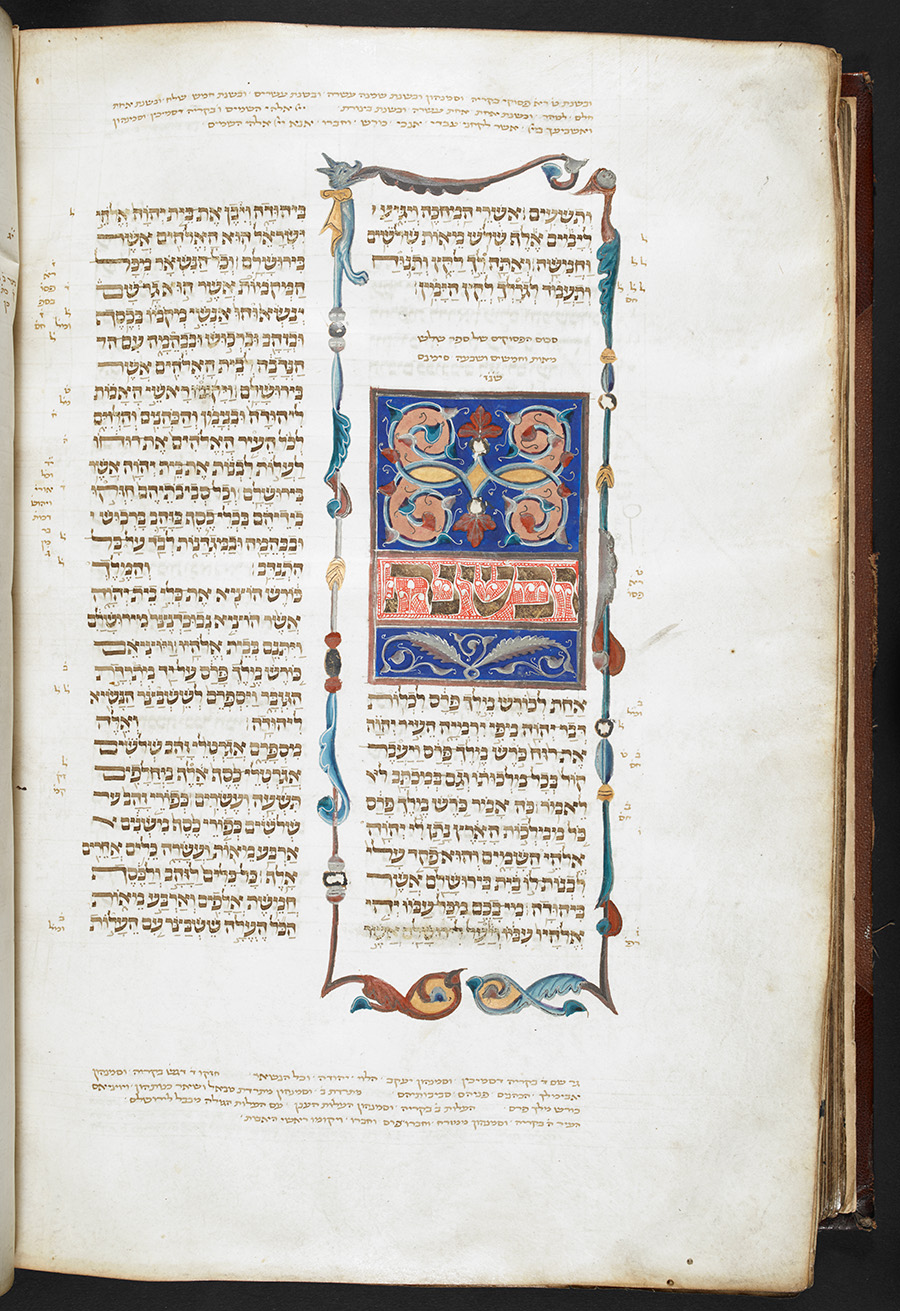
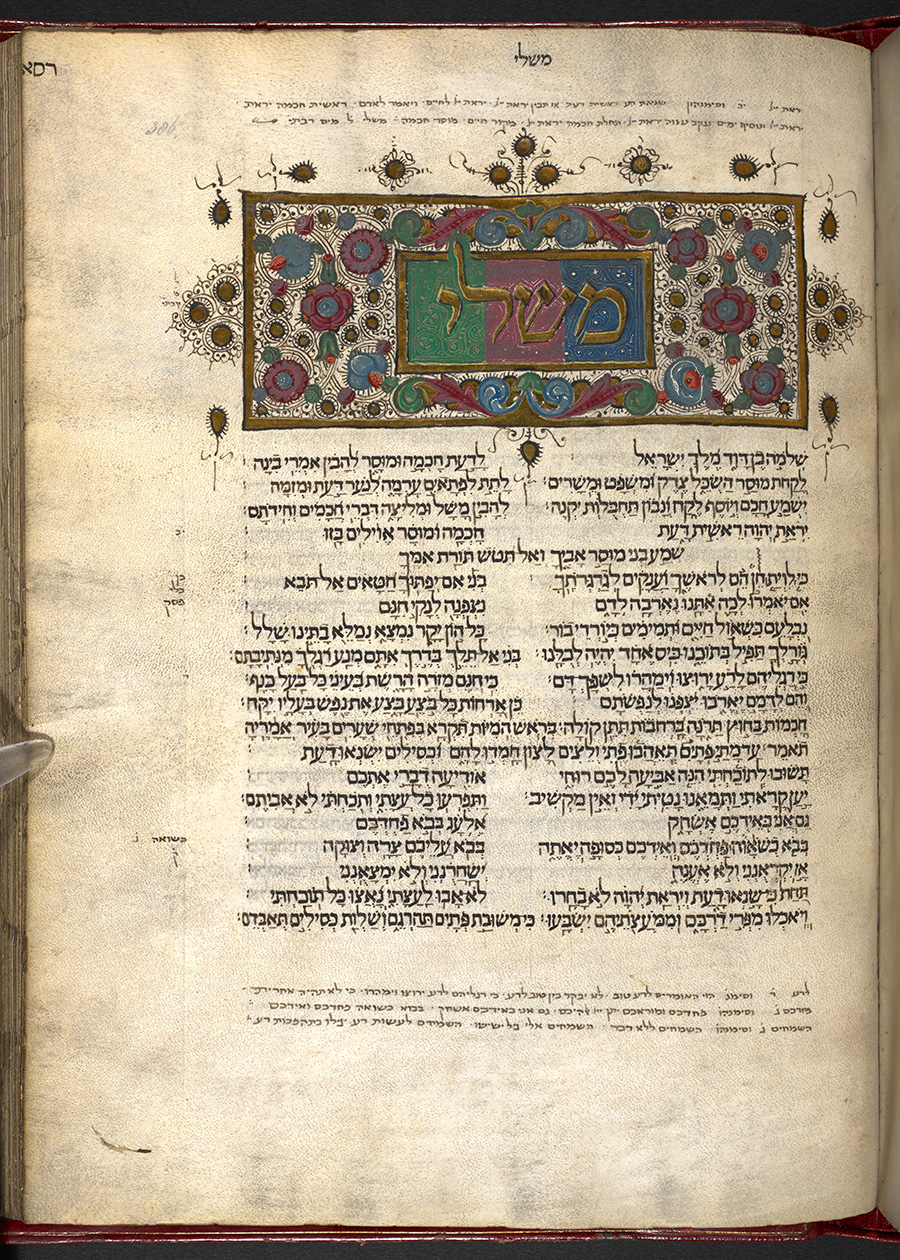
From the most splendid Gospel books to humble pocket-size manuscripts, the Bible for the Christians was written in the codex form throughout the Middle Ages. Interestingly, however, we also find that many Jewish Biblical manuscripts produced in Christian communities were also written in the codex form. Some were beautifully decorated in a style shared with Christian manuscripts from the same region (Fig. 2, Fig. 3).
 ©British Library Board |
 ©British Library Board |
| Fig. 2. Beginning of the Book of Ezra-Nehemia, Bible with masorah magna and parva. Italy, last quarter of the 13th century, British Library, Harley MS 5711, fol. 286v [2] Click here to take a closer look | Fig. 3. Beginning of the Book of Proverbs, Duke of Sussex’s Bible. Italy, 1448-98, British Library, Add. MS 15251, fol. 386r [3] Click here to take a closer look |
The use of the codex in such cases must have been influenced by the local book culture, in which codex was the dominant book form, as well as the availability of local book producers and materials, which were all geared towards producing codices rather than scrolls.
This notwithstanding, the scroll has remained the sacred book form in Judaism, for even today, the Torah (the first five books of the Bible, also known as the Book of Moses) is written on a scroll made of specially prepared parchment and under strict rules to be observed by the scribe. The Christian Bible, on the other hand, continues to be produced in codex.
Books featured in the article
All images are reproduced by permission of the British Library.
- Christ in Majesty, Moutier-Grandval Bible. France, Tours, c. 830-c. 840, British Library, Add. MS 10546, fol. 352v
- Beginning of the Book of Ezra-Nehemia, Bible with masorah magna and parva. Italy, last quarter of the 13th century, British Library, Harley MS 5711, fol. 286v
- Beginning of the Book of Proverbs, Duke of Sussex’s Italian Bible. Italy, 1448-98, British Library, Add. MS 15251, fol. 386r
References
- Colin H. Roberts and T. C. Skeat, The Birth of the Codex, London: The British Academy, 1983.
- Larry W. Hurtado, ‘Chapter 5: The “Meta-Data” of Earliest Christian Manuscripts’, in Texts and Artefacts Collected Essays on Early Christian Manuscripts, Library of New Testament Studies 584 (Bloomsbury T&T Clark, 2018), pp. 83–98.
- Larry W. Hurtado, ‘Early Christian Dilemman: Codex or Scroll?’ Archaeological Views (November/December 2018), pp. 54-56, 66.
Global Codex: Hidden Stories of Books Across Cultures

Global Codex: Hidden Stories of Books Across Cultures





