Home
/ History / Medieval History / Global Codex: Hidden Stories of Books Across Cultures / Comparing the shape of codices

Comparing the shape of codices
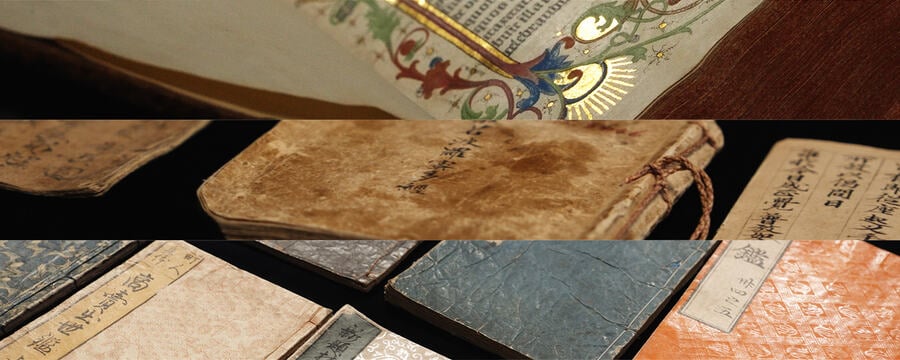
Watch Takahiro Sasaki compare the aspect ratios of Chinese, Korean, and Japanese books, and ask why only one comes close to the golden ratio.
Codices come in many different sizes and proportions. But are these differences simply a matter of size and design?
In this video, I’ll compare printed books from China, Korea, Japan, and Vietnam looking closely at their height, width, and proportions.
What might the shape of a book tell us about where, and how, it was made?
Books featured in the video
- Zhouyi jianyi 周易兼義. 1631, Ming-dynasty Chinese edition, 25.4 × 16.0 cm (1.6:1), private collection
- Jeungjeong sagi chan 増定史記纂. 17th century, Korean edition, 33.2 × 21.3 cm (1.56:1), private collection
- Mugonshō 無言抄. 1598-1615, Japanese edition, 28.6 × 21.3 cm (1.34:1), private collection
- Senka shi 千家詩. 1660, Japanese edition, 26.0 × 16.0 cm (1.625:1), private collection
- Chanlin baoxun hezhu 禅林宝訓合註. 1858, Vietnamese edition, 28.3 × 17.1 cm (1.65:1), Keio Institute of Oriental Classics, Gベトナム・202・2
This article is from the online course:
Global Codex: Hidden Stories of Books Across Cultures
Created by

This article is from the free online
Global Codex: Hidden Stories of Books Across Cultures


