Home
/ History / Medieval History / Global Codex: Hidden Stories of Books Across Cultures / Exploring square codices

Exploring square codices
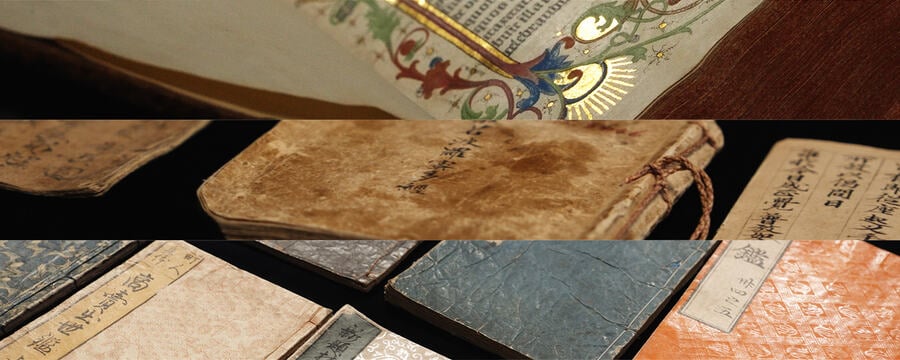
Watch Takahiro Sasaki trace square-format books from Dunhuang to Japan, then compare them with rare examples from the British Library and Cambridge.
Most codices are taller than they are wide — but what about square books?
Square codices appear in some unexpected places. What might their shape tell us about connections between book cultures, and about the ways books were held and used?
In this video, I’ll bring together examples from Keio University, the British Library, and Cambridge University Library.
Books featured in the video
An image for Or.8210/S.5451 is reproduced by permission of the British Library
- Tokiwa no uba 常盤の嫗. Late 16th to early 17th century, Keio University Library, 110X@281@1
- Jisanka 自讃歌. Late 17th century, private collection
- Jingang bore boluomiduo jing 金剛般若波羅蜜多經 (Diamond Sutra). 906, 14.3 x 11.5 cm, British Library, Or.8210/S.5451
- Han jiang Wang Ling bian 漢将王陵變. 10th century, detchōsō, 13.8 × 13.2 cm, British Library, Or.8210/S.5437
- Jingang bore boluomiduo jing 金剛般若波羅蜜多經 (Diamond Sutra). 969, tetsuyōsō, 15.7 × 14.4 cm, British Library, Or.8210/S.5646
- Prayer-book in Hebrew. 15th century, 11.5 x 9.5 cm, Cambridge University Library, MS Add.541
- Psalter and Ethiopian Canticles in Ge’ez. 18th century, 17 x 15.5 cm, Cambridge University Library, MS Add. 1005
- A book of supplications. Before 1624, Indonesia, 10.3 x 10 cm, Cambridge University Library, MS Dd. 3.82
This article is from the online course:
Global Codex: Hidden Stories of Books Across Cultures
Created by

This article is from the free online
Global Codex: Hidden Stories of Books Across Cultures


