Home
/ History / Medieval History / Global Codex: Hidden Stories of Books Across Cultures / Exploring horizontal codices

Exploring horizontal codices
Watch Takahiro Sasaki trace horizontal books from Japan to Tibet, Yunnan, and India, and uncover their surprising origins in palm-leaf manuscripts.
Not all codices are taller than they are wide.
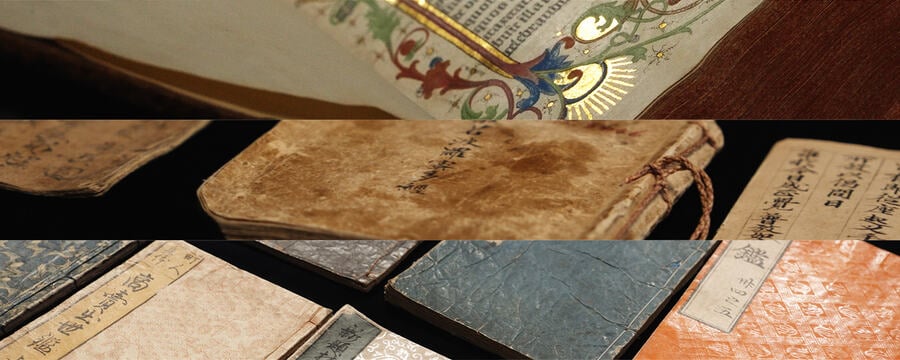
What can we learn from books that have a horizontal form? In Japan, horizontal books were used for a variety of purposes. But similar shapes can also be found in other parts of Asia.
Let’s follow the horizontal form and see where it takes us.
Books featured in the video
- Taishokkan 大職冠. 1600-1640, British Library, Or.13129
- Edo kagami 江戸鑑. 1691, British Library, Or.75.f8
- A Naxi manuscript. British Library, Moso 92
- A Naxi manuscript. British Library, Or.13077
- Hannya-Shingyo (Heart Sutra) and Dharani Mantra in Sanskrit 梵本心経並びに尊勝陀羅尼. 7th to 8th century, Tokyo National Museum, N-8
- Vessantara Jataka. Thai, Lao, Cambodian Collections, 19th century, British Library, Or.1245
- Kammavācā. Thai, Lao, Cambodian Collections, 1881, British Library, Or.15084
This article is from the online course:
Global Codex: Hidden Stories of Books Across Cultures
Created by

This article is from the free online
Global Codex: Hidden Stories of Books Across Cultures


