Home
/ History / Medieval History / Global Codex: Hidden Stories of Books Across Cultures / How paper shapes Japanese books

How paper shapes Japanese books
Watch Takahiro Sasaki explain how Japanese paper types and standard sizes, like Mino-ban and Hanshi-ban, shaped the size of printed books.
What determines the size and shape of a book? One important clue is the paper used to make it.
I’ll introduce some of the paper sizes traditionally used in Japan. Let’s look at some real examples and see how the size of a sheet of paper could shape the book it became.
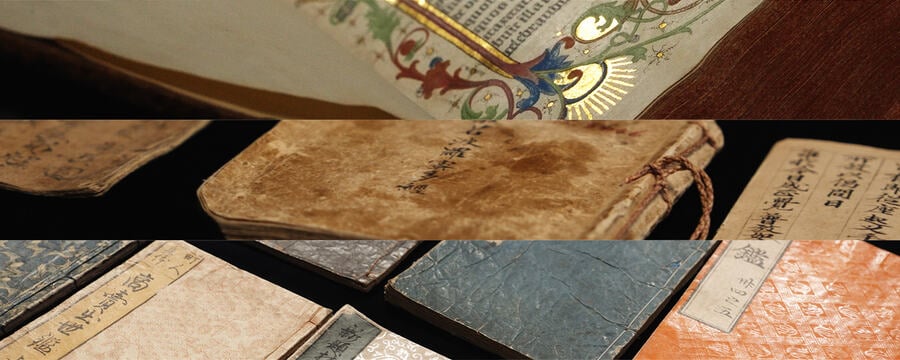
Books featured in the video
- Example of Hishi paper: Shuishu and Shinkokinshu 拾遺集・新古今集零葉. Two sheets, 15th-16th century, private collection
- Example of Minoban paper: Taiheiki 太平記零葉. One sheet, 17th century, private collection
- Example of a book made by Minoban: Hobutsu-shu 宝物集. 1661, private collection
- Example of a book made by half size of Minoban: Tamatsubaki 娜真都翳喜. Early 19th century, private collection
- Example of Hanshiban paper: Hokusai manga 北斎漫画8編零葉. One sheet, 19th century, private collection.
- Example of a book made by Hanshiban: Shindairin wakashū 新題林和歌集. 1716, private collection
- Example of a book made by half size of Hanshiban: Eiga monogatari 栄花物語. 1656, private collection.
This article is from the online course:
Global Codex: Hidden Stories of Books Across Cultures
Created by

This article is from the free online
Global Codex: Hidden Stories of Books Across Cultures


