Home
/ History / Medieval History / Global Codex: Hidden Stories of Books Across Cultures / What lies inside Japanese book covers?

What lies inside Japanese book covers?
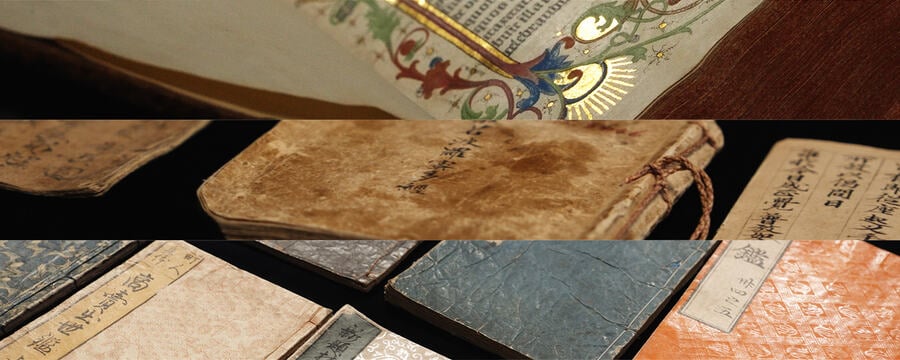
Watch Takahiro Sasaki reveal how Japanese book covers were made using recycled waste paper, a practice traced back to Korean printing.
Books can hold traces of their past in unexpected places. Let’s begin by looking inside their covers.
We often notice a book cover for its colour, decoration, or design. But a cover can be more than just the face of a book — sometimes, it has its own story hidden inside.
In this video, I’ll show you how traditional Japanese book covers were made, and compare two early printed books from Japan and Korea.
Let’s look closely at their covers and see what they can tell us.
Books featured in the video
- Jeungjeong sagi chan 増定史記纂. Korea, 17th century, copper movable-type edition, private collection
- Futari shizuka 二人しつか (Tamaya edition 玉屋本). Early 17th century, private collection
This article is from the online course:
Global Codex: Hidden Stories of Books Across Cultures
Created by

This article is from the free online
Global Codex: Hidden Stories of Books Across Cultures


