
Framing illustrations in medieval manuscripts
| Now let’s turn to illustrations in medieval European manuscripts. |  |
“You were Framed!” – Frames in Illustrations of Medieval Europe Codices
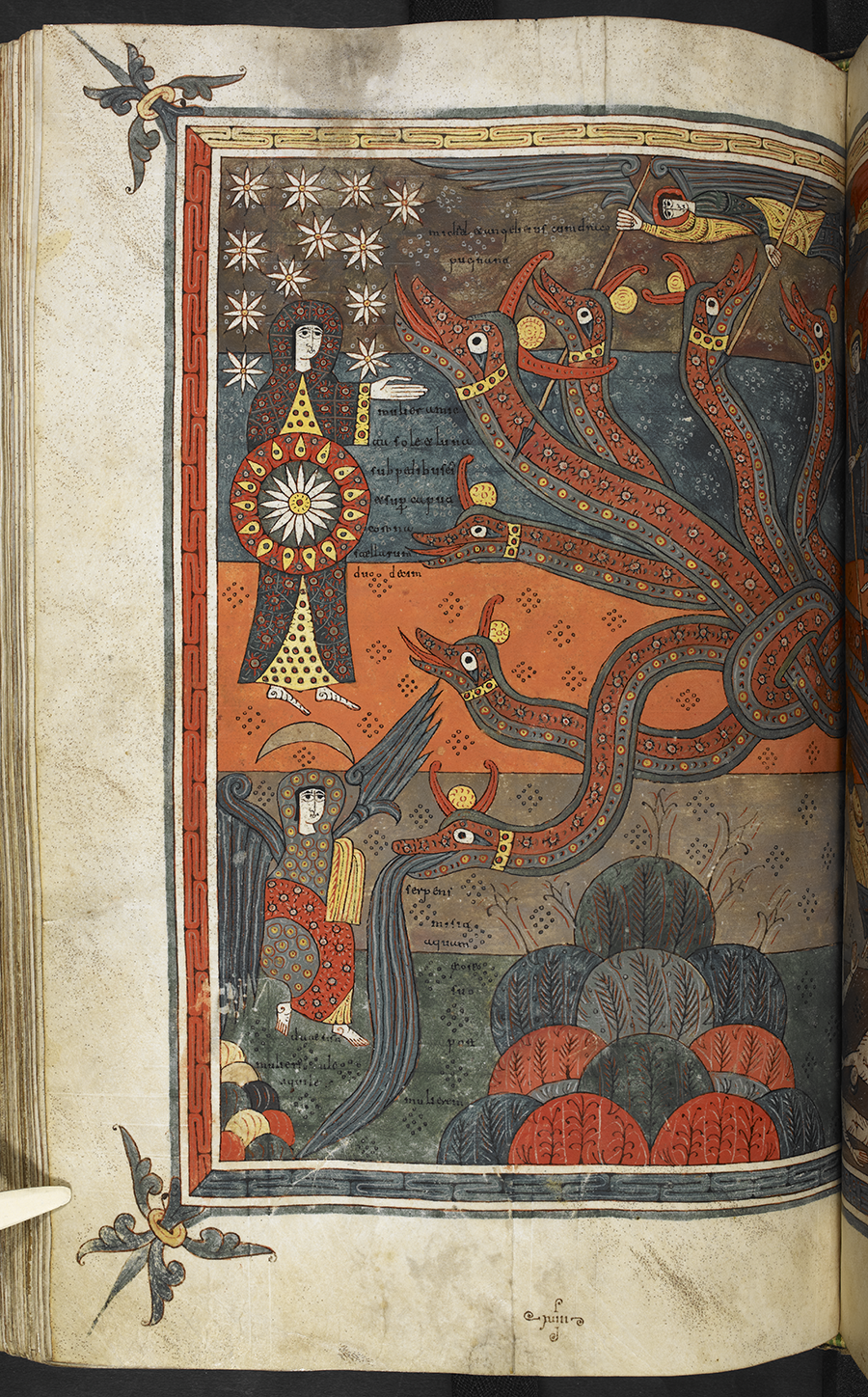
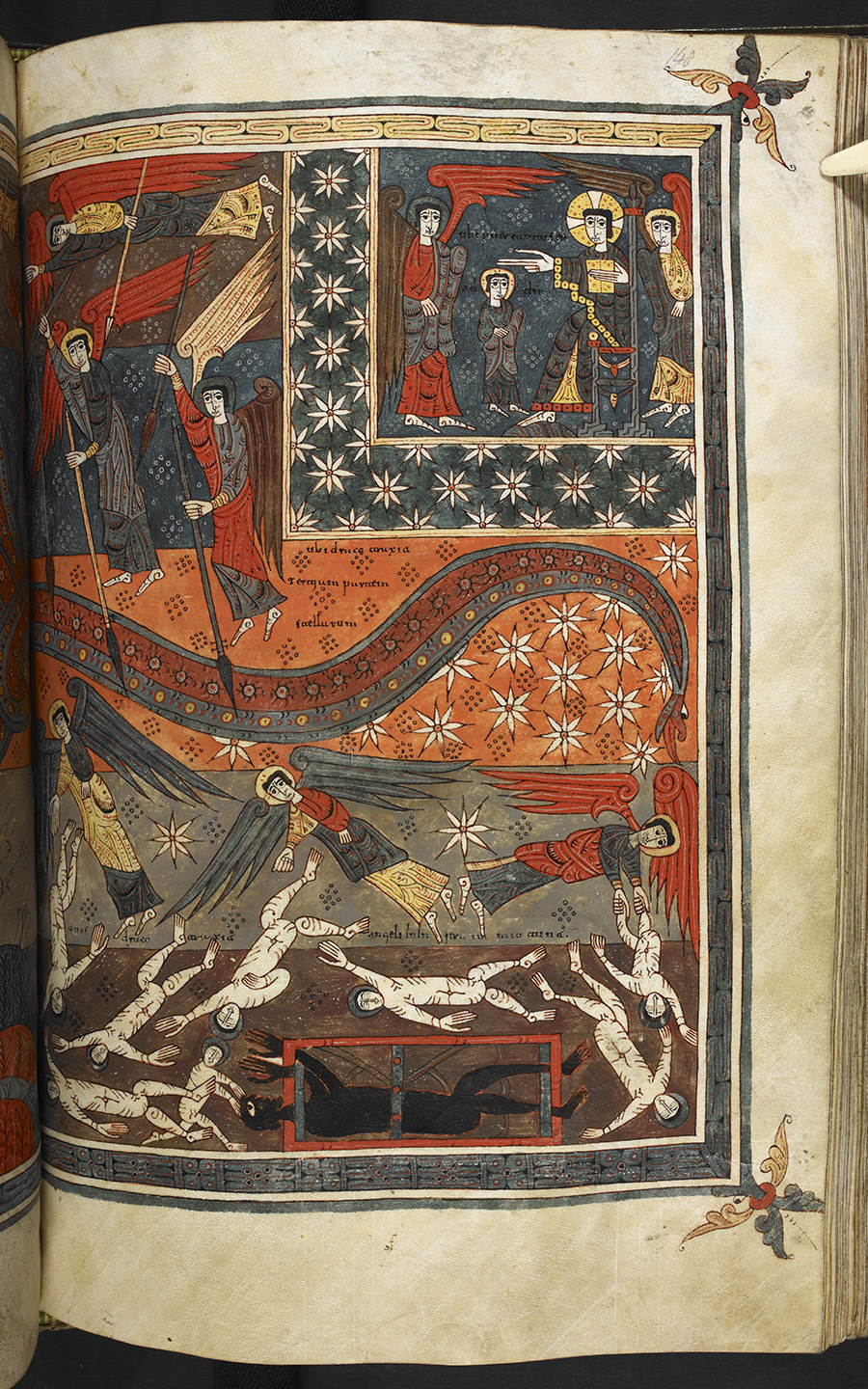
Many illustrations in medieval European codices are framed. This may sound like an obvious statement, but it actually is not. For one thing, as discussed in the previous step, illustrations in early Japanese books were typically unframed, likely influenced by the strong tradition of illustrated scrolls, which were unframed. In the ancient and early Christian illustrated scrolls in the West, too, illustrations were typically unframed. We might speculate that the practice of framing illustrations was, at least to some extent, prompted by the page-based layout of the codex form. Furthermore, in European codices, it is highly uncommon to find illustrations spread across facing pages (Fig. 1). The size of an illustration in European codices, therefore, was determined by a frame, which in turn was determined by the size of a page.
 ©British Library Board |
 ©British Library Board |
Fig. 1. Silos Apocalypse. Spain, Silos, 1109, British Library, Add. MS 11695, ff. 147v–148r [1] / Amongst the most famous of the exceptional double-page spreads in medieval European codices is the twelfth-century Silos Apocalypse. It displays highly expressive representations of St. John’s visions stretching across two facing pages. / Click here to take a closer look – left page | right page
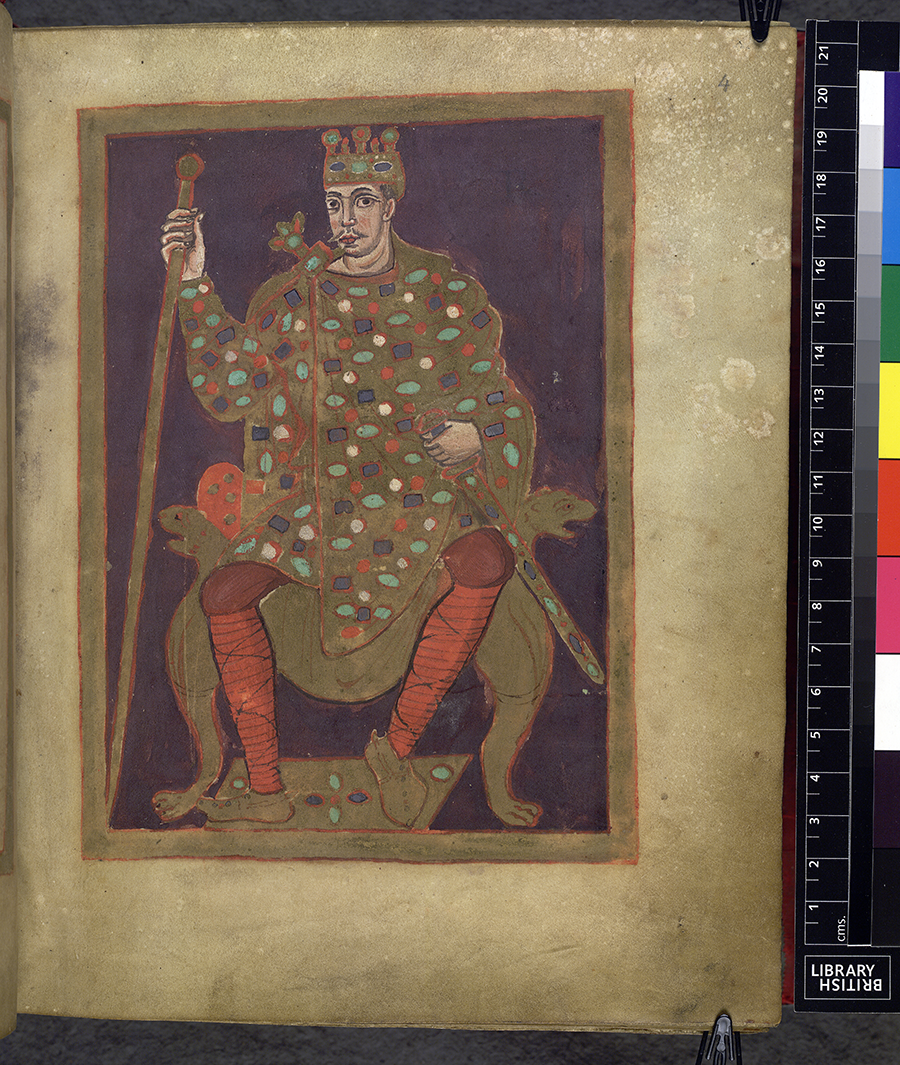
We encounter numerous modes of framing images throughout medieval manuscripts. Amongst the simplest frame designs is a rectangular band, as we see in the Lothar Psalter from the Carolingian period (Fig. 2). Note that the frame has created ample margins on the page, which contributes to the beauty of the layout. Frames thus existed not only to determine spaces for illustrations; they also generated margins.
 ©British Library Board |
Fig. 2. Lothar Psalter. Carolingian Empire, c.840-55, British Library, Add. MS 37768, fol. 4r [2] / An example of rectangular band. Carolingian Empire / Click here to take a closer look |
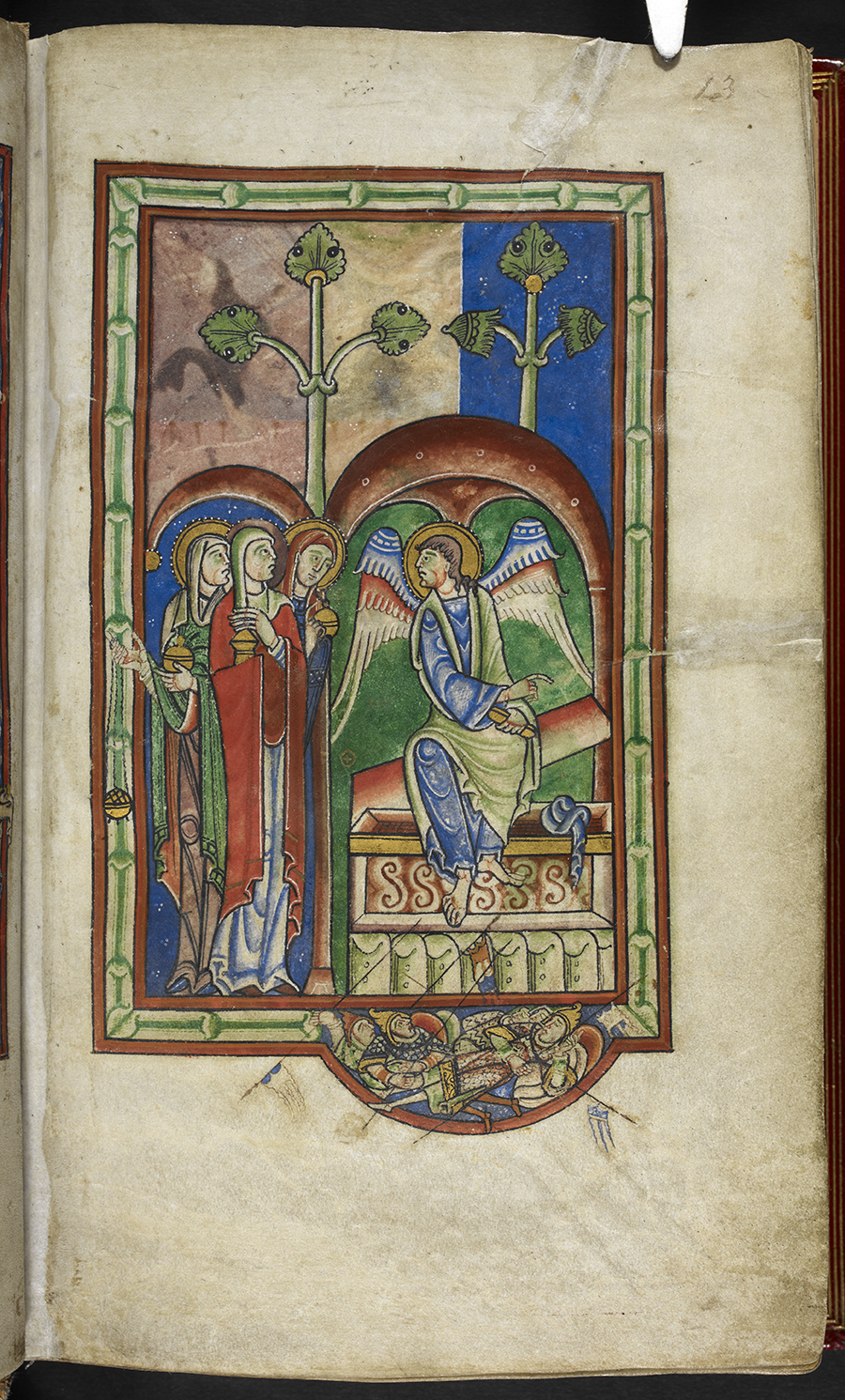
Frames limited and determined the areas in which the artists were allowed to wield their brushes. However, as with many rules, frames were often bent and transgressed in playful manners.
In this scene of the Three Maries visiting the tomb of Christ, the soldiers, who fell asleep while guarding the tomb, are compressed into a pit created by the bend in the lower frame (Fig. 3). They were literally, and quite cleverly, pushed out of the holy scene. Interestingly, the spears of the soldiers jut out of the frame into the lower margin, outside of the ‘official’ illustrative space, echoing, so to speak, the lowly status of these men.
 ©British Library Board |
Fig. 3. Shaftesbury Psalter. England, probably West Country, c.1130–40, British Library, Lansdowne MS 383, fol. 13r [3] / An example of the bend in the lower frame / Click here to take a closer look |
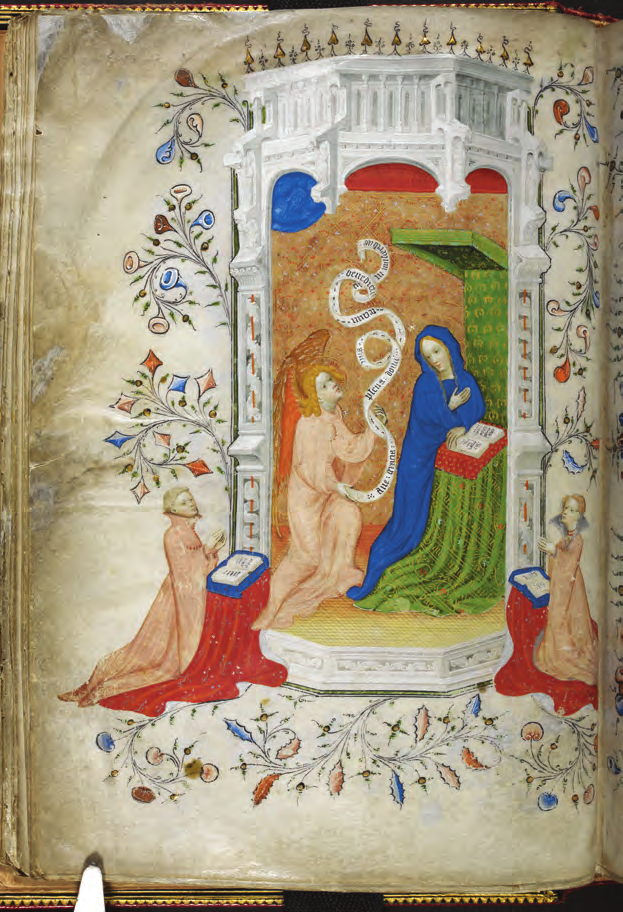
The creativity of artists did not stop there. Many frames mimicked architecture, thus literally ‘housing’ illustrations and often playing a double role as a pictorial frame and an architectural setting of a scene. In fact, in Fig. 3, above the Three Maries and the angel are an arch and a vault, respectively, which seem to serve as a building structure of the scene as well as frames for the two groups. This example is relatively modest, especially in comparison to the elaborate architectural frames that abound in later manuscripts. One exquisite example of this kind is Fig. 4, the Annunciation miniature with two donor portraits, who are assumed to be John Beaufort (d. 1439) and his wife Margaret Holland (d. 1439).
 ©British Library Board CC BY-NC-ND-4.0 Source:ResearchGate |
Fig. 4. The Beaufort/Beauchamp Hours. London, c.1440–43, with additions in Bruges and London (?), 1401–15, British Library, Royal MS 2 A. xviii, fol. 23v [4] / An example of architectural frames / Click here to take a closer look |
The illusionistic architectural frame, doubtless inspired by Gothic niches on church walls that housed statues of holy figures, presents to the reader the moment when Gabriel the Angel appears to the Virgin with the message from God. The two donors are physically separated from the holy event by the frame, being placed in the margin of the page, but on a closer look we notice that the edge of Gabriel’s robe transcends the frame and touches the fabric of John’s prie-dieu (a piece of furniture used for praying), as if to bridge the sacred and the earthly worlds. What an elegant play by the artist on the illusionistic frame of a manuscript page!
As the century progressed, the margin, that is, the place outside the frame, developed into an alternative space for illustrations, always remaining a less controlled area than the main illustrative space defined by a frame. In many cases, the images in the margin of a page refer to the text or illustration in the frame.
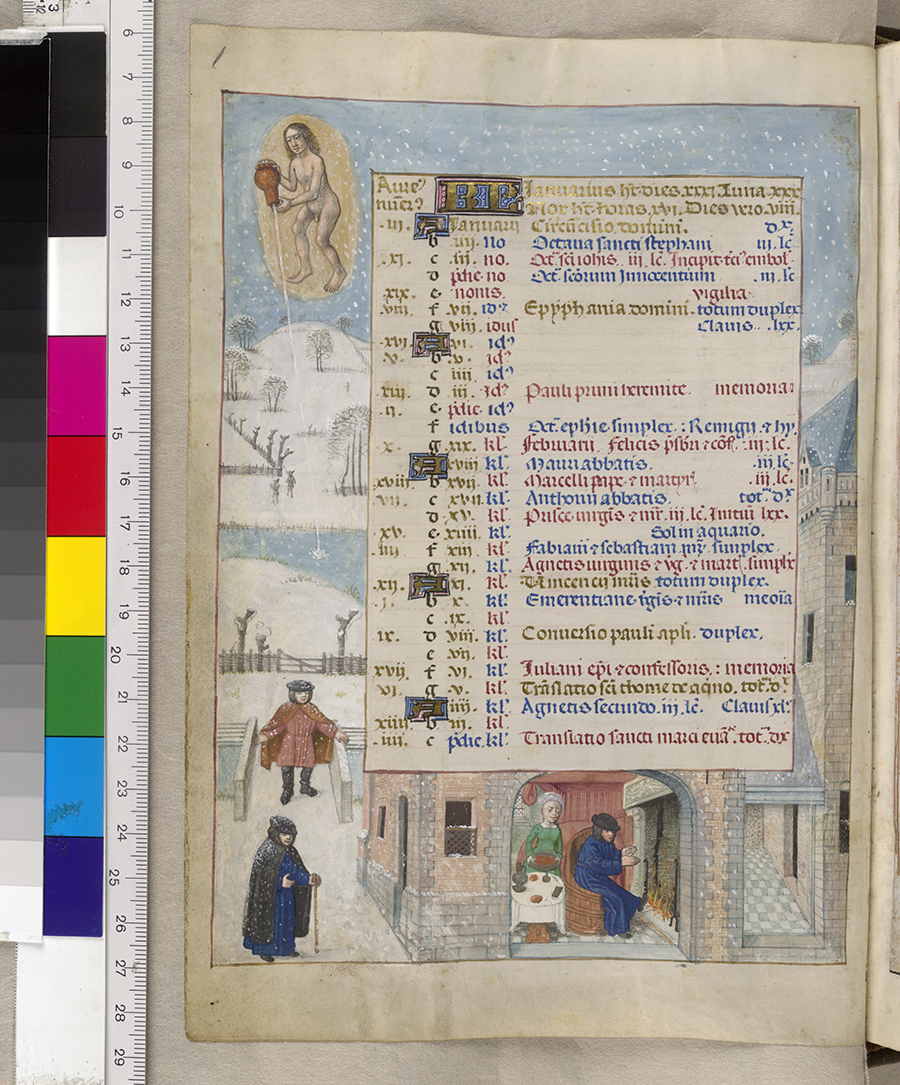
The lavishly illuminated manuscript, The Isabella Breviary, is replete with such marginal illustrations. The one shown here (Fig. 5), the January page of the calendar, is particularly charming.
 ©British Library Board |
Fig. 5. The Isabella Breviary. Bruges, 1492–1502, British Library, Add. MS 18851, fol. 1v [5] / Click here to take a closer look |
The backdrop of the framed calendar is a snowy village with two men hurrying towards a house, inside which is a cozy scene with a man (perhaps the same man as the one with a blue robe) warming in front of a crackling fireplace and a woman serving food, all visible to the reader through an open arch created on a wall of the house. Here, what used to be the ‘exterior’ of the frame has now come to the fore, telling a story and entertaining the eye of the reader.
Books featured in the article
All images are reproduced by permission of the British Library.
- Silos Apocalypse. Spain, Silos, 1109, British Library, Add. MS 11695, ff. 147v-148r.
- Lothar Psalter. Carolingian Empire, c.840-55, British Library, Add. MS 37768, fol. 4r.
- Shaftesbury Psalter. England, probably West Country, c.1130-40, British Library, Lansdowne MS 383, fol. 13r.
- The Beaufort/Beauchamp Hours. London, c.1440-43, with additions in Bruges and London (?), 1401-15, British Library, Royal MS 2 A. xviii, fol. 23v
- The Isabella Breviary. Bruges, 1492-1502, British Library, Add. MS 18851, fol. 1v.
Bibliography
- For a classical study of illustrated scrolls in Europe, see Kurt Weitzmann, Illustrations in Roll and Codex: A Study of the Origin and Method of Text Illustration [2d. print., with addenda], (Princeton University Press, 1970)
Global Codex: Hidden Stories of Books Across Cultures

Global Codex: Hidden Stories of Books Across Cultures





