Making a book your own
| Printing is a technology for mass production, so it is easy to assume that all copies of a printed book are identical. However, that is not always the case. |  |
It was very common for the first owner—and subsequent owners—to personalize their copies, turning mass-produced-items into a one-of-a-kind objects. Let’s look at how readers actively customized the pages of their books.
Coats of arms in printed books
Even if the printed text was exactly the same, a book was often considered “finished” only after a professional artist added hand-painted decorations or the owner’s coat of arms. In this way, a mass-produced item became a unique personal possession. Here we have an example of hand-painted coats of arms in printed books (Fig. 1). The first volume of the Keio copy of Vitae illustrium virorum bears the owner’s coat of arms, Francesco Chieregati, Bishop of Teramo in the Kingdom of Naples, at the bottom of the elaborate border decoration with ivy patterns. This is not a rare example, and you can find other examples of the painted coats of arms in the collections of the Keio University Library, British Library, and Cambridge University Library, and of course other libraries.
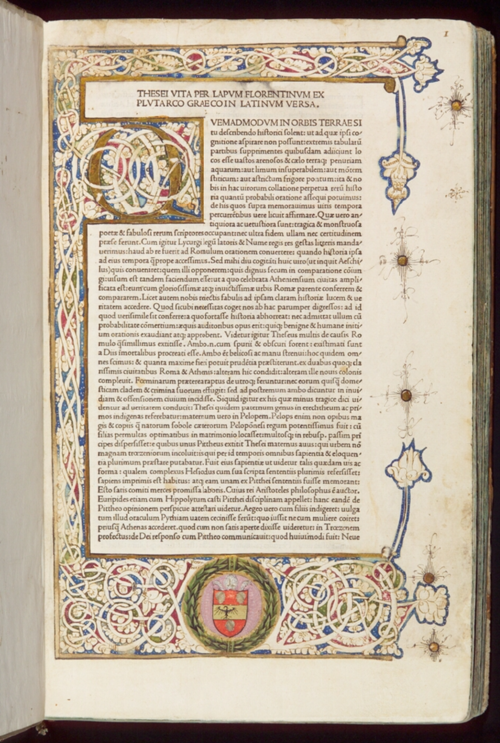 |
Fig. 1. Plutarchus, Vitae illustrium virorum. Venice, 1478, Keio University Library, 142X@51@2@1 [1] Click here to take a closer look |
Marginalia: leaving traces of mind
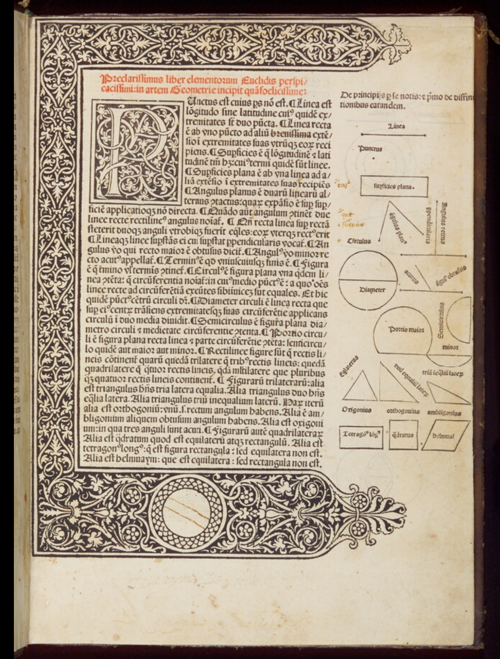
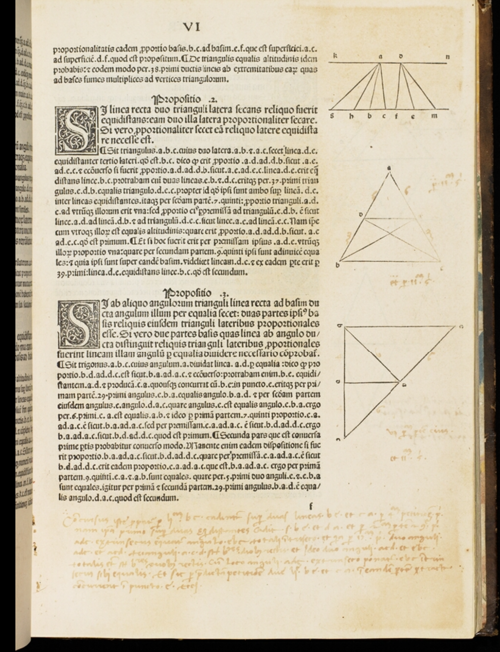
Take this first printed edition of Euclid’s Elementa Geometriae, featuring intricate geometrical figures in the margins (Fig. 2). Unlike the previous examples, the border decoration on the opening page was pre-printed. However, if you look at the bottom center—the space reserved for a coat of arms—you will see only two diagonal lines. The owner’s crest was never painted in. Instead, the traces of this copy’s owner can be found in the many diagrams and the vast amount of handwritten notes (marginalia) left in the margins. Since some of these notes cover the same geometry we still learn in school today, we can see how hard people studied over 400 years ago. It makes these early scholars feel surprisingly relatable, doesn’t it?
 Closer look |
 Closer look |
Fig. 2. Euclides, Elementa geometriae. Venice, 1482, Keio University Library, 120X@766@1 [2]
A personal anthology: Creating a “playlist” of books
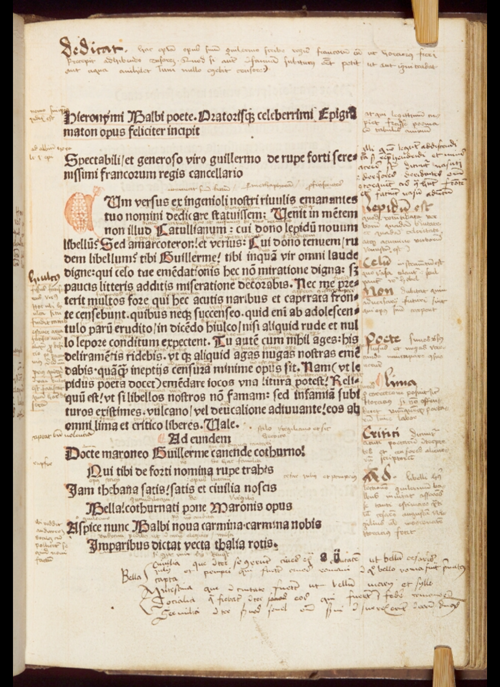
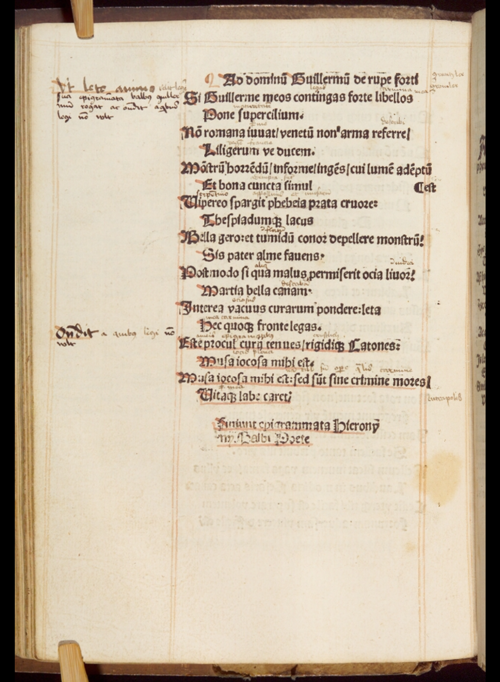
Readers also curated their own content. This fascinating volume, a bound copy of seven works of Neo-Latin verse and its composition (Fig. 3) brings together seven different texts on Latin verse and composition, produced by five different printers, and used for university-level humanistic studies. Marginalia and interlinear glosses are inserted by several hands, and at least the same hand annotated two texts; these traces demonstrate that this book was heavily used for study.
This kind of personal anthology book is called “Sammelband” using a German word. The practice of binding multiple distinct texts of the same format into a single volume based on the owners’ decisions and tastes was common in the manuscript period and also in the incunabula period. Much like how we create our own music playlists today, the owner curated their favorite or most necessary works to create a unique, personalized book.
 Closer look |
 Closer look |
Fig. 3. Hieronymus Balbus, Epigrammata, bound with six other works. Leipzig, c.1490–95, Keio University Library, 120X@860@1 [3]
Interleaved copies and physical alterations
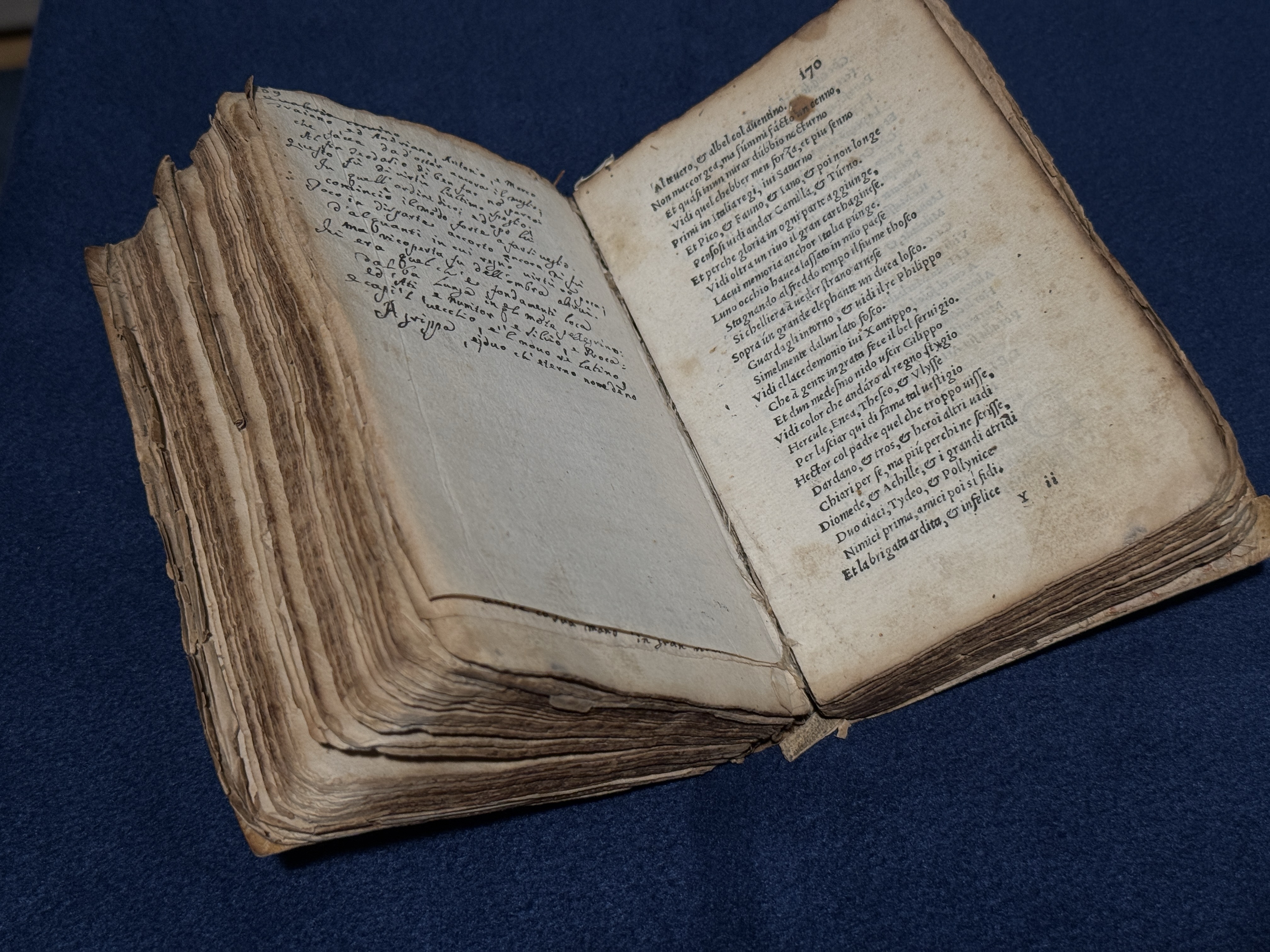
Sometimes, owners altered the physical structure of the book itself, driven by a variety of personal motives. Scholars occasionally had books rebound with blank sheets interleaved between the printed pages, providing ample space for extensive commentary. These “interleaved” copies reveal the owner’s intent to transform a printed work into a personal, evolving dialogue—a testament to a life spent in deep, hands-on engagement with knowledge.
In this particular example (Fig. 4), the owner even used these blank sheets to hand-write missing pages that had been lost from the original printed book. Although it is a small volume, you can truly feel the immense time and effort the owner poured into it.
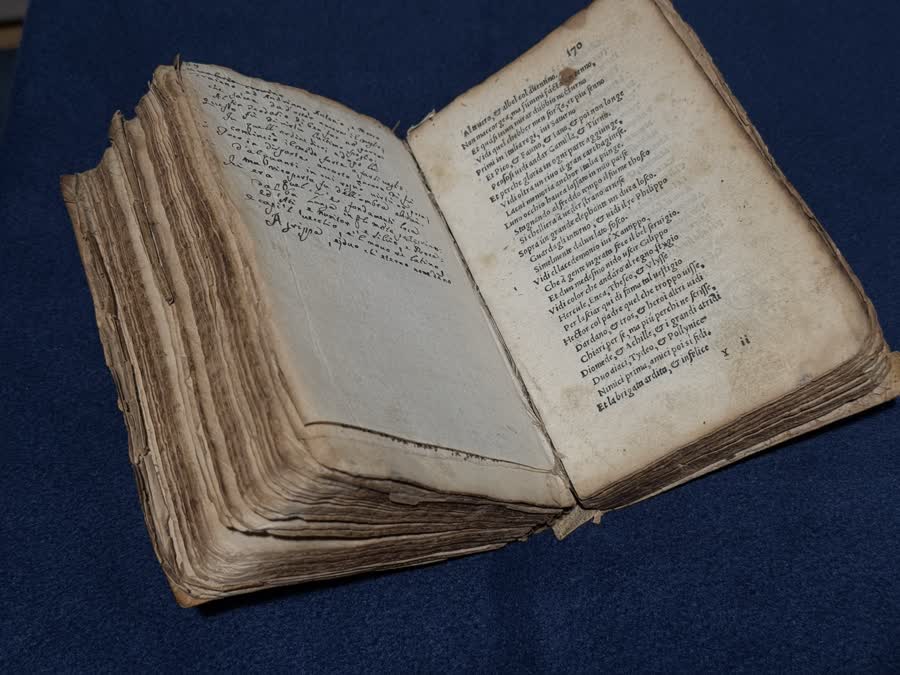 |
Fig. 4. A bound volume of two works by Petrarch. Venice, 1520s, private collection [4] Closer look |
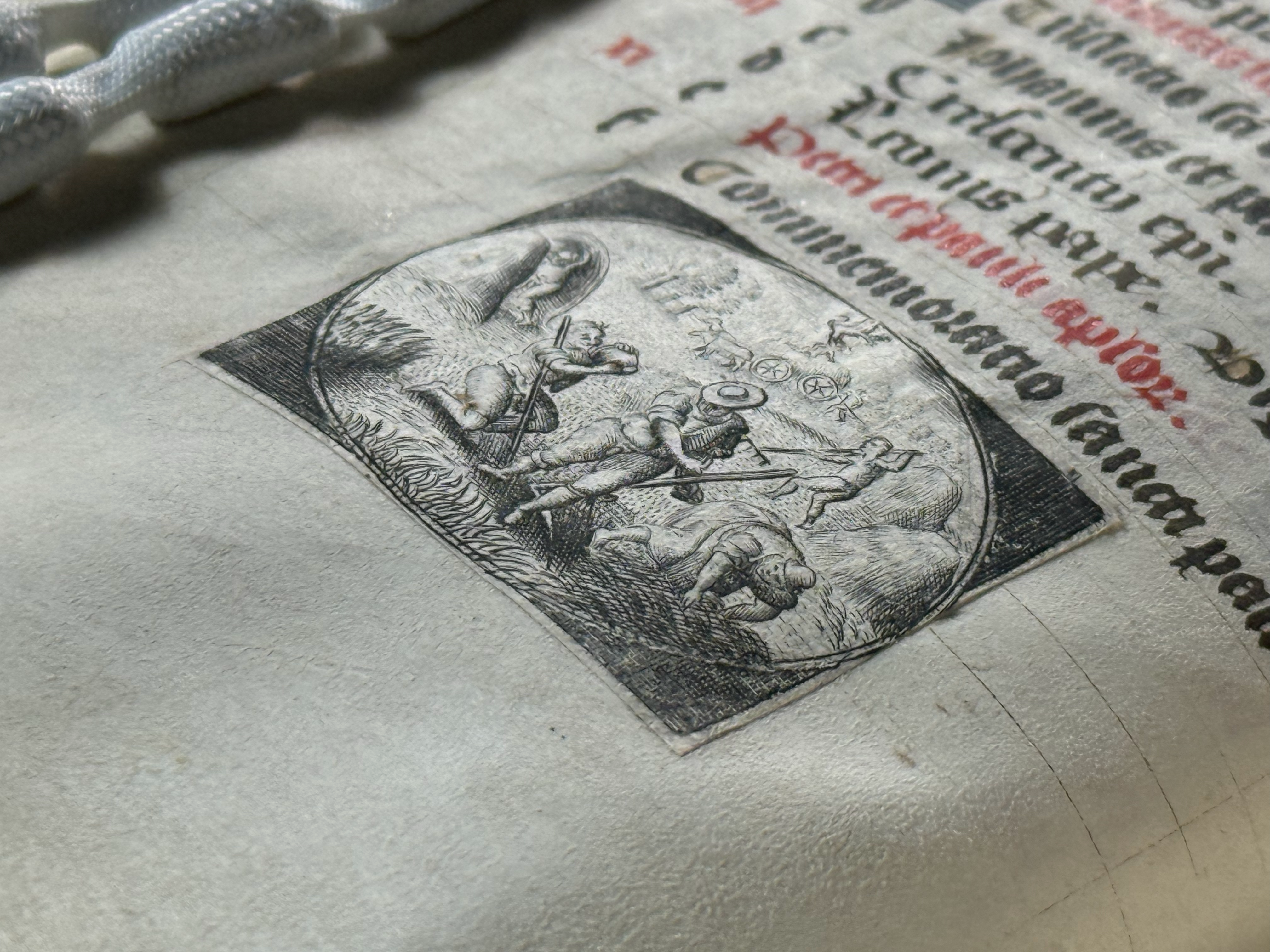
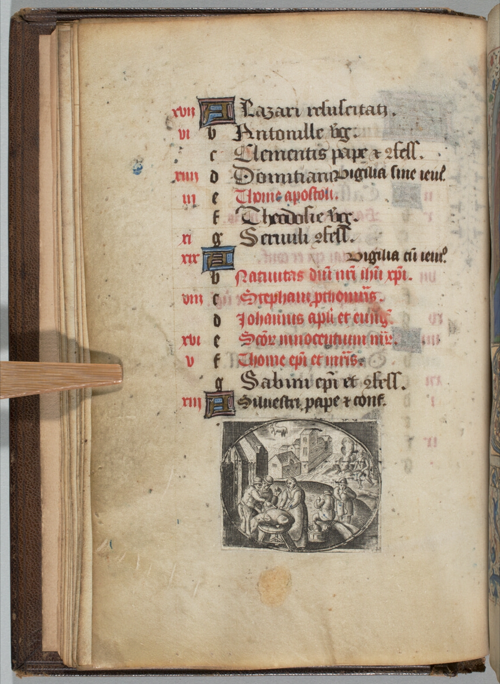
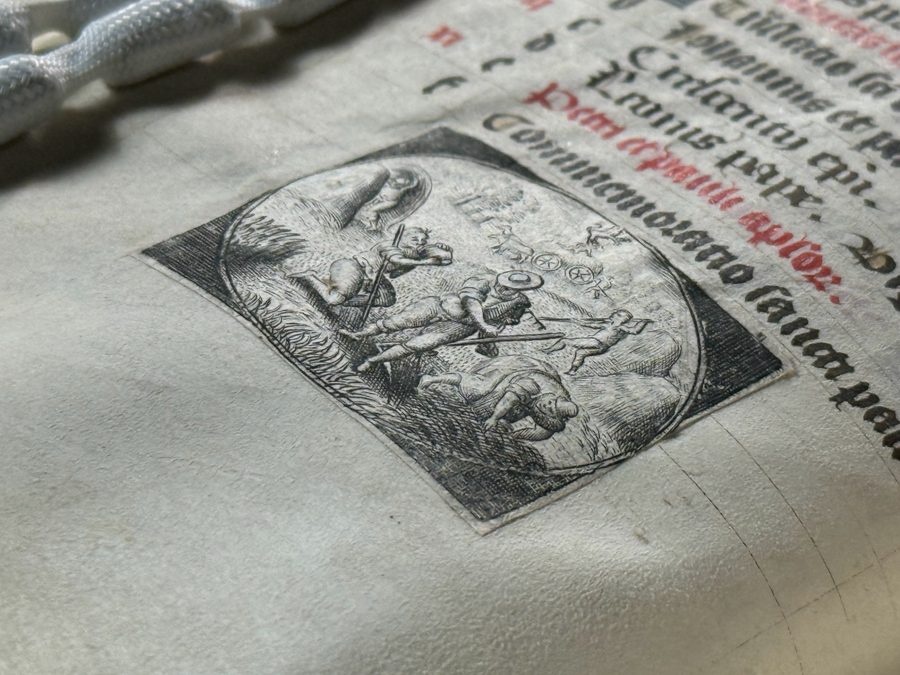
Other times, owners modified pages by physically adding new visual material. For instance, in this 15th-century vellum manuscript Book of Hours [5], a later 17th-century copperplate prints were pasted onto the calendar pages (Fig. 5). It may look as if the monthly scenes were illustrated in black and white directly on the vellum surface, but a close-up image shows the upper right corner is slightly pasted out from the surface. It demonstrates that this Book of Hours was still in use and cherished after two hundred years from its production.
 Closer look |
 Closer look |
Fig. 5. Book of Hours in Latin. Rouen, c.1465–85, Keio University Library, 120X@680@1
17th-century print was pasted on the calendar pages of a 15th-century vellum manuscript Book of Hours. [5]
Fore-edge painting
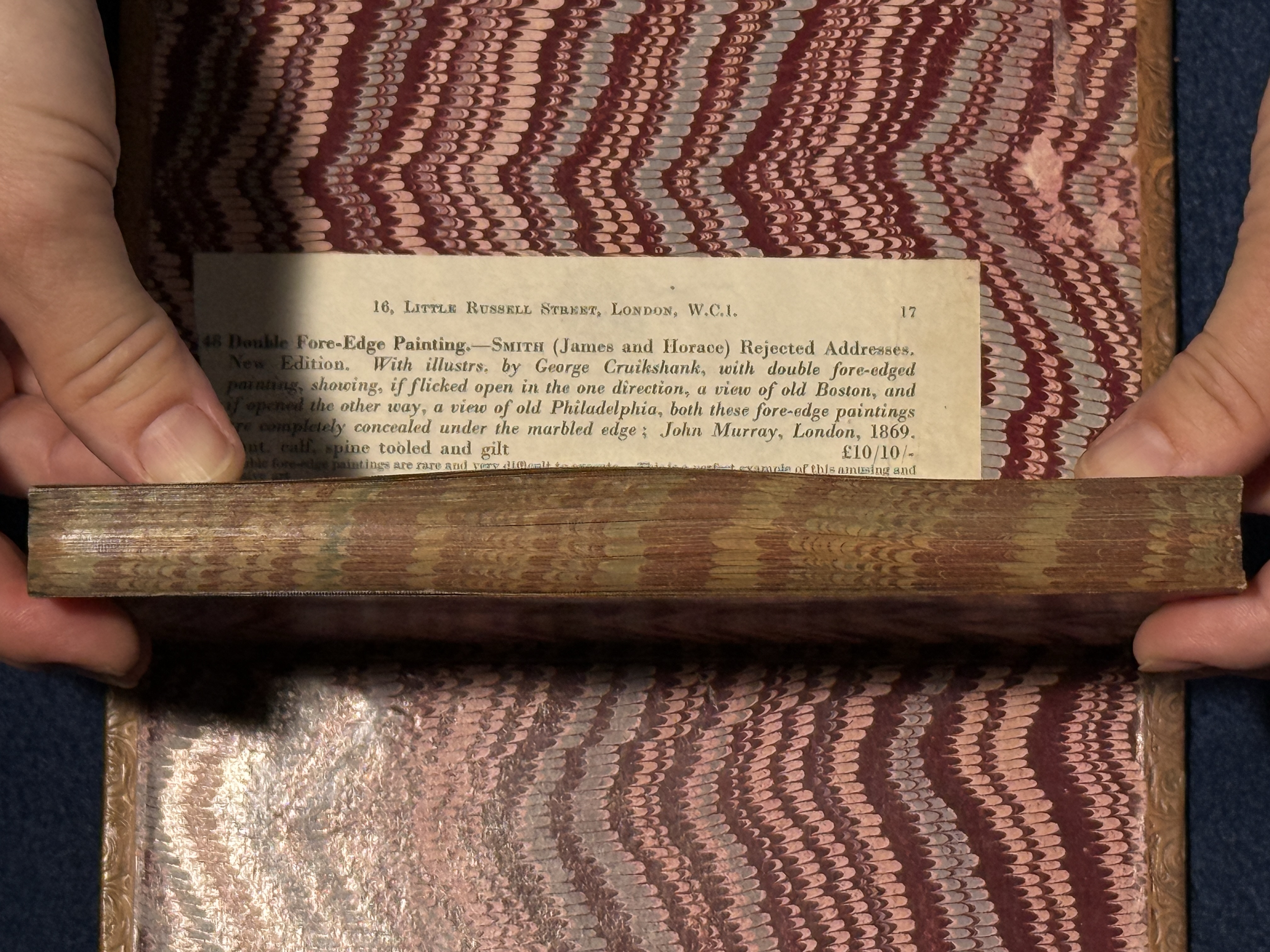
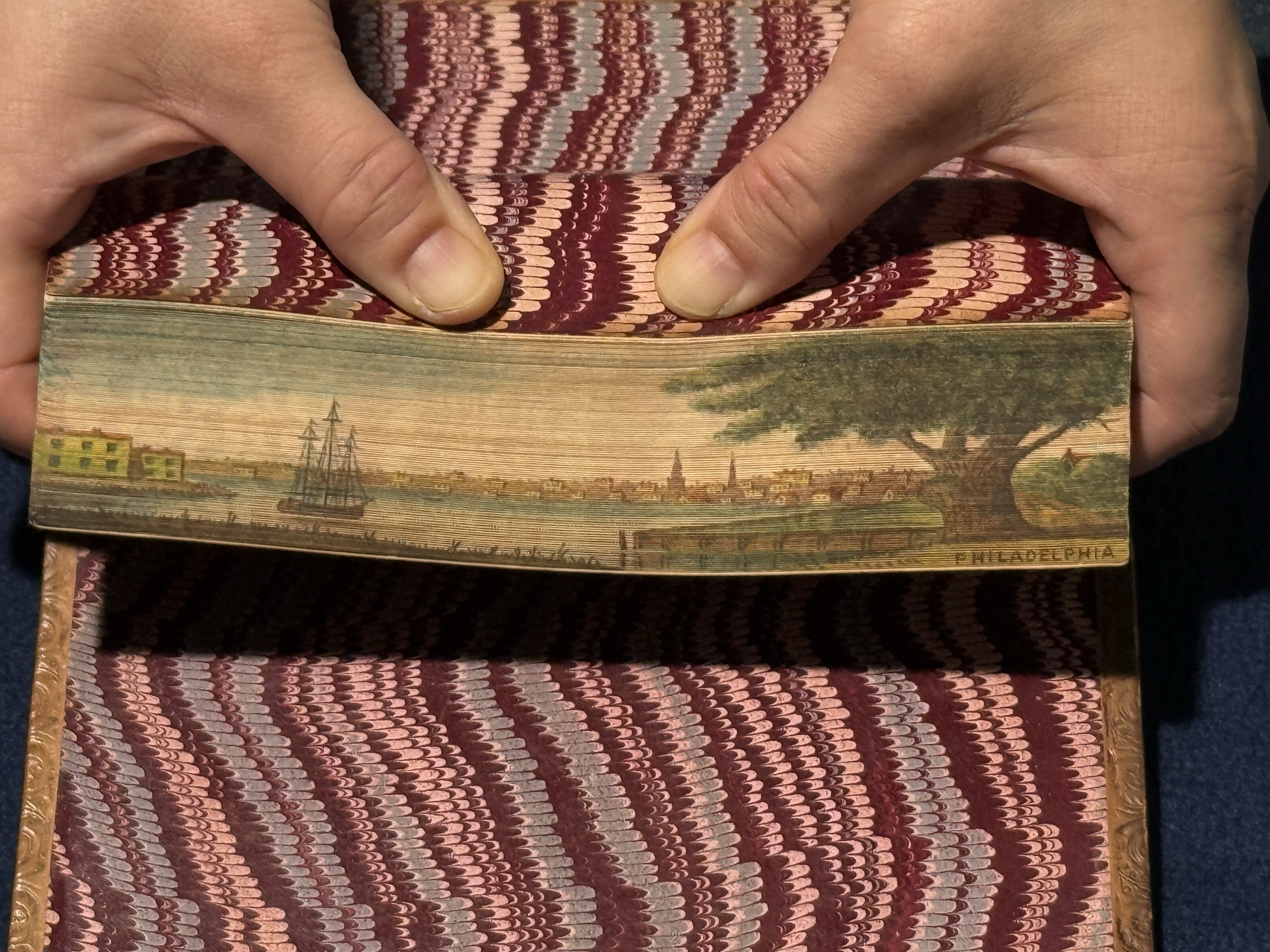
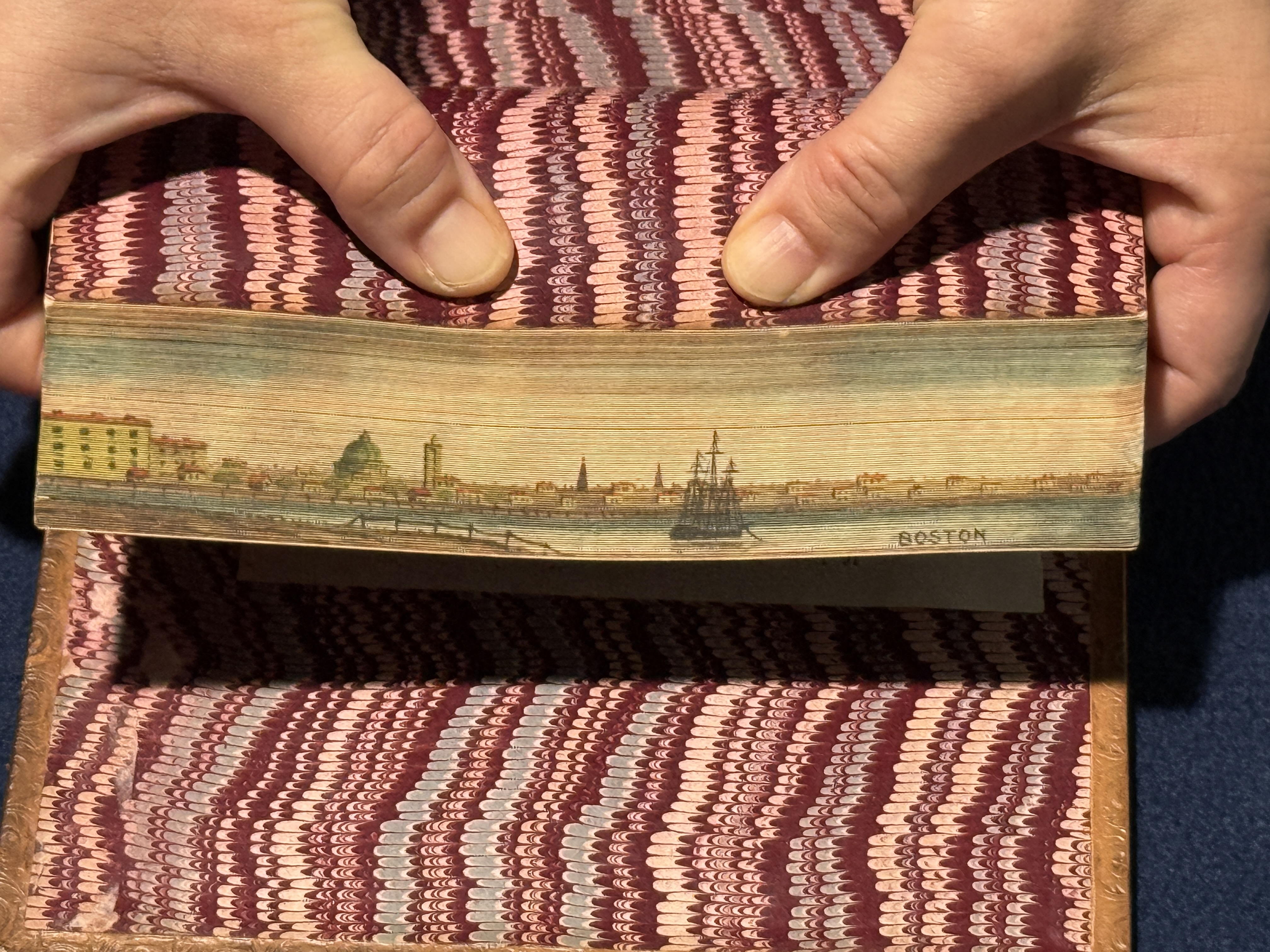
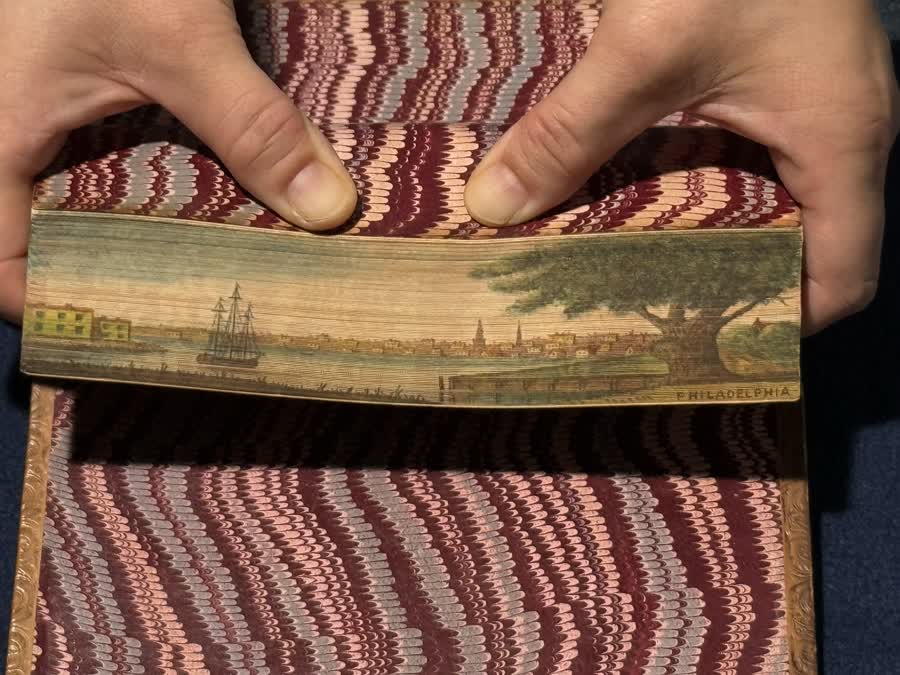
At first glance, this might look like a beautiful but typical 19th-century book. But look a little closer—the owner had a stunning secret custom-made just for this single copy. While the page edges (the fore-edge) feature a marbled pattern that matches the endpapers (Fig. 6), fan the pages slightly to one side, and a view of Philadelphia suddenly appears (Fig. 7). This decorative technique is known as fore-edge painting. It gained popularity in England from the late 18th to the 19th century, and during the 20th century, it was often added to older volumes as well.
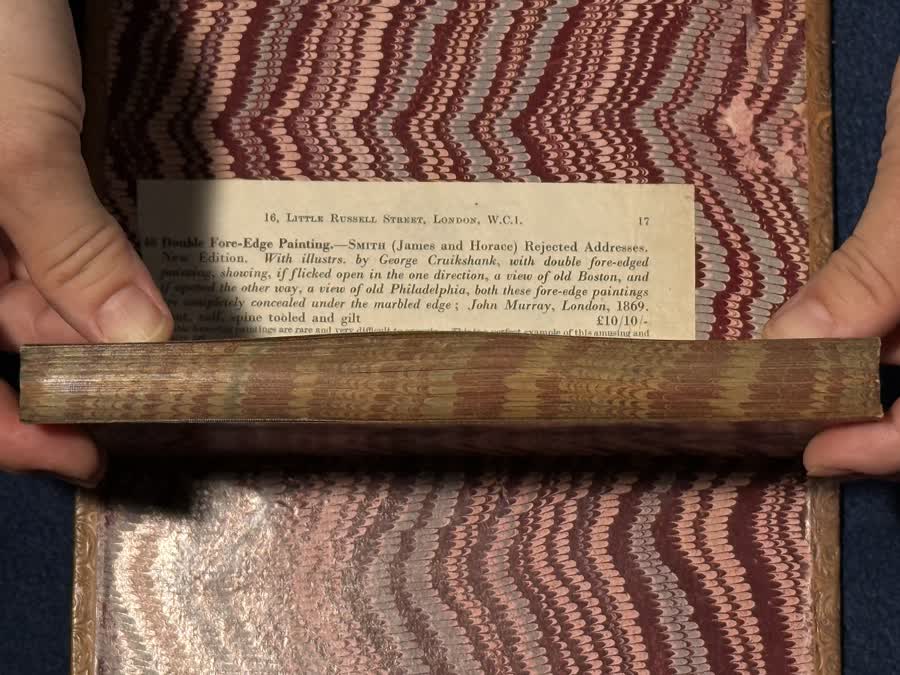 |
Fig. 6. James Smith and Horace Smith, Rejected Addresses; or, The New Theatrum Poetarum, with illustrations by George Cruickshank. New edition. London, 1869, private collection Marbled Fore-edge [6] Closer look |
 Closer look |
 Closer look |
| Fig. 7. James Smith and Horace Smith, Rejected Addresses; or, The New Theatrum Poetarum, with illustrations by George Cruickshank. New edition. London, 1869, private collection Fore-edge painting (Philadelphia) [6] |
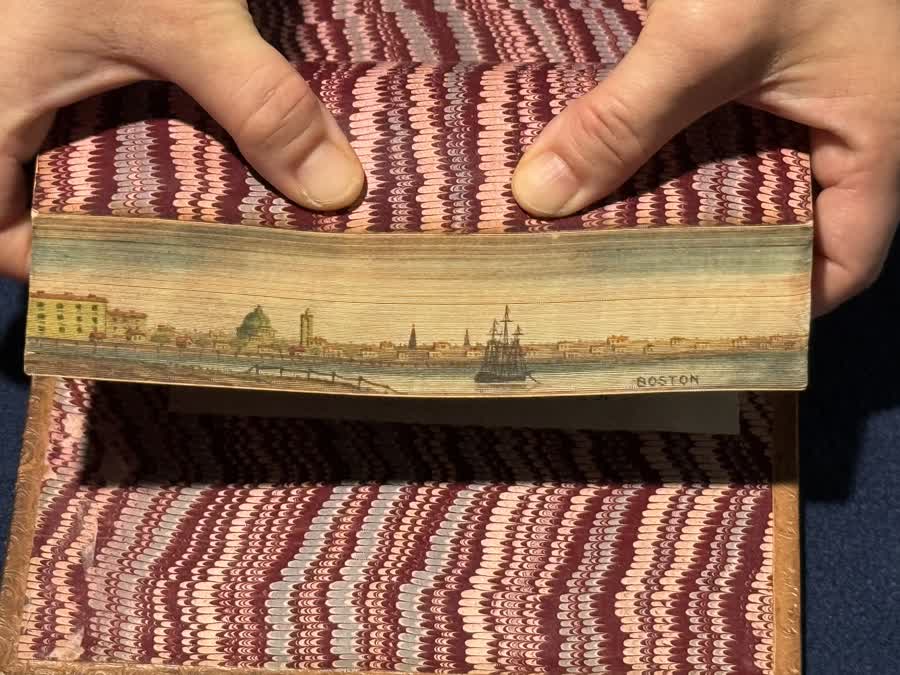
Fig. 8. James Smith and Horace Smith, Rejected Addresses; or, The New Theatrum Poetarum, with illustrations by George Cruickshank. New edition. London, 1869, private collection Fore-edge painting (Boston) [6] |
What makes this particular book even more special is that if you fan the pages in the opposite direction, a second painting emerges—this one showing a scenic view of Boston (Fig. 8). This is an example of a “double fore-edge painting.” It’s a truly one-of-a-kind volume, hiding a breathtaking piece of art that only its owner knows is there.
Through these unique additions, such as whether adding hand-painted decorations to printed books, writing in the margins, binding texts together, pasting in new visuals, or hiding secret paintings on the fore-edge, owners transformed static books into evolving and personalised treasures.
Books featured in the article
- Plutarchus, Vitae illustrium virorum. Venice, 1478, Keio University Library, 142X@51@2@1
- Euclides, Elementa geometriae. Venice, 1482, Keio University Library, 120X@766@1
- Hieronymus Balbus, Epigrammata. Leipzig, c. 1490-95, Keio University Library, 120X@860@1
- A bound volume of two works by Petrarch. Venice, 1520s, private collection
- Book of Hours in Latin. Rouen, c. 1465‒85, Keio University Library, 120X@680@1
- James Smith and Horace Smith, Rejected addresses; or, The new theatrum poetarum, with illustrations by George Cruickshank. New edition. London, 1869, private collection
Global Codex: Hidden Stories of Books Across Cultures

Global Codex: Hidden Stories of Books Across Cultures