Statistical codicology
| So far, we’ve looked closely at individual fragments and books, discovering how much we can learn from their physical details. |  |
But what happens when we step back and look at hundreds — or even thousands — of books at once?
In this article, I’ll introduce you to statistical codicology, an approach that uses measurements and data to reveal broader patterns in the history of books.
Statistical codicology / quantitative codicology
As we’ve seen so far in this course, the size and shape of bound books vary greatly, depending on the period, region, and type of book. This step introduces a research approach that analyses data on page sizes—whether made of paper or parchment. This field is often referred to as statistical codicology or quantitative codicology.
This method statistically examines numerical data such as the overall size of a book (height + width = taille), its aspect ratio (width/height = proportion), and the relationship between its size and thickness. While “codicology” usually refers to the study of manuscripts, this approach can be applied to any bound book, whether it’s a handwritten manuscript or an early printed book.
For example, take a look at this book (Fig. 1). Measured by its cover, it stands 490 mm tall. Even the text pages themselves measure 471 mm high, 335 mm wide, and 150 mm thick—making a single page larger than a standard sheet of modern A3 paper (297 mm × 420 mm). Bound in thick wooden boards covered with leather, this visually massive volume weighs an astonishing 16.8 kg. Its content? A medieval encyclopedia. Seeing how big and thick it is, that content probably makes a lot of sense, doesn’t it?
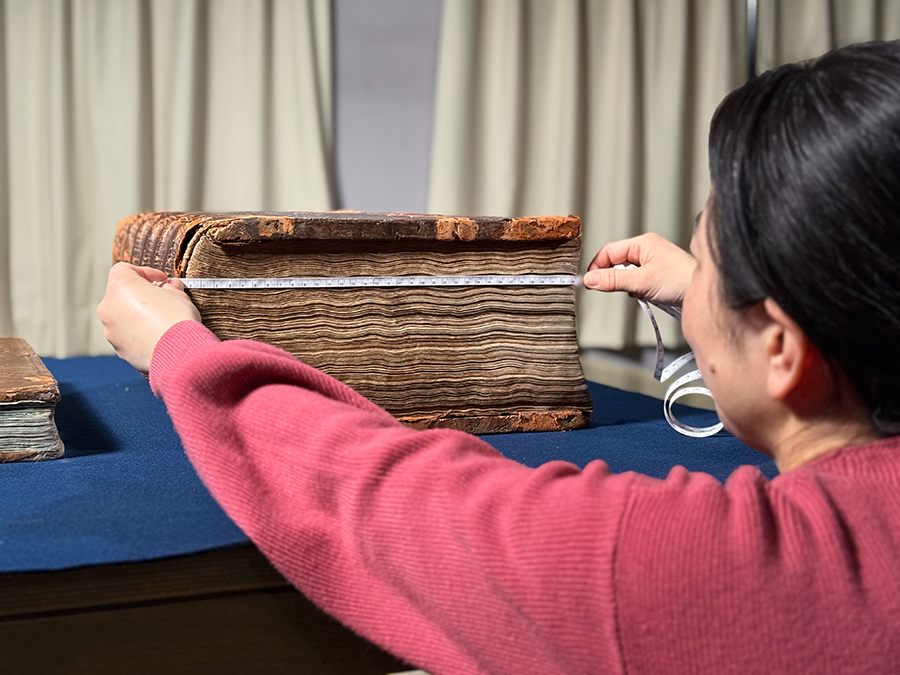 |
Fig. 1. Vincentius Bellovacensis, Speculum historiale. Strassburg, 1476-80, also recorded as c.1473, Keio University Library, 143X@13@1 [5] Closer look |
Even today, many of us may expect encyclopedias and dense academic books to be large hardcovers, while light fiction comes in compact paperbacks. There has been a connection between a book’s physical form and its purpose, to a certain extent—a relationship that grew naturally out of shared expectations between bookmakers and readers.
Proportion and taille of the books
So, what can we learn when we look at book sizes and proportions on a scale of hundreds or even thousands of volumes?
A pioneering study by Bozzolo and Ornato, which surveyed over 2,000 medieval French manuscripts, revealed that their aspect ratio (proportion) was heavily concentrated between 0.67 and 0.72.
Because the proportions of most books fall within this relatively consistent range, adding the height and width together—a measurement called taille—gives us an intuitive way to grasp and compare book sizes. Bozzolo and Ornato categorised taille into the following four size brackets:
- Petits (small): under 320 mm
- Petit-moyens (small- medium): 320–490 mm
- Moyen-grands (medium-large): 491–670 mm
- Grands (large): over 670 mm
Looking at changes in taille over time shows us how books gradually became smaller alongside shifts in reading habits, such as the growth of universities and the popularity of personal prayer books made for individuals.
In recent years, studies focusing on proportion and taille have really taken off. Researchers have used these metrics to examine English verse manuscripts, as well as nearly 5,000 liturgical manuscripts produced between 500 and 1601. Analyses connecting book size with thickness are also advancing. By focusing on these physical dimensions, we can better understand where a specific work or manuscript fits within the broader context of book history.
While most of the medieval manuscripts described above were written on parchment, this typical proportion carried over to incunabula (early printed books), which were mostly printed on paper. As mentioned in Step 2.8, the paper size ratios established in 14th-century Italy—which were in a sense passed down to modern A-series paper—matched the silver ratio (1:1.414). In terms of proportion, this is around 0.70. Some researchers believe these paper ratios originated in the Islamic world. In fact, Gumbert pointed out that this ratio originally arose from the most efficient way of cutting parchment from animal skins. The possible historical relationship between paper and parchment as primary writing supports is also fascinating.
Examples
Now, let’s look at some printed books of various sizes from the Keio University Library as an example.
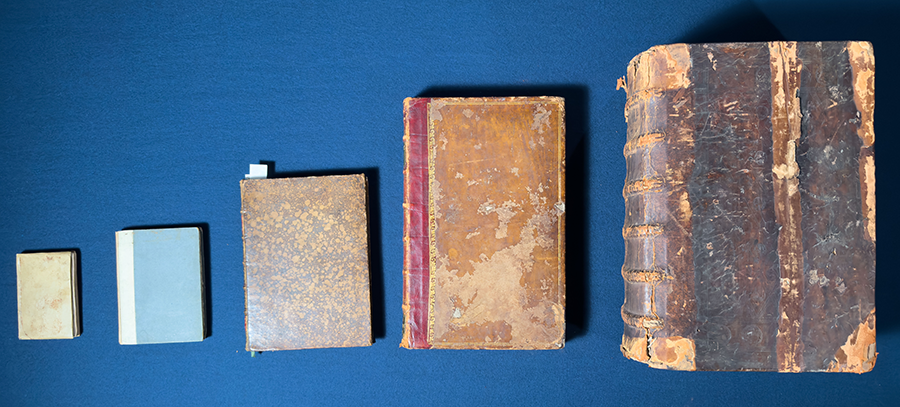
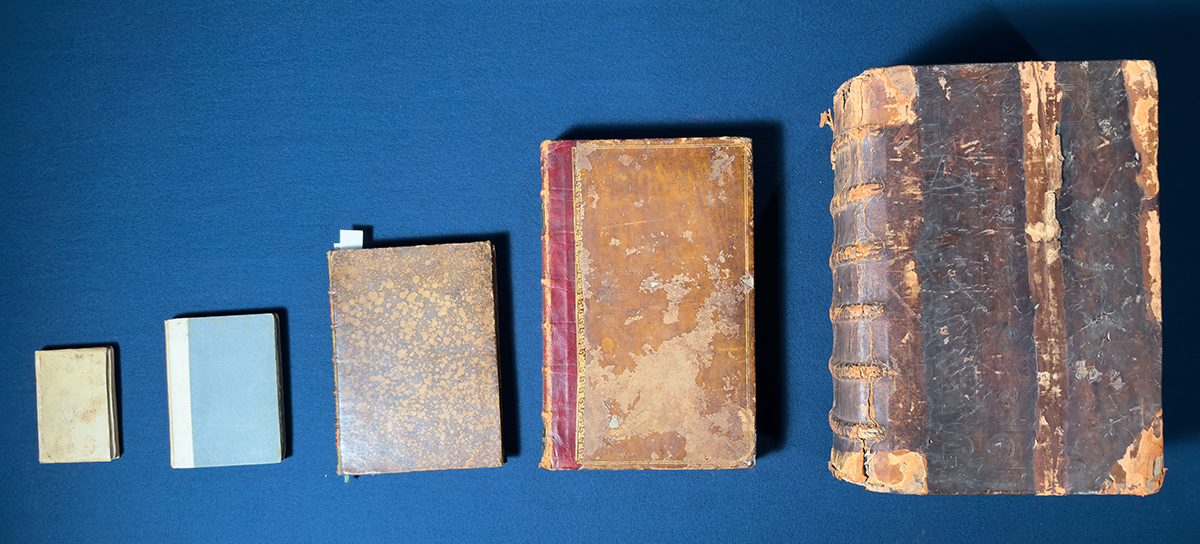
Fig. 2. Five examples of various sizes of the books Closer look
In this photo, the books are lined up from left to right, going from smallest to largest.
From the left:
- Book #1: Parte de Qvisiti del S. Aleesandro Tassoni Modonese…Dati in luce da G. Cassiani [1]
- Book #2: Renascence: : A book of verse [2]
- Book #3: Elementa geometriae [3]
- Book #4: Vitae illustrium virorum [4]
- Book #5: Speculum historiale [5]
If we summarise the page dimensions of each volume alongside their calculated taille and proportion, we get a table (Table 1) like the one below.
Table 1 – Taille and propotion of five books in Fig. 1
| Book #1 | Book #2 | Book #3 | Book #4 | Book #5 | |
|---|---|---|---|---|---|
| Format | octavo | quarto | folio | folio | folio |
| Height (mm) | 148 | 191 | 289 | 425 | 471 |
| Width (mm) | 99 | 146 | 204 | 261 | 335 |
| Taille | 247 | 337 | 493 | 686 | 806 |
| Proportion | 0.67 | 0.76 | 0.71 | 0.61 | 0.71 |
| Taille category | petits | petits | moyen-grands | grands | grands |
Looking at the taille, you can see how drastically the overall sizes differ, whereas the proportion values stay remarkably consistent across the board—though you might notice that the quarto format is slightly squarer than the rest.
The largest volume here is the medieval encyclopedia we saw at the beginning of this Step, which was compiled and used by clergy members. The second and third largest books contain marginal notes left by their readers; in particular, the volume in the middle—Euclid’s work on geometry—shows signs of very earnest study. On the other hand, the two smallest volumes were light reading intended for personal use, showing no marginalia or handwritten notes.
Data collection and digital humanities
When conducting large-scale research on taille and proportion, physically measuring every single book one by one isn’t practical. That’s where the information recorded in library catalogues plays a key role. Researchers collect data by extracting details from printed manuscript catalogues or, more recently, from online library catalogues (OPACs) and open datasets.
However, standard library catalogues often only record the rounded-up height of the outer cover (since their main goal is just figuring out which shelf the book fits on). That means width measurements and the exact sizes of the paper or parchment pages inside are frequently missing.
Fortunately, libraries and archives around the world are increasingly publishing digital images of their collections. If technology develops to automatically estimate exact page dimensions using rulers included in these digital photos, we’ll be able to analyse trends based on even larger datasets in the future.
In book history, the close examination and close reading of an individual volume will always be essential. At the same time, since the progress of digitisation gives us broader access to metadata, page images, and text data, we can now collect massive amounts of information for quantitative analysis. This new computational approach to humanistic materials is known as Digital Humanities (or digital scholarship in the humanities), and it has advanced rapidly in recent years. It’s an exciting field that is opening up whole new doors in the study of books.
Books featured in the article
- S. Alessandro Tassoni, Parte de Quisiti del S. Alessandro Tassoni Modonese … Dati in luce da G. Cassiani. Modona, per Giulian Cassiani, 1608, private collection
- Walter Crane, Renascence : a book of verse. E. Mathews, 1891, private collection
- Euclides, Elementa geometriae. Venice, 1482, Keio University Library, 120X@766@1
- Plutarchus, Vitae illustrium virorum. Venice, 1478, Keio University Library, 142X@51@2@1
- Vincentius Bellovacensis, Speculum historiale. Strassburg, 1476-80, also recorded as c. 1473, Keio University Library, 143X@13@1
References
- Bozzolo, C., & Ornato, E. (1980). Pour une histoire du livre manuscrit au Moyen Age : trois essais de codicologie quantitative. Editions du Centre national de la recherche scientifique.
- Gumbert, J. Peter. (1993). Sizes and Formats. In Marilena Maniaci and Paola F. Munafo (Eds), Ancient and medieval book materials and techniques: Erice, 18–25 September 1992, Studi e Testi (pp. 227–63, 357–58). Biblioteca Apostolica Vaticana.
Global Codex: Hidden Stories of Books Across Cultures

Global Codex: Hidden Stories of Books Across Cultures