
What does the codex mean to us?
Over the past three weeks, we have explored books from many different regions and perspectives.
Along the way, we have discovered how much they can reveal beyond the words and images they contain.
As we bring our journey to a close, let’s return to Dunhuang, where our journey began, and consider one final question: what does the codex mean to us as human beings?
Related courses from Keio University
If you enjoy this course, you might also be interested in the following related courses on FutureLearn offered by Keio University.
- Japanese Culture Through Rare Books – 3 weeks course
- Sino-Japanese Interactions Through Rare Books – 4 weeks course
- The Art of Washi Paper in Japanese Rare Books – 3 weeks course
- Travelling Books: History in Europe and Japan – 3 weeks course
You’ll enjoy learning more about Japanese culture, how Chinese culture influenced Japanese culture, the beauty of Washi paper used in rare books and history of books in Europe and Japan. Please join us!
Credits
Educators and invited speakers (in order of appearance)
Keio University
- Takahiro Sasaki, Professor, Keio Institute of Oriental Classics
- Satoko Tokunaga, Professor, Faculty of Letters, Department of English and American Literature
- Mayumi Ikeda, Associate Professor, Faculty of Science and Technology, Department of Foreign Languages and Liberal Arts
- Mari Agata, Professor, Faculty of Letters, Department of Library and Information Science
The British Library
- Mélodie Doumy, Lead Curator, Chinese Collections (Stein and Hoernle) and manager of International Dunhuang Programme (IDP)
- Karen Limper-Herz, Head of Printed Heritage Collections
University of Cambridge
- Alessandro Bianchi, Head of World Collections, University of Cambridge Libraries and Archives
- Yasmin Faghihi, Head of Near and Middle Eastern Department, University of Cambridge Libraries and Archives
- Orietta Da Rold, Professor in Medieval Literature and Manuscript Studies, Academic Director of the Cambridge University Library Research Institute
- Irène Fabry-Tehranchi, French Specialist, Collections and Academic Liaison, University of Cambridge Libraries and Archives
- Laura Moretti, Professor of Early Modern Japanese Literature and Culture, Department of East Asian Studies, Faculty of Asian and Middle Eastern Studies
Invited speakers
- Eric White, Scheide Librarian and Assistant University Librarian for Special Collections, Rare Books and Manuscripts, Princeton University Library
- Azusa Tanaka, Japanese Studies Librarian, University of Washington Library
Production
British Library
- Luisa Elena Mengoni – Director of Collections
- Sara Chiesura – Head of East Asian Collections, Asian and African Collections
- Jiyeon Wood – Lead Curator East Asian Collections (Japanese and Korean)
- Yasuyo Ohtsuka – Curator, Japanese Collections
- Han-Lin Hsieh – Curator, Chinese Collections
- Annabel Teh Gallop – Lead Curator, Southeast Asian Collections
- Jana Igunma – Ginsburg Curator, Thai Lao Cambodian Southeast Asian Collections
University of Cambridge Libraries and Archives
- Alessandro Bianchi – Head of World Collections
- Suzanne Paul – Keeper of Rare Books and Early Manuscripts
- Amelie Roper – Head of Research, University Library Research Institute
- Hiroko Roberts-Taira – Senior Library Assistant, Japanese Collections
- Emily Dourish – Deputy Keeper of Rare Books and Early Manuscripts
- Liam Sims – Rare Books Specialist, Rare Books and Early Manuscripts
Keio University
- Keiko Okawa – Executive producer, Keio University
- Alanur Imin – Producer, Keio University
- Shoko Matsuura – Producer, Keio University Press
- Yukiteru Date – Administrative supporter, Keio University
- Yukiko Maeda – Administrative supporter, Keio University
- Mika Sakanashi – Administrative supporter, Keio University
- Takashi Kuramochi – Rare books coordinator, Keio University Library
- Akihiko Matsuzawa – Video director, director of photography, editor
- Takahiro Niibe – Camera crew (Japan)
- Dimitris Mastroyiannis – Camera crew (UK)
- Goki Miyakita – Visual designer, Keio University
- Hidekazu Goto – Editor, Keio University Press
- Ruri Totsuka – Editor, Keio University Press
- Junko Azuma – IP advisor
- Janak Bhimani – English proofreader
Libraries, museums and institutions
- The British Library (UK)
- University of Cambridge Libraries and Archives (UK)
- Dunhuang Academy (China)
- The Imperial Household Agency (Japan)
- National Institute of Japanese Literature (Japan)
Keio University
- Keio Institute of Oriental Classics
- Keio Museum Commons
- Keio University Library
- Research Institute for Digital Media and Content, Keio University
- Keio University Global Research Institute
Get extra benefits, upgrade your course
You can now get extra benefits by upgrading this course, including:
Unlimited access to the course: Go at your own pace with unlimited access to the course for as long as it exists on FutureLearn.
A Certificate of Achievement or Statement of Participation: To help you demonstrate your learning we’ll send you a Certificate of Achievement or Statement of Participation when you become eligible.
Global Codex: Hidden Stories of Books Across Cultures
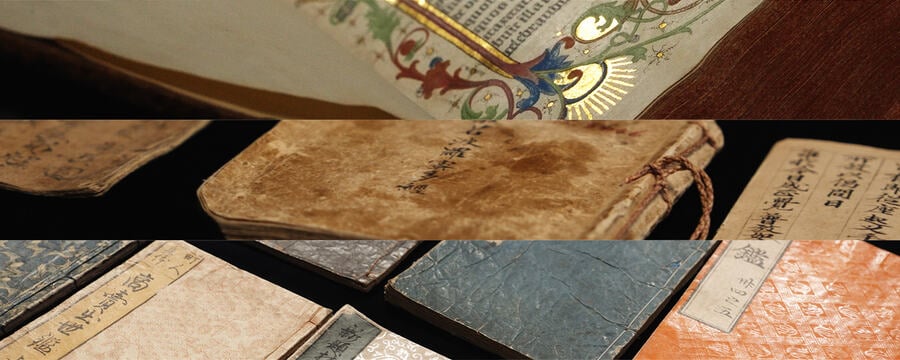

Global Codex: Hidden Stories of Books Across Cultures


