
Building a skill
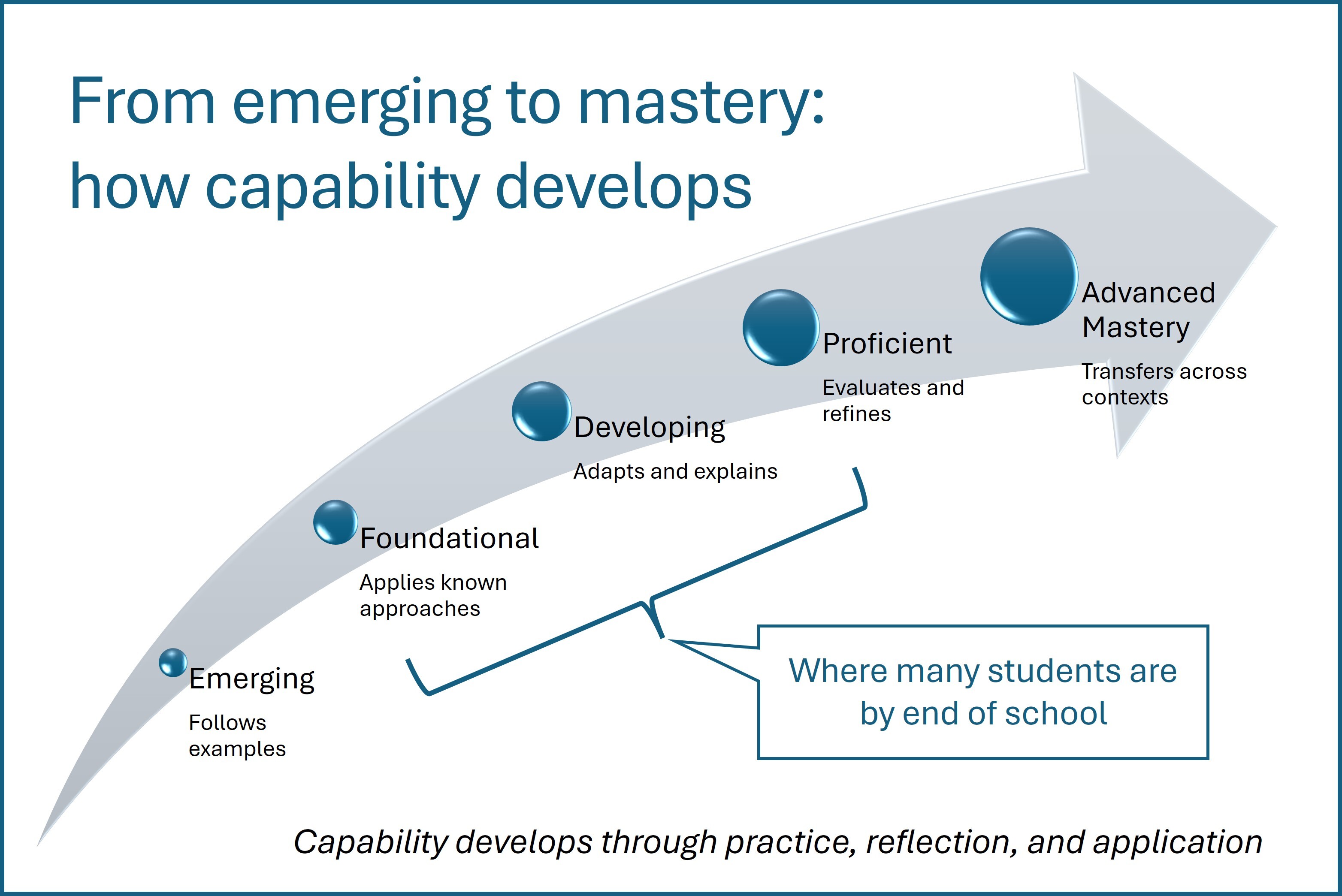
When we talk about transferable or durable skills, it can be tempting to think of them as something students either have or don’t have.
In reality, skills develop over time. They are built through repeated experiences, across different subjects, contexts, and challenges. A single task rarely develops a skill on its own. Instead, capability grows gradually as students encounter opportunities to practice, reflect, and apply what they are learning in new situations.
Let’s take an example: problem-solving.
At an early stage, a student may:
- follow a set process with guidance
- attempt simple tasks with support
- rely on familiar strategies
As they develop, they begin to:
- choose between different approaches
- adapt when something doesn’t work
- explain their thinking
At more advanced levels, students can:
- tackle unfamiliar problems
- combine ideas from different areas
- evaluate and refine their approach independently
This progression from emerging to more sophisticated capability is reflected in many skills frameworks. The Common Core State Standards Initiative emphasise the development of skills like reasoning, problem-solving and communication over time, rather than as one-off achievements.
In Europe, the European Commission’s Key Competences for Lifelong Learning similarly highlight that capabilities like critical thinking, creativity, and learning to learn are developed across different learning experiences and contexts.
Across these frameworks, there is a shared idea: Skills are cumulative, not isolated. However, this is not always how learning is experienced by students. In many classrooms, learning is structured as a series of tasks:
- complete the assignment
- submit the work
- move on to the next topic
When this happens, students may not see how their capability is building over time. Each task feels separate, rather than part of a larger learning journey. This is another aspect of the recognition gap. The skill is developing, but the progression is not always visible. Helping students recognise this growth does not require new content. It requires making the learning process more explicit:
- noticing the skills being used
- connecting learning across experiences
- reflecting on how capability is developing over time
Example: Critical thinking (Progression of Capability)
Adapted to align with OECD and PISA
These frameworks describe how problem-solving develops from structured tasks to complex, independent reasoning.
Emerging
- Identifies simple information or ideas
- Responds to questions with guidance
- Accepts information at face value
What it looks like: A student can recall or recognise information but may not question or interpret it independently.
Foundational
- Begins to interpret information
- Identifies obvious differences between ideas or perspectives
- Offers simple explanations for their thinking
What it looks like: A student can explain their thinking in familiar situations but may rely on surface-level understanding.
Developing
- Compares different ideas or viewpoints
- Uses evidence to support their thinking
- Recognises when information may be incomplete or biased
- Begins to justify decisions
What it looks like: A student can analyse information, consider alternatives, and explain why they reached a particular conclusion.
Proficient
- Evaluates information from multiple sources
- Weighs evidence and considers reliability
- Identifies assumptions and limitations
- Forms well-reasoned judgements
What it looks like: A student can critically assess information, draw reasoned conclusions, and explain their thinking with evidence.
Advanced / Mastery
- Critically evaluates complex and conflicting information
- Synthesises ideas across different domains
- Challenges assumptions and reframes problems
- Makes informed judgements in uncertain or ambiguous situations
What it looks like: A learner can navigate complexity, evaluate competing perspectives, and make defensible, well-informed decisions.
Where would a high school graduate typically be?
Most students, by the end of secondary school, are working between foundational to proficient. They can:
- compare and evaluate ideas
- use evidence to support their thinking
- form reasoned judgements
But may still be building confidence in highly complex or ambiguous situations and the ability to synthesise across different domains.
Reflection
Think about your own capbility, where are you at Proficient or Mastery and how has that developed over time?
Lifelong Learning: Recognise and Articulate School Skills

Lifelong Learning: Recognise and Articulate School Skills





