
Ms Rivera’s rewritten essay task
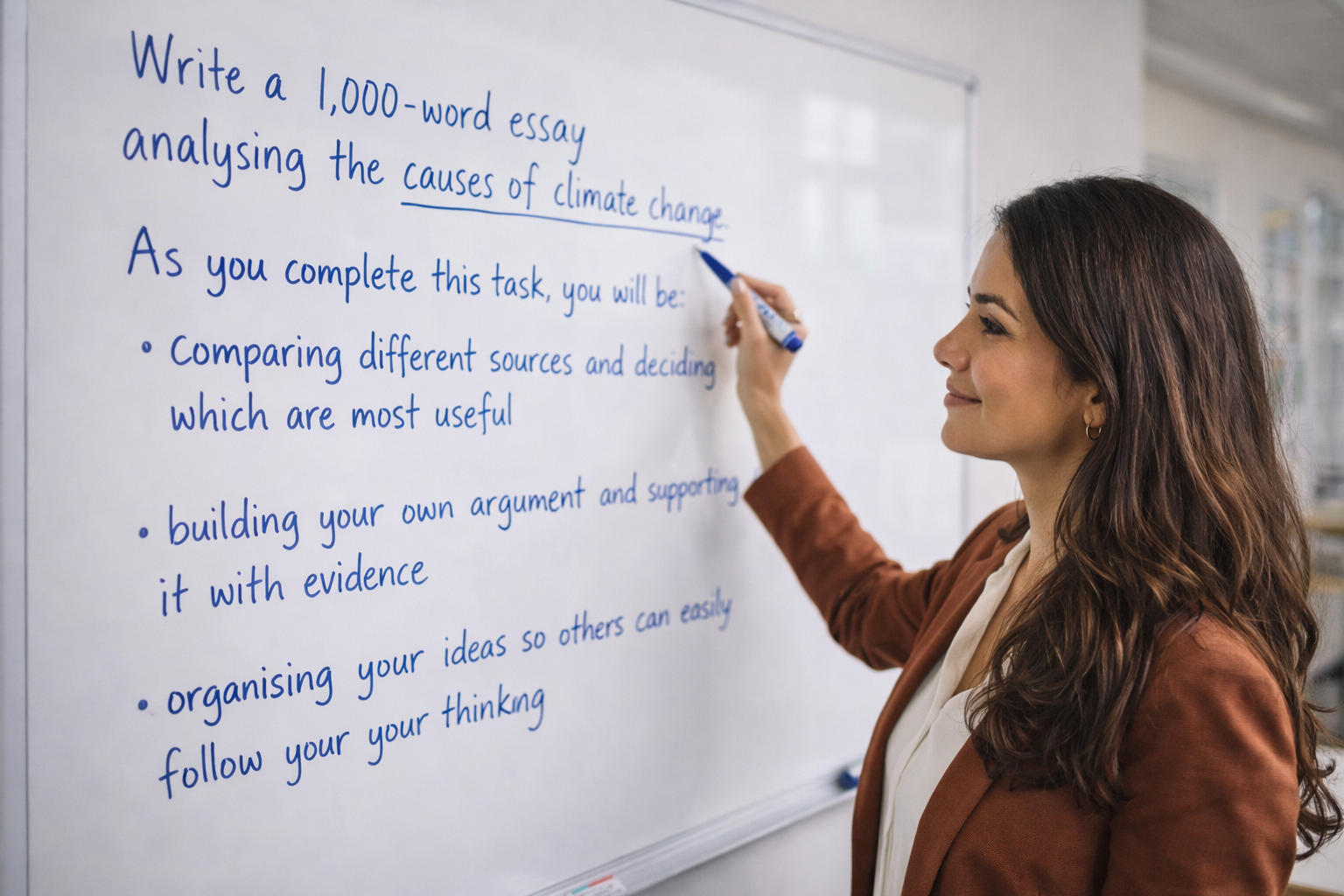
Ms Rivera sets a familiar task.
Write a 1,000-word essay exploring the causes of climate change. As you complete this task, focus on:
- explaining the key factors contributing to climate change
- using evidence from at least three sources
- organising your ideas clearly to support your argument
- analysing information
- selecting and evaluating sources
- constructing an argument
- organising their ideas
- communicating their thinking clearly
Write a 1,000-word essay analysing the causes of climate change. As you work though this task, you will be:
- comparing different sources and deciding which are most useful (critical thinking)
- building your own argument and supporting it with evidence (reasoning / argumentation)
- organising your ideas so others can easily follow your thinking (communication)
These are skills you will continue to use across different subjects and contexts. Analysing information, evaluating evidence, building arguments, and communicating clearly are important across further study, workplaces, and community settings.
The task, academic standard and assessment hasn’t changed, but the second version makes the skills visible. It helps students see not just what they are writing about but also the skills and capability they are developing and how they can be used beyond the classroom.
Using Skills Language
This is what it looks like to translate a classroom task into skills language. You don’t need to rewrite everything or change the syllabus. It’s about making small, intentional shifts in how we describe learning. Instead of focusing only on, “What needs to be completed”, we also begin to highlight, “What this shows you can do”.
For a student:
- In the first version, they might think: “I need to write an essay.”
- In the second, they are more likely to think: “I am learning how to build an argument and use evidence.”
That is a very different way of experiencing the same task and relates directly to skills literacy. When we make skills visible in this way, we help students to:
- recognise what they are doing
- articulate it in meaningful language
- see evidence of it in their work
- and begin to translate it beyond the task
Points to consider
- Think about a task you regularly set. How might you adjust the wording slightly to make the skills more visible to students?
- Could you design a short activity that helps students investigate how these skills are used in different jobs, industries, or community contexts?
Lifelong Learning: Recognise and Articulate School Skills


Lifelong Learning: Recognise and Articulate School Skills





