
Simple prompts to surface skills
The following prompts are designed to help students move beyond describing what they did, and begin to show what they can do.
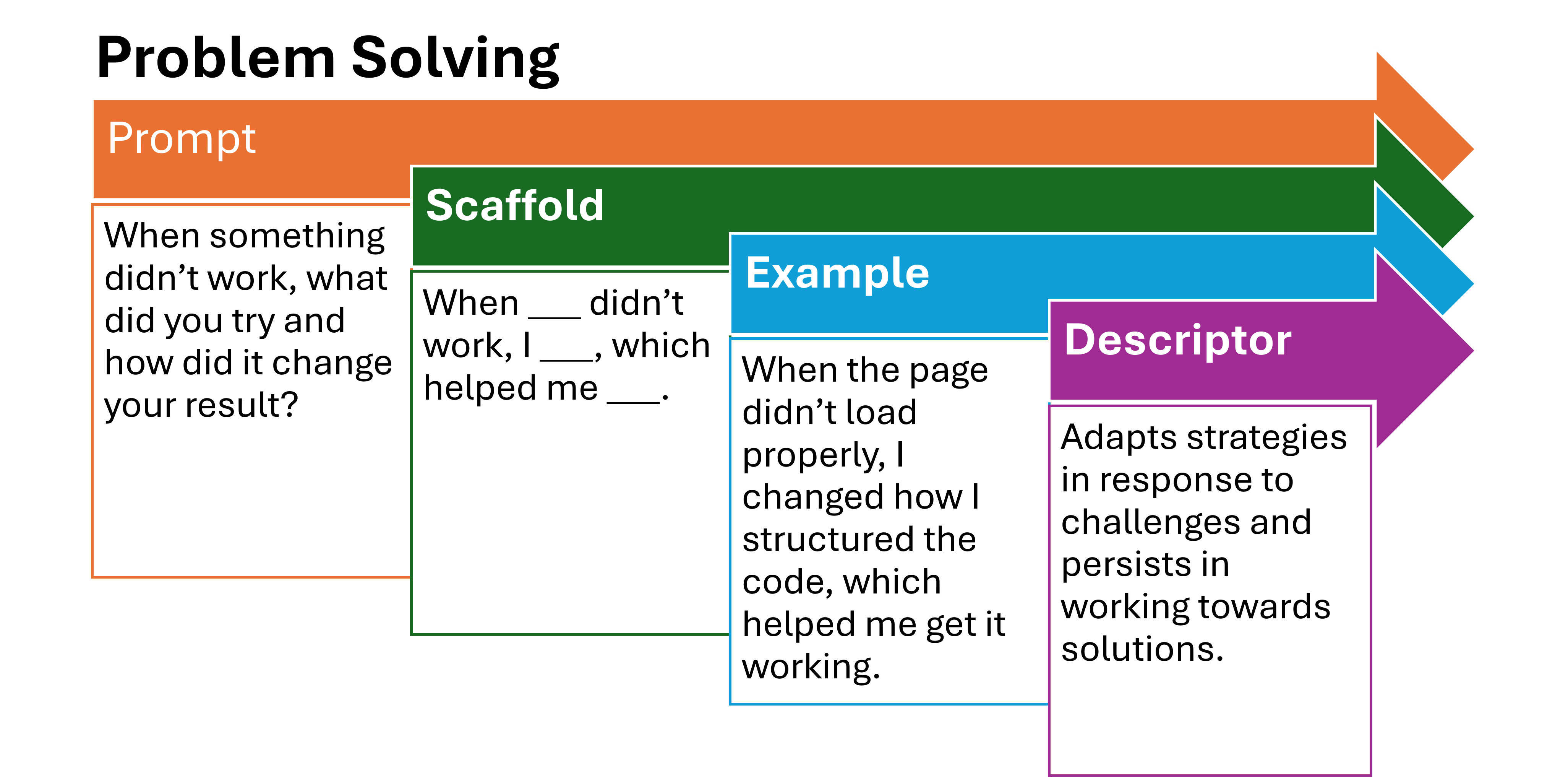
The first prompt is a text version of the diagram above.
Each one includes a simple sentence starter to support students in getting started and is linked to a skill and descriptor adapted from OECD Learning Compass 2030.
Skill: Problem-solving
Prompt: When something didn’t work, what did you try and how did it change your result? This prompt helps students focus on:
- what went wrong
- what they did next
- what improved as a result
Scaffold: When __ didn’t work, I __, which helped me ___.
Example: When the page didn’t load properly, I changed how I structured the code, which helped me get it working.
Descriptor: Adapts strategies in response to challenges and persists in working towards solutions.
Skill: Critical thinking
Prompt: What choices did you make, and why did you choose that approach? This prompt helps students focus on:
- decisions they made
- reasons behind those decisions
- how those decisions shaped the outcome
Scaffold: I chose to __ because __, which resulted in ___.
Example: I chose to simplify the layout because it made the message clearer, which resulted in a better final design.
Descriptor: Evaluates options, makes informed decisions, and reflects on the impact of those decisions.
Skill: Applying learning
Prompt: What can you now do, and where else could you use this? This prompt helps students focus on:
- what has changed
- what they are now capable of
- how that might apply beyond this task
Scaffold: I can now __, and I could use this when __.
Example: I can now build and adjust simple interactive features, and I could use this when creating other digital projects.
Descriptor: Applies learning in new contexts and transfers knowledge and skills across situations.
Using These in Practice
Using these in practice can begin quite simply. You might introduce one prompt at a time, using the scaffold as a sentence starter to support students as they build confidence. As they become more familiar with the language, you can gradually remove the scaffold and encourage more independent responses. Over time, students begin to recognise what they are doing, explain it more clearly, and show what they can do in different contexts.
Lifelong Learning: Recognise and Articulate School Skills


Lifelong Learning: Recognise and Articulate School Skills





