
Building Credible Evidence
Credible evidence is not just understandable. It is something others can trust and use with confidence. This is what allows learning to be recognised beyond the classroom.
From Usable to Credible
Earlier, we looked at how evidence becomes usable through action, context and impact. This allows someone to interpret what happened. But credibility asks a different question:
Is this a reliable indication of what the student can do?
Because evidence is rarely used in isolation. It is often read, interpreted, and acted on by others:
- another teacher
- a school leader
- a future educator
- a parent
- an employer
For that to happen, the evidence needs to do more than describe. It needs to hold up under interpretation.
What Makes Evidence Credible?
Credibility is not about adding more detail for its own sake. It is about whether the evidence is strong enough to support a judgement. We can think about this through three simple questions:
1. Can I interpret this clearly?
Is it easy to understand what the student actually did? Vague statements such as:
- “Worked well”
- “Completed the task”
do not provide enough clarity. Clear descriptions focus on observable actions.
2. Does this feel reliable?
Does the evidence suggest this is something the student can do again? Credible evidence shows:
- decision-making
- adjustment
- reasoning
It moves beyond one-off completion to show how the student approached the task.
3. Could this support a decision?
Would this help someone make a judgement about the student’s capability? For example:
- giving feedback
- reporting progress
- identifying next steps
- supporting pathways
If the answer is yes, the evidence is more likely to be credible.
An Example
One of the areas I’ve worked in a lot is project management. If someone asks me for an example, I might say: “I’m good at problem-solving.” But this is just a skill statement. It names the skill, but it doesn’t show how it is applied. It is difficult for someone else to interpret or use.
A more developed version might be: “When a project wasn’t meeting its goals, I broke the problem into smaller parts, tested different approaches, and adjusted the plan based on what the data showed.” This is usable evidence. It shows:
- what I did
- how I approached the situation
- and the context in which it happened
Someone reading this can begin to understand how I solve problems.
We can take it one step further: “While leading the rollout of a new learning platform, the project began falling behind schedule due to low user engagement. I analysed usage data, identified where participants were dropping off, and worked with the team to redesign the onboarding experience. We tested different approaches, adjusted the rollout plan, and introduced targeted support at key points. As a result, completion rates increased, timelines stabilised, and the platform was successfully implemented across the organisation.”
This is credible evidence. It not only shows what happened, but also:
- a clear and relevant context
- specific, observable actions
- decision-making and adaptation
- and a meaningful, measurable outcome
It gives enough detail for someone else to interpret the capability, trust that it is meaningful and repeatable and use it to make a judgement about what I can do in a similar situation:
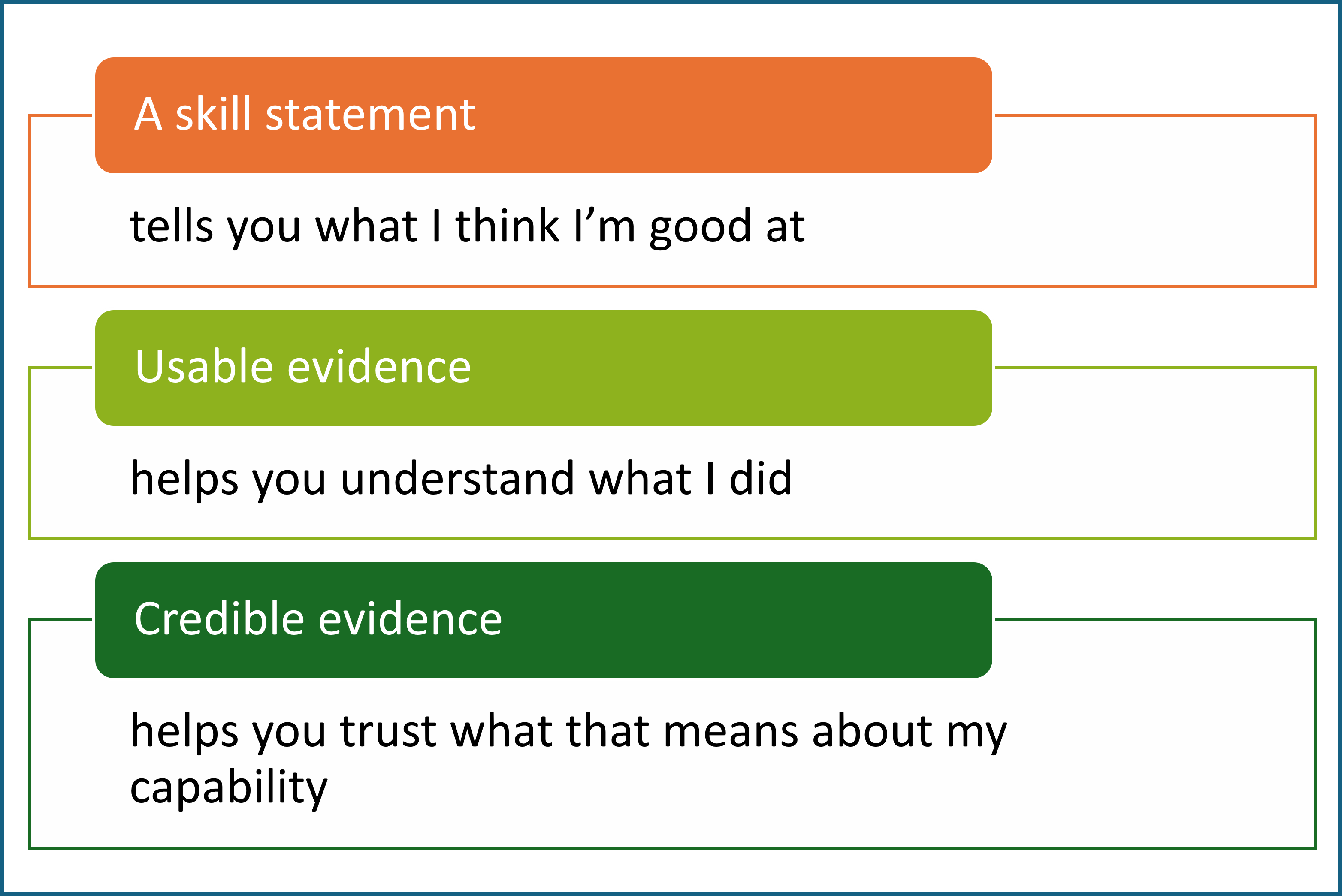
- A skill statement tells you what I think I’m good at
- Usable evidence helps you understand what I did
- Credible evidence helps you trust what that means about my capability
Looking Beyond the Classroom
This question is being explored in school systems internationally. Organisations such as, FullScale Learning, XQ Institute and the OECD, are rethinking how learning is recognised and reported. (see links below for further reading)
Their work often moves beyond grades and task completion, toward:
- demonstrated capability
- competency-based progression
- learner agency and profiles
Across these approaches, there is a common shift from describing what students have done, to providing evidence others can trust and act on. See the links below to explore further.
A Practical Balance
In everyday classroom practice, we don’t always need to aim for this level. Making evidence visible is often the right step. If we think back to the skills literacy framework we are working towards constant reinforcement of naming and describing.
It helps students, recognise what they skills they are using and to describe their thinking. As this becomes part of regular practice, it creates a foundation.
Over time, these small moments of usable evidence begin to accumulate. Students become more confident in recognising and articulating what they can do, and teachers develop a clearer picture of capability across different contexts.
Credible evidence becomes most important at key moments, such as:
- formal feedback
- reporting
- portfolio building
- or when learning progress needs to be shared beyond the classroom
This is where the evidence is brought together more deliberately. Individual examples are selected, refined, and described in ways that others can understand, trust, and use.
In some systems, this is through approaches such as digital credentials or Comprehensive Learner Records (CLRs). These bring together pieces of evidence over time to show a broader, more complete picture of what a learner can do, across subjects, experiences, and contexts.
Rather than capturing every task, CLRs rely on selected, credible evidence that represents meaningful capability. In this way, everyday usable evidence becomes the building blocks, and more formal, credible evidence becomes what is shared and recognised.
This balance matters because if we try to make every task fully documented and “credible,” it can quickly become overwhelming for both teachers and students.
Instead, we build towards credibility over time and experiences.
We’ll look more at digital credentials and profiles and CLR’s next week.
Lifelong Learning: Recognise and Articulate School Skills

Lifelong Learning: Recognise and Articulate School Skills





